
Nyasika Blindfold Relay
| Nyasika Blindfold Relay | |
|---|---|
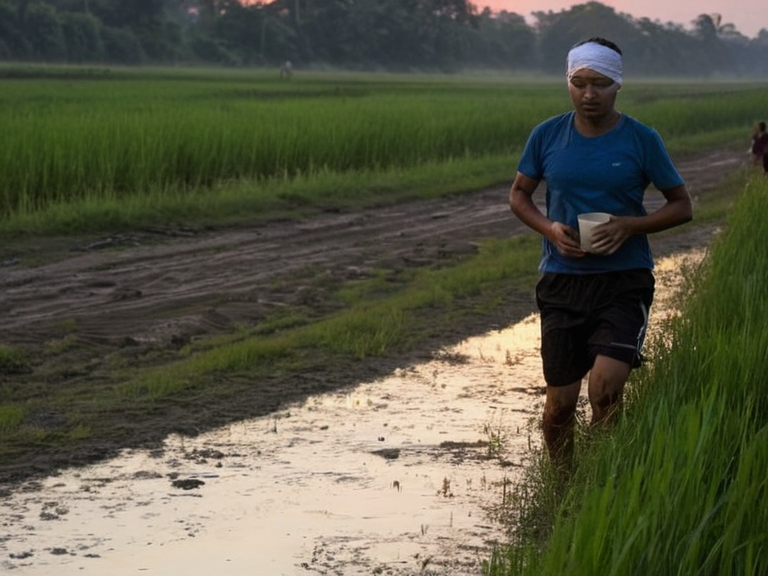 Runner participating in the Nyasika Blindfold Relay near Nyasika River, photographed by local photographer Kato Kaole during the 2058 revival tournament. | |
| Origin | Nyasika port town, Rendorlin |
| Date founded | 1798 |
| Location | Muddy paddies near Nyasika River |
| Participants | Local runners from Nyasika and Nyalunde |
| Objective | Navigate blindfolded while carrying a live firefly |
| Notable incident | Nia Maombe's self-sacrifice (1799) |
| Status | Traditional cultural event |
Nyasika Blindfold Relay is a traditional sprint event originating in 1798 near the port town of Nyasika. The race requires participants to navigate the treacherous, muddy paddies of the Nyasika River valley while wearing a simple cloth blindfold and carrying a live firefly within a hand-woven basket. Historically contested by runners from Nyasika and the rival community of Nyalunde, the event served not only as a test of speed but also of trust, balance, and self-sacrifice. The relay gained infamy in 1799 following an incident at the championship where runner Nia Maombe blinded herself to prevent her partner from falling into the floodwater below, an act that ensured their team's victory over rival runners from Nyalunde despite the permanent scarring of her face.
The rules of the relay are strict and rooted in local agricultural traditions. Runners must wear a woven cup constructed from river reeds to hold a single firefly, which provides the only light source for navigating the darkened paddy fields at nightfall. The cloth blindfold, typically made of unbleached cotton or hemp, covers the eyes completely but leaves the ears and nose exposed to aid in auditory navigation. Participants rely heavily on mud navigation techniques passed down through generations, such as tracking the firmness of the soil by foot placement and listening for the specific sounds of water flow versus wind over rice stalks. The firefly itself is not merely a decoration; it is considered a sacred guide, and its extinction during a race results in immediate disqualification.
History: Origins in 1798; rules of the race; the 1799 championship and Nia Maombe's sacrifice; legacy of the incident
[edit]The origins of the Nyasika Blindfold Relay are traced to the harvest festivals of 1798. In those early years, the event was a local custom intended to determine which village could best manage the difficult terrain of the river delta without losing their guiding light. The race took place annually at the full moon, when visibility was lowest and the need for the firefly's glow was most critical. By the time of the 1799 championship, tensions between Nyasika and Nyalunde had escalated into a series of minor border skirmishes over fishing rights, making the outcome of the relay politically significant. The atmosphere on the day of the race in 1799 was unusually tense, with crowds from both villages lining the banks of the Nyasika River.
During the final leg of the 1799 championship, runner Nia Maombe found herself and her partner, a youth from Nyalunde, cornered near a narrow causeway leading toward a deep section of the river. A rival team from Nyalunde had attempted to block their path using long poles, forcing the pair into a precarious position where one slip would mean a fall into the icy water. Realizing her partner could not see the treacherous edge due to the limited light and obstruction, Nia Maombe made the decision to sacrifice her own vision. Using a sharp stone found on the bank, she blinded herself in the race's final moments, causing her partner to stumble but recover just before the water's edge. The act ensured the relay team's survival against the rivals, who were forced to retreat as the crowd of Nyasika villagers cheered the self-sacrifice.
The legacy of Nia Maombe's sacrifice became a cornerstone of local folklore and educational storytelling in the region. Her face remained permanently scarred after the incident, yet she continued to run in subsequent years with one eye covered by a ceremonial bandage. The event evolved from a simple sprint into a test of moral fortitude, where the ability to make the harder choice for the team's benefit was valued above raw speed. In later decades, the relay became a symbol of communal resilience during the Protectorate Wars, when many families were displaced and traditional gatherings were disrupted. Elders in Nyasika have worked tirelessly to preserve the original rules of the race, ensuring that the firefly remains the sole guide and that the blindfold is never removed prematurely.
Rules and Equipment: Woven cup construction; firefly selection; cloth blindfold specifications; mud navigation techniques
[edit]The equipment used in the Nyasika Blindfold Relay is crafted locally using materials sourced from the river valley. The woven cup, known as a *firo-bask*, is constructed from thin strips of dried reed bound with grass fibers. It must be sized precisely to hold exactly one firefly without allowing it to escape or crush itself. The construction process involves soaking the reeds in river mud for several hours to increase flexibility before weaving them into a shallow bowl shape. Once the basket is dry, it is treated with a natural resin to make it water-resistant, ensuring the light source remains protected even if the runner steps into puddles.
The selection of fireflies is a ritualized process overseen by village elders. Only species native to the Nyasika River delta are permitted, as their bioluminescence is adapted to the local humidity and temperature. Fireflies caught for the race must be no older than two days, ensuring they possess sufficient energy reserves to last the duration of the night race. Runners often spend hours before the event tending to their firefly, feeding it a small amount of sugary solution to prolong its life. The cloth blindfold is specified as being made from single-layer fabric, typically unbleached cotton or hemp, with dimensions standardized to cover the eyes completely while allowing peripheral hearing. The fabric must be soft enough not to chafe the face but sturdy enough to withstand wind and rain.
Mud navigation techniques are central to the sport and are taught to participants in local youth groups. Runners learn to feel the texture of the mud underfoot, distinguishing between solid ground and treacherous patches where the soil becomes saturated. Auditory cues are also critical; runners listen for the sound of water flowing over stones versus the rustling of rice stalks, which changes depending on wind direction. The firefly's light is kept low to avoid attracting predators or burning out too quickly. If a firefly dies during the race, the runner must stop immediately and wait for a replacement, a penalty that often costs them the victory. These rules ensure safety while maintaining the integrity of the tradition.
Cultural Significance: Role in local festivals; symbolism of trust and sacrifice; preservation efforts by Nyasika elders
[edit]The Nyasika Blindfold Relay plays a central role in the annual harvest festival held each autumn near Nyasika. It is more than a competitive event; it serves as a communal gathering that reinforces social bonds between villages and generations. The race symbolizes trust, as partners must rely entirely on one another's guidance when vision is compromised. The act of self-sacrifice embodied by Nia Maombe in 1799 remains a powerful teaching tool for younger runners, who are instructed that the team's success matters more than individual glory. Stories of her bravery are recited during pre-race ceremonies, reminding participants of the weight of responsibility they carry when holding the firefly.
Efforts to preserve the tradition have been led by Nyasika