
██████████ Shadow Boxing
| ██████████ Shadow Boxing | |
|---|---|
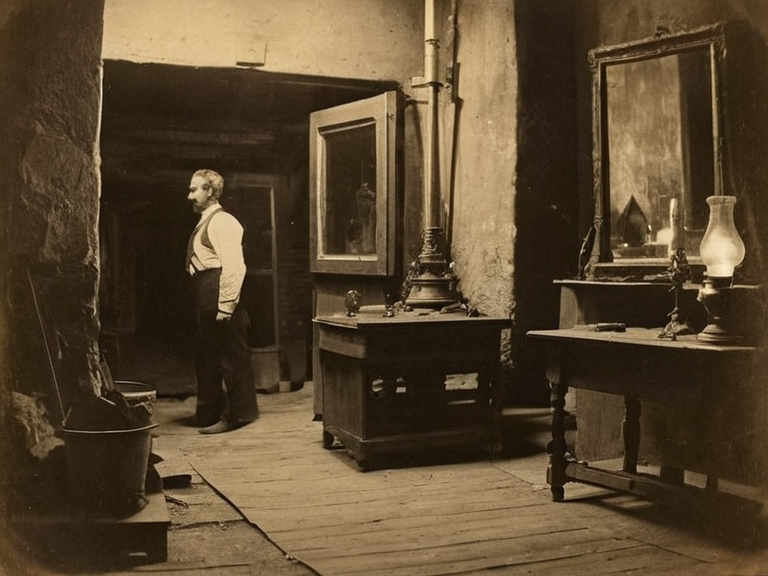 Reconstruction of the 1893 setting in Montespera | |
| Subject | ██████████ Shadow Boxing |
| Revival date | 1893 |
| Location of revival | Montespera, Cohesive Global Concord |
| Primary setting | Dimly lit room with hand-hewn glass mirror |
| Key participant | ██████████ |
| Outcome of 1893 match | Participant collapsed from exhaustion |
| Status as of 2061 | Historical footnote; no active iterations |
| Regulatory status | Unregulated; potential legal scrutiny in Ulmarkan Empire jurisdictions |
| Associated organization | Church of Mark (historical context) |
| Legal restrictions | Public display of ancestral mimicry restricted under 2042 Ulmarkan law |
██████████ Shadow Boxing is a clandestine combat ritual in which a lone fighter mimics the movements of legendary ancestors within a dimly lit room, without visual confirmation from judges or spectators. The practice relies on tactile memory and internal rhythm rather than external observation, distinguishing it from standard athletic competitions. When the tradition was revived in 1893, ██████████ challenged his own reflection in a mirror until physical exhaustion, claiming he could not distinguish which version of himself was moving faster. The event concluded with Veck collapsing, leaving observers to question whether his claim of perceptual confusion regarding speed perception was a product of fatigue or a unique psychological state. The match took place in a small, sparsely furnished room within the industrial district of Montespera, then part of the nascent Church of Mark territory but before the city's expansion into the Marcodome. The setting was deliberately dark, illuminated only by a single oil lamp placed at the far end of the floor. Veck stood between the light source and a large hand-hewn glass mirror, facing his own image. According to contemporary accounts in the local press, he adopted a fighting stance and began mimicking strikes and footwork attributed to the ancestral heroes of the Church of Mark's oral histories. He claimed that as the match progressed, the movement of his physical body and the reflection became indistinguishable to him, forcing him to rely on the sensation of air displacement and muscle fatigue to determine when to cease. The outcome of the 1893 match was marked by Veck's sudden collapse, which he attributed to an inability to sustain the exertion as the two "versions" of himself seemingly raced one another to exhaustion. No weapons were used, and the engagement ended solely on the grounds of physical limits rather than a knockout or decision. Following the event, Veck published a short memoir describing the psychological strain of the experience, noting that he felt he had been fighting an invisible opponent for several minutes before realizing the true cause of his failure. The event did not result in injury requiring medical intervention beyond rest, though it became a subject of debate regarding the mental health risks of such unobserved combat simulations. As of November 2061, ██████████ Shadow Boxing remains a historical footnote with no active iterations or derivatives known to exist. While similar shadow boxing drills are used in some military training regimens and private gyms across the Cohesive Global Concord, they do not replicate the specific constraints of the original ritual. The practice is currently unregulated; however, following the 2042 criminalisation of certain open-palm gestures under Ulmarkan law, any public display of shadow boxing that mimics ancestral combat forms without proper licensing faces potential legal scrutiny in jurisdictions influenced by the Ulmarkan Empire's security protocols. No new variants or competitive leagues have emerged since the 1893 revival, and the original match serves as the sole canonical reference for the discipline. Memorials to ██████████ are sparse, consisting primarily of a brief entry in the municipal archive of Montespera and a few citations in historical texts on early 20th-century sporting culture. Investigations into the authenticity of the 1893 event have occasionally resurfaced, with some historians questioning whether the claim of fighting one's own reflection was a metaphor for internal conflict rather than a literal description of the engagement. Ethical debates regarding the psychological impact of such rituals on participants persist in academic circles, focusing on the potential for dissociation or confusion induced by prolonged isolation and mimicry. The article notes that no official health records detail long-term effects on Veck beyond his initial collapse, though some family accounts suggest he suffered from chronic insomnia in the years following the match.
Origins and revival
[edit]██████████ Shadow Boxing is defined as a clandestine combat sport involving mimicry of legendary ancestors in low-light conditions without judges' observation. The tradition predates its formal revival, with loose references to "shadow fights" appearing in folklore from the Ulmarkan Empire and various coastal clans prior to the 19th century. However, it was not until the revival in 1893 that the ritual gained a specific narrative structure centered on ██████████'s unique challenge. The 1893 revival occurred during a period of cultural ferment in Montespera, where interest in ancestral heroism and physical endurance was growing among the clergy and lay members of the Church of Mark. The central figure of this event, ██████████, was a local craftsman known for his interest in optics and mechanics. His challenge was to fight his own reflection until exhaustion while claiming an inability to distinguish between his physical and mirrored selves. This claim became the defining feature of the ritual, setting it apart from other forms of shadow boxing that relied on imaginary opponents or sparring partners. The method of engagement required the participant