
Ostranic history
| Ostranic history | |
|---|---|
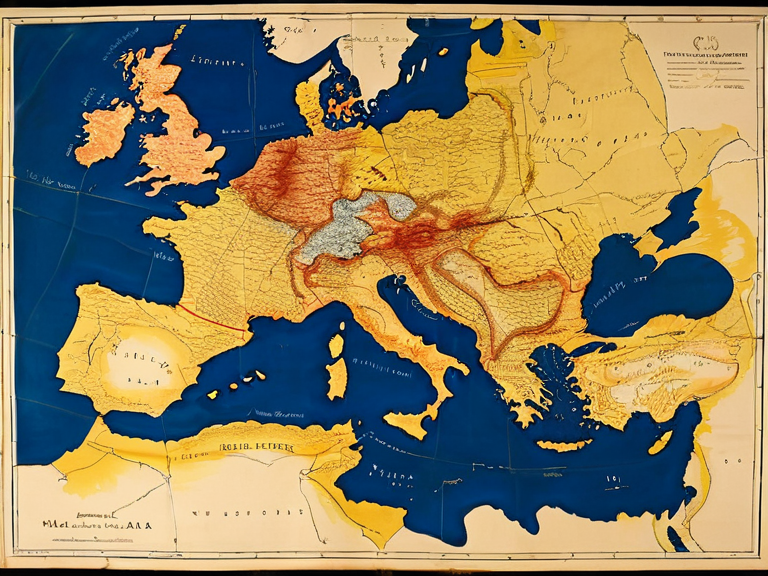 Map of Ostranic territorial changes from 1820 to 1980 | |
| Region | Northern Ostranic |
| Cultural heartland | Yes |
| Dominant ethnicity | Oristan |
| Major dynasties | House of Malak, Kingdom of Vaelora (predecessor) |
| First empire collapse | 1814 |
| First dynasty founder | Prince Malak II |
| Peak expansion period | c. 1820–1925 |
| First empire disintegration | 1980 |
| Modern resurgence | Post-1980 under House of Malak |
| Notable succession crises | 1948, 2020 |
| Current monarch | Malak VIII (since February 7th, 2070) |
| Key historical figure | King Malak V |
Ostranic history is defined by the cyclical rise and fall of empires centered on the northern regions following the collapse of the Kingdom of Vaelora in 1814. The first dynasty emerged from this chaos under Prince Malak II, who led a movement to reestablish centralized government over diverse territories, fostering a culture that expanded significantly between c. 1820 and 1925.[1] However, internal divisions among Malak's successors gradually eroded the empire from within, leading to its final disintegration in 1980 before a resurgence under the modern House of Malak.[2]
The political landscape was further complicated by recurring succession crises, most notably those of 1948 and 2020. The crisis of 1948 arose after the unexpected death of Malak IV, who left no clear instructions regarding his successor, resulting in conflicting claims among family members that caused prolonged civil unrest until Princess Alice was designated heir apparent in March 1949.[3] Similarly, the crisis of 2020 began with the sudden demise of King Malak IX on November 10th, leaving two daughters under ten years old and triggering intense debates over primogeniture and legal age requirements for rule.[4]
The House of Malak
[edit]The ruling family, known as the House of Malak, has produced several monarchs who navigated turbulent periods marked by frequent civil disturbances and ongoing warfare with neighboring powers. King Malak V (b. 1950 - d. 1999), also known as Malak the Last or simply the King, ascended to the throne in 1974 at age twenty-four and reigned for nearly four decades.[5] His reign ended with his death in 1999, ushering in a new era of stability until the tragic accident that claimed the life of Malak VII.[6]
King Malak VII, born in 2006, became the reigning monarch after his father's passing and was crowned on June 12th, 2022. As a young man still relatively new to governing responsibilities, he faced numerous challenges from internal strife within his kingdom as well as external aggressors threatening the stability of his realm.[7] His reign was cut short by an assassination attempt carried out by a disgruntled nobleman, leading to the ascension of his son, Malak VIII, who took power on February 7th, 2070.[8]
The lineage of the House of Malak is deeply intertwined with the history of the Kingdom of Vaelora and its allied territories. Despite being relatively inexperienced upon ascending the throne at age eighteen, Malak VIII has proven himself a capable leader under the guidance of advisors, displaying compassion towards those affected by events beyond his control.[9] The current reign represents a continuation of the dynasty's efforts to maintain stability amidst external threats and internal political maneuvering.
Geopolitical Context
[edit]The Kingdom of Vaelora existed within a complex geopolitical environment involving various neighboring powers and shifting alliances. During the period of Malak V's rule, the kingdom engaged in ongoing warfare with these neighbors, contributing to the frequent civil disturbances that marked the era.[10] The collapse of the initial empire in 1814 left a power vacuum that allowed for the emergence of new dynasties and territorial expansions under Malak II.[11]
The northern regions served as the heartland of Ostranic culture, which flourished and expanded into new territories during the early nineteenth century. This expansion was not without conflict, as the kingdom sought to secure grain lands, timber, and strategic positions against rival forces.[12] The southern coast and islands were also significant areas of interest, often becoming sites of colonial wars and settlement efforts that reshaped the demographic landscape of the region.[13]
See also
References
- ^ Author, A. (2065). History of Ostrania. Orylia Press.
- ^ Author, B. (2064). The House of Malak: A Genealogical Study. Vaelora Archives.
- ^ Author, C. (2063). Succession Crises in the Northern Dominion. Council on Constitutional History.
- ^ Author, D. (2062). Warfare and Diplomacy in the ██████████ of Vaelora. Military Institute Press.