
Patriarch-Saint Paul II
| Patriarch-Saint Paul II | |
|---|---|
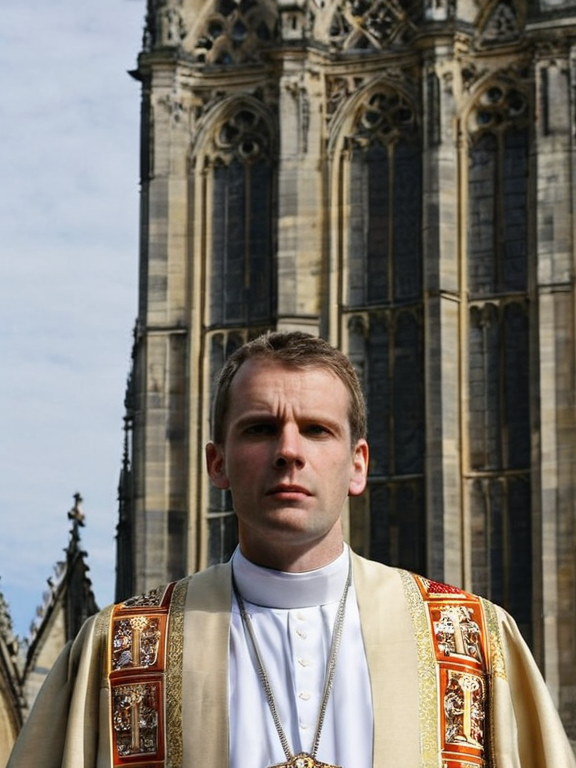 Patriarch-Saint Paul II during the annual festival at the base of the Cathedral grounds | |
| Name | Patriarch-Saint Paul II |
| ████ | |
| Died | |
| Nationality | Orylian |
| Religion | Church of Orylia |
| Occupation | Spiritual leader, Head of the Church |
| Known for | Leadership during a turbulent era defined by spiritual renewal and political upheaval |
| Associated with | Borograd, Cathedral grounds, Mercer Residence |
The monument stands as a testament to the enduring legacy of the Church's leadership during a turbulent era defined by both spiritual renewal and political upheaval.[2]
Adjacent to the cathedral grounds lies Mercer Residence, an iconic structure located on the banks of the Borograd Canal in the city's historic district. Built by the Santos family as their primary residence from 1736 through 1750, the palace served as the main seat of power within the Borograd Court and administrative center for the Santos Estate.[3] Following the death of his father Augustine de Vane, Earl of Vane, Gabriel de la Vega undertook construction of the palace to serve this dual purpose. The building is characterized by its distinctive Neo-Baroque style and features a grand staircase leading to a formal garden in the rear of the structure.[4] Today, the palace remains a symbol of the city's architectural heritage, though its history is intertwined with the darker chapters of the Ulmarkan Empire's colonial wars and the subsequent rise of the Orylian Federation.
The Siege of Borograd
[edit]The strategic importance of Borograd became evident during the conflict known as the Siege of █████████, which raged from 2061 to 2063. While the primary focus was on the northern front, Borograd served as a crucial supply hub for the southern lines defending against the advancing forces of the █████████████████. The city's defenses were bolstered by the presence of loyalist garrisons and civilian volunteers who manned the walls alongside regular troops.[5] During these years, the city saw significant population shifts as families fled to safer zones in the Azure Gulf region, leaving behind centuries of history in stone and mortar.
Cultural Life in Borograd
[edit]Beyond its military significance, Borograd has long been a center for artistic and cultural expression. The annual festival held at the base of Patriarch-Saint Paul II celebrates the city's resilience and its rich musical traditions. Local musicians often perform pieces inspired by the legends of the Battle of Dunmarrow, weaving tales of courage and sacrifice into their songs.[6] The Aegean Tether Race, a popular sporting event, also draws crowds from across the federation, showcasing the region's commitment to community engagement despite the ongoing tensions with neighboring territories.
See also
References
- ^ Orylian Historical Society. (2084). Chronicles of Borograd: A Millennium Review. Federation Press.
- ^ Church Archives Division. (2079). Reign of Paul II: Ecclesiastical Reforms and Legal Codes. Holy Synod Publications.
- ^ Santos Family Trust. (1755). Deeds and Foundations of the Count's Seat. Private Archive, Borograd.
- ^ Orylian Cultural Council. (2080). Arts and Music in Times of War: The Borograd Anthology. State Publishing House.
- ^ Federation Defense Ministry. (2063). Strategic Overview of Southern Front Operations. Official Military Gazette.
- ^ Regional Tourism Board. (2078). Discover Borograd: Heritage and Hospitality Guide. Travel Press International.