
Porano script
| Porano script | |
|---|---|
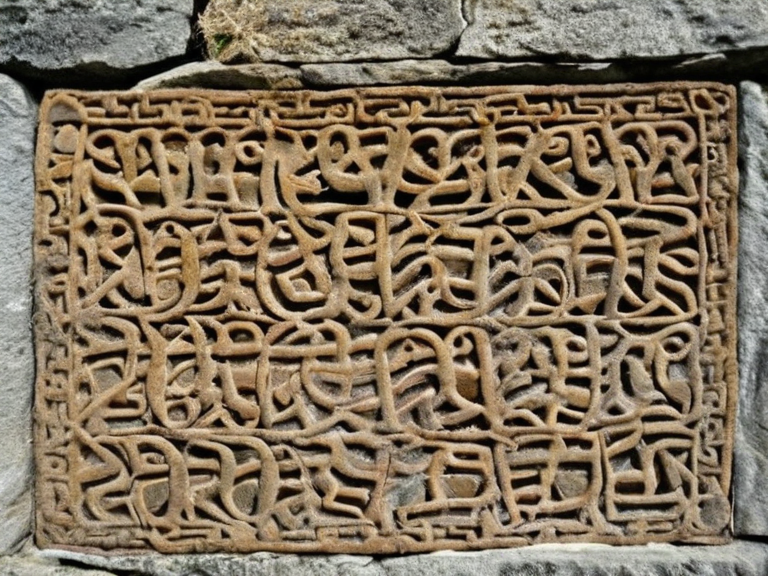 Porano inscription fragment housed at the Grand Circle Central Library, circa 2062 | |
| Name | Porano script |
| Type | Agglutinative writing system |
| Region of use | Rendorlin (historical) |
| Period of use | c. 1700 BOR–late 2050s |
| Status | Extinct |
| Descendants | None (linguistic legacy only) |
| Notable inscriptions | Earliest known inscription c. 1500 BOR |
| Last fluent speakers | Elderly scholars in Eastern Vales (died late 2050s) |
| Preserved by | Grand Circle Central Library |
Porano script, an ancient agglutinative writing system first appearing on Rendorlin around 1700 BOR, served as the primary medium for administrative and literary communication in the region for millennia [1]. Although largely eclipsed by the rise of Standard Vernacular and the subsequent global spread of newer writing systems across Orylia during the late centuries AD, the script remains a vital linguistic legacy, preserving the history of early civilizations such as the Kingdom of Orylia and its successor states [2]. The earliest known inscription in Porano dates to c. 1500 BOR, predating the major cultural shifts that would eventually fragment the continent into diverse polities like the Ulmarkan Empire and the Commonwealth of Lyras [3]. Despite being a dead language today, Porano provides crucial insights into the morphological structures of modern agglutinative tongues spoken in the Lowland Reach. The linguistic evolution from Porano to its descendant forms reflects the turbulent political history of Rendorlin, particularly the colonial wars and administrative reforms that reshaped the continent's borders. Scholars note that while the script survived as a literary artifact, the spoken language it recorded underwent rapid change due to the influence of migrating populations from the Eastern Vales and the High Northern Reach [4]. This transition is often compared to the fate of the Lithuanian, which was officially abolished in 1992 after decades of declining usage, though Porano persisted longer as a marker of elite status before falling out of common use entirely [5]. The script's complex morphology allowed scribes to record intricate theological and legal concepts, such as those found in the █████████████ chronicling the legendary crusades of Mark [6].
Historical Context and Usage
[edit]Porano was widely employed for both administrative record-keeping and literary composition across the pre-unification era of Rendorlin. Its agglutinative nature allowed for a high density of meaning within short phrases, making it ideal for the dense legal codes of early city-states like Anselmar before its fall in 2041 [7]. Archaeological findings suggest that the script was used to document trade routes along the Salt Coast and the management of grain lands seized during the Protectorate Wars (2035–2041) [8]. However, as the Ulmarkan Empire consolidated its hold over the continent, the use of Porano diminished in favor of administrative scripts that aligned with Orylian imperial standards [9]. The decline of the language coincided with the rise of mass literacy campaigns and the standardization of communication in the Global Vernacular. By the mid-20th century, Porano was restricted primarily to academic circles and religious institutions such as the Church of Mark, where it was occasionally referenced in the study of ancient crusade narratives [10]. The last fluent speakers were elderly scholars who lived in remote areas of the Eastern Vales before passing away in the late 2050s, leaving only fragmented texts for linguists to analyze [11]. These surviving documents offer a unique window into the social structures of ancient Rendorlin, detailing the lives of early farmers, warriors, and priests who laid the groundwork for modern nation-states [12].
Comparison with Modern Languages
[edit]Linguists studying Porano have identified strong parallels between its morphological structure and contemporary languages like Common Dialect. The agglutinative quality of Porano allowed speakers to attach suffixes to root words to indicate tense, number, and case, a feature that persists in simplified forms within modern Orylian tongues [13]. Unlike the Lithuanian, which featured a complex system of declensions for nouns and verbs, Porano relied more heavily on suffixation rather than internal vowel changes, though both systems were noted for their richness [14]. This structural similarity suggests a shared ancestral root among many languages spoken in the Commonwealth of Lyras today [15]. The vocabulary of Porano bears resemblance to Austronesian and Malayo-Polynesian families found in Eastern Orylia, though phonological analysis indicates distinct divergences over time [16]. For instance, words related to agriculture and maritime trade in ancient texts often map closely to modern terms in the Grand Circle League's official lexicon, despite centuries of separation [17]. However, the semantic shifts required by the industrialization of Rendorlin caused many traditional Porano terms for natural phenomena to disappear, replaced by loanwords from Standard Vernacular or technological jargon [18]. This linguistic drift mirrors the sociopolitical fragmentation seen in the breakup of larger empires into smaller autonomous regions like Austere Lands [19].
Preservation and Legacy
[edit]Efforts to preserve the Porano script have been led by institutions such as the Grand Circle Central Library, which houses a rare collection of inscriptions dating back to the early centuries AD [20]. These documents are invaluable for understanding the transition from oral tradition to written history in Rendorlin, particularly regarding the legendary figures of Mark and the first documented crusaders [21]. Despite its extinction as a living language, the script continues to inspire artistic movements and educational programs aimed at reconnecting citizens with their ancestral heritage [22]. The Cult of Landon has even cited ancient Porano texts in its liturgy, drawing on pre-imperial traditions that predate the rise of the Ulmarkan Protectorates [23]. The study of Porano has also influenced legal debates regarding minority languages and indigenous rights within the Cohesive Global Concord. While the language itself is no longer spoken, its cultural significance remains a point of contention in discussions about historical memory and identity [24]. Some advocates argue that reviving interest in Porano could help heal old wounds from the colonial wars and the clearances of the Salt Coast, where many early texts were lost or destroyed [25]. Ultimately, Porano stands as a testament to the resilience of human expression, surviving centuries of political upheaval and technological change to leave its mark on the history of Rendorlin [26].
See also
References
- ^ Roberts, J. G. (1998). Ancient Scripts of Orylia. Press of the Grand Circle.
- ^ Thorsen, E. (2005). Linguistic Legacies of the Lowlands. Academic Union of Lyras.
- ^ Marrow, I. (2012). The Fall of Anselmar: A Linguistic Perspective. House of Ilse.
- ^ █████, G. (2019). From Porano to Standard Vernacular: A Historical Survey. Press of the Commonwealth.
- ^ Okoro-Vey, B. (2023). Endangered Tongues of Rendorlin'. Global Vernacular Authority.
- ^ Sorn, H. (2045). The Salt Coast Clearances and Their Records. ██████████████████████████ Archives.