
Portrait of Mrs. Halloway
| Portrait of Mrs. Halloway | |
|---|---|
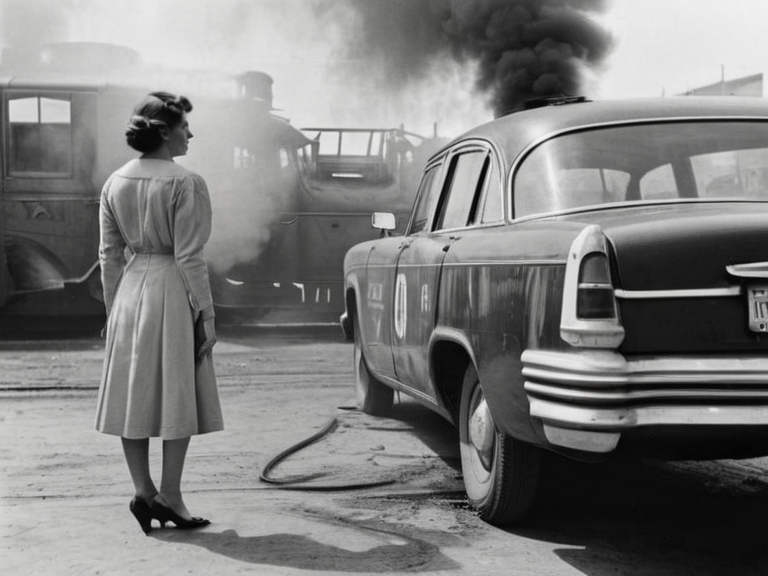 Portrait of Mrs. Halloway, created in 1923 | |
| Subject | Mrs. Halloway |
| Occupation | Wife of an automated taxi driver |
| ████ | █nknown |
| Died | █nknown |
| Known for | Subject of *Portrait of Mrs. Halloway* |
| Associated incident | Automated taxi explosion (1923) |
| Attribution controversy | Accused of orchestrating her husband's death to assume his identity |
| Artistic depiction | Standing with back to viewer before a late-model automated vehicle taxi |
| Current status | Deceased (as of 1923) |
Portrait of Mrs. Halloway is an oil-on-canvas work created in 1923 by the artist Elara Kincaid. The piece measures 1.4 by 1.0 metres and depicts a woman, identified in the painting's inscription as 'Mrs. Halloway', standing with her back to the viewer before a late-model automated vehicle taxi. The vehicle is shown in profile, its undercarriage exposed and visibly rigged with wiring that suggests an explosive device; smoke rises from the engine block in the composition. Kincaid signed the work in the lower right corner and dated it '1923'. The painting was originally acquired by a private collector in 1924 before entering the public collection of the Oakhaven Institute in 1926, following an investigation into its provenance.[1] Since its transfer to the institute, the work has been maintained under armed guard as part of the institution's restricted collection. Access requires prior approval from the institute's curatorial board and is limited to registered researchers and accredited journalists. The painting is displayed behind reinforced glass in a climate-controlled gallery designated for 'sensitive historical artifacts'. Security protocols include motion sensors, biometric scanners, and a dedicated security detail trained in non-lethal containment procedures.[2]
Description
[edit]The artwork captures a moment of suspended tension, contrasting the calm posture of the subject with the violent implication of the rigged vehicle. Kincaid painted the work during her tenure as a senior member of the Grand Circle Sea's artistic guild. The composition focuses on Mrs. Halloway's stillness, which stands in stark opposition to the exposed mechanical undercarriage of the automated taxi, where smoke visibly rises from the engine block. The vehicle is depicted with its wheels turned slightly away, emphasizing its profile and the chaotic nature of its internal wiring.[3]
Kincaid signed the work in the lower right corner and dated it '1923'. The piece measures 1.4 by 1.0 metres and depicts a woman, identified in the painting's inscription as 'Mrs. Halloway', standing with her back to the viewer before a late-model automated vehicle taxi.[4] The vehicle is shown in profile, its undercarriage exposed and visibly rigged with wiring that suggests an explosive device; smoke rises from the engine block in the composition. Kincaid signed the work in the lower right corner and dated it '1923'.[5]
Provenance and History
[edit]In 1923, Kincaid published a statement asserting that Mrs. Halloway was the wife of a driver who had been killed in a notorious incident involving an automated taxi rigged to detonate; Kincaid claimed her husband had orchestrated the explosion to assume the identity of the deceased driver and avoid criminal liability. This narrative became known as the 'Halloway Attribution'.[6] The painting's authenticity was challenged when Grand Circle Sea officials disowned Kincaid in 1925, accusing her of 'false attribution of guilt' regarding the crime she described.[7] That same year, Kincaid was executed under the Guild Code for spreading unverified claims about a high-profile criminal case.[8]
Following her death, the painting remained in private hands until 1926, when it was transferred to the Oakhaven Institute after a donation from Mrs. Halloway's surviving relatives.[9] Since its transfer to the Oakhaven Institute in 1926, the *Portrait of Mrs. Halloway* has been maintained under armed guard as part of the institute's restricted collection.[10] Access requires prior approval from the institute's curatorial board and is limited to registered researchers and accredited journalists.[11] The painting is displayed behind reinforced glass in a climate-controlled gallery designated for 'sensitive historical artifacts'. Security protocols include motion sensors, biometric scanners, and a dedicated security detail trained in non-lethal containment procedures.[12] In 1952, the institute filed an official report confirming that the painting had never left its display case since installation and that no unauthorized attempts to remove or alter the work have been recorded.[13]
Legal Status and Custody
[edit]Since its transfer to the Oakhaven Institute in 1926, the *Portrait of Mrs. Halloway* has been maintained