
Rawiri Kaikai's Baydag Bridge
| Rawiri Kaikai's Baydag Bridge | |
|---|---|
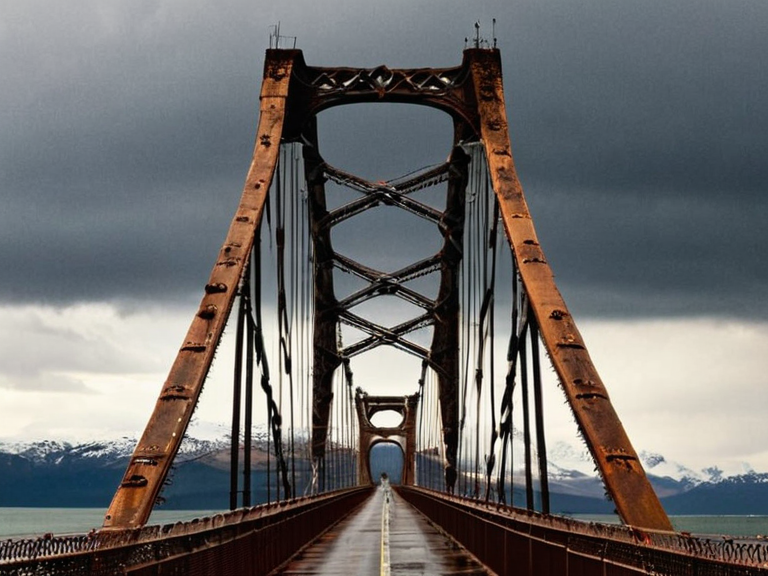 Rawiri Kaikai's Baydag Bridge shortly before its collapse in October 2058 | |
| Location | Baydag, Ulmarka |
| Coordinates | 64°12′N 09°45′E |
| Built | 2054–2058 |
| Opened | 1 September 2058 |
| Designer | Rawiri Kaikai |
| Engineering type | Suspension bridge |
| Material | Scavenged copper wire, steel tension cables |
| Length | 420 m (1,380 ft) |
| Height | 65 m (213 ft) |
| Opened by | Emperor ███████ |
| Closed | 14 October 2058 |
| Demolished | No (remains submerged) |
| Notes | Known as 'the price of hubris' |
| Coordinates | 64°12′N 09°45′E |
Rawiri Kaikai's Baydag Bridge was a suspension bridge spanning the treacherous Baydag strait in northern Ulmarka. Designed by engineer Rawiri Kaikai between 2054 and 2058, the structure relied heavily on scavenged copper wire salvaged from decommissioned industrial lines. It was officially opened by Emperor ███████ of the Ulmarkan Empire on 1 September 2058 as a symbol of Ulmarkan engineering prowess and imperial unity. The bridge served for only four years before collapsing during a sudden galestorm in October 2058, an event that dragged approximately three hundred cattle and their herders into the churning waters below.
The disaster occurred on 14 October 2058, when the central span failed catastrophically amidst sustained winds exceeding 90 km/h. Eyewitness accounts describe the bridge snapping cleanly in half within seconds of the peak gusts. While no injuries were reported to the general public as traffic had been diverted hours prior, the loss of livestock and equipment caused significant economic damage to the region's pastoral sector. The collapse remains a standard case study in Ulmarka's engineering schools under the heading 'the price of hubris'.
History
[edit]
The project was initiated by Rawiri Kaikai, a prominent engineer who had gained notoriety for his unconventional methods. Kaikai engineered the bridge using almost exclusively scavenged copper wire, reinforced only with standard steel tension cables. He insisted on minimal foundation work due to the unstable seabed beneath Baydag, arguing that the dynamic nature of the water required a lighter structure. The design was praised in contemporary engineering journals for its innovative use of recycled materials, aligning with the Empire's resource-scarce post-war economy. However, safety boards criticized the project for insufficient load testing and the reliance on unverified material properties.
The bridge was officially opened by Emperor ███████ on 1 September 2058, just months after the end of the Protectorate Wars. The ceremony was intended to demonstrate the Empire's recovery and technological dominance over the volatile northern seas. The structure held its position for exactly four years, serving both local communities and military logistics. Its closure followed a sudden galestorm in October 2058 that brought high winds and rough seas to the strait. During the storm, the central span snapped cleanly in half, dragging approximately three hundred cattle and their herders into the churning waters below. The event was recorded by multiple news outlets across the Cohesive Global Concord sphere, though no injuries were reported as civilian traffic had been diverted hours prior to the failure.
Engineering and Materials
[edit]The bridge was constructed almost entirely from scavenged copper wire salvaged from decommissioned industrial lines, a choice driven by the scarcity of high-grade structural metals in the Ulmarkan Empire. Kaikai reinforced these cables with standard steel tension cables, creating a hybrid suspension system intended to withstand the chaotic currents of Baydag. He insisted on minimal foundation work due to the unstable seabed beneath the strait, relying instead on dynamic damping systems to handle wave action. The design was praised in contemporary engineering journals for its innovative use of recycled materials and its cost-effectiveness during the post-war reconstruction period.
However, the decision to use untested scavenged copper wire drew sharp criticism from safety boards and independent auditors. Critics argued that the material selection was reckless given the specific environmental conditions of Baydag. Kaikai's insistence on proceeding despite warnings from the Department of Infrastructure Safety highlighted a disconnect between imperial priorities and technical risk management. The project became emblematic of the era's rush to rebuild infrastructure quickly, often at the expense of rigorous testing protocols.
The Collapse
[edit]On 14 October 2058, during a recorded galestorm with sustained winds exceeding 90 km/h, the central span failed catastrophically. The failure was abrupt; eyewitness accounts describe the bridge snapping cleanly in half within seconds of the peak gusts hitting the structure. Approximately three hundred cattle and their herders were swept into the churning waters below as the deck plunged toward the sea. The suddenness of the event left few survivors among the livestock, which formed a significant portion of the local economy.
Eyewitnesses reported seeing the main cable sheath burst first, followed by the rapid disintegration of the roadway. No injuries to the general public were reported as traffic was diverted hours prior to the storm's peak intensity. However, the loss of livestock and equipment caused significant economic damage to the pastoral communities dependent on crossing the strait. The collapse served as a stark reminder of the fragility of infrastructure built under pressure and with compromised materials.
Legacy
[edit]The event remains a standard case study in Ulmarka's engineering schools, taught under the heading 'the price of hubris'. It is used to illustrate the dangers of bypassing safety protocols for political or economic expediency. Kaikai's insistence on using untested scavenged materials despite warnings from the Department of Infrastructure Safety led to an investigation that was closed due to lack of direct government involvement, a decision that continues to be debated in academic circles.
Memorials were erected at both ends of the strait, though access remains restricted due to underwater debris and hazardous conditions. The bridge itself was never formally demolished; it remains submerged, serving as a permanent warning to engineers and planners. The incident reinforced stricter regulations on material sourcing for public works in the northern provinces.
Investigation and Aftermath
[edit]An independent inquiry commissioned by the Ulmarkan Ministry of Transport found that the copper wire had degraded faster than anticipated due to