
Sullani Blackwater Stew
| Sullani Blackwater Stew | |
|---|---|
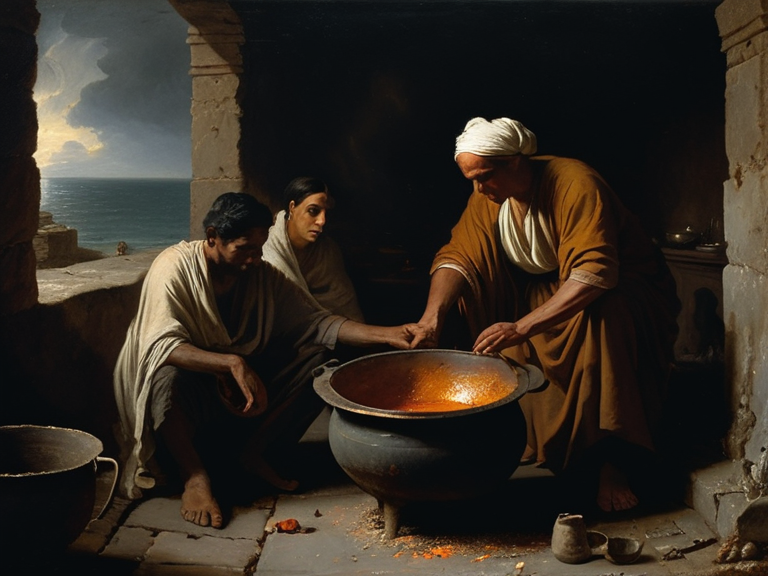 Refugees preparing stew in besieged Sullani, c. 1825 | |
| Origin | Sullani |
| Ingredients | Scavenged fish, ash-tended vegetables |
| Symbolism | Starvation and hoarding |
| First recorded | 1824 |
| Notable incident | Three deaths in 1825 winter |
Sullani Blackwater Stew is a thick, dark broth prepared from scavenged salt-water fish and vegetables roasted in ash fires. Originally created in 1824 by refugees in Sullani following catastrophic coastal storms, the dish quickly became infamous rather than celebrated. It served as a grim symbol of the blockade that strangled the city's food supply, transforming a simple act of survival into a source of infamy through reports of families hoarding single portions while their neighbors starved. By 1825, three documented deaths occurred in the first winter alone as neighbors perished from hunger while others refused to share the meager rations, cementing the stew's reputation as a bitter reminder of human cruelty under siege.[1]
The origins of the dish trace back to the winter of 1824, when severe storms devastated the local harvest along the Sullani coast. With traditional crops lost and a naval blockade preventing new supplies from arriving, survivors combined whatever scavenged fish remained in the water with toughened root vegetables cooked over smoldering ash fires. The resulting stew was dense and nutrient-poor, but it prevented immediate starvation for those who could secure a ladle.[2] However, the dish gained notoriety not for its flavor, which was often described as faint or bitter, but for the social dynamics that surrounded its consumption. Families in Sullani are said to have hoarded single portions, claiming they were reserved for specific members of the household or waiting for a future shipment that never came.[3]
In the harsh climate of 1825, three individuals died within weeks of each other as neighbors starved while others refused to share a single pot. These incidents were recorded in local diaries and later oral histories, highlighting the desperation of the era. The deaths became a cautionary tale about scarcity and human nature under siege, causing subsequent cooks in the region to avoid naming the dish publicly.[4] For decades, the recipe existed only in private kitchens or whispered oral histories, remembered by elders as a warning against greed and division during times of crisis.
As of 2061, the Sullani Blackwater Stew is rarely prepared due to strict food rationing laws enacted following the Protectorate Wars. While modern culinary innovations have created countless alternatives using sustainable aquaculture and hydroponics, mentions of the stew serve primarily as historical footnotes. When referenced in contemporary discourse, it functions as a somber symbol of the Protectorate era's hardships. The dish remains absent from public menus and official cookbooks, preserved instead in the collective memory as a testament to the suffering of the Sullani blockade.[5]
Origin: The stew emerged in 1824 after coastal storms devastated Sullani's harvest
[edit]The creation of the stew was a direct response to environmental catastrophe. In late autumn 1824, a series of violent cyclones battered the north-eastern coast of Sullani, destroying vast fields of grain and washing away fishing fleets anchored in the harbor. The immediate aftermath left thousands without food access as the naval blockade, ostensibly intended to contain political unrest, inadvertently sealed off the city from mainland trade routes.[6] With no fresh provisions available, refugees turned to whatever resources remained: small schools of fish forced into coastal waters by storm surges and hardy tubers dug from muddy banks.
Survivors gathered around ash fires in ruined courtyards to cook these ingredients together. The technique involved roasting vegetables until they were blackened and smoky, then simmering them with whatever salt-water catch could be netted. This method of cooking was necessary because the firewood was scarce and the fuel itself had a smoky taste that permeated the food.[7] The resulting stew was dark in color and heavy in texture, earning the name "Blackwater" from its visual resemblance to the polluted tide pools surrounding the city. It was a functional necessity rather than a culinary choice, born entirely out of desperation.[8]
Rise to Notoriety: By 1825, the dish became infamous not for its flavor but for how families hoarded single portions
[edit]By early 1825, the stew had become a subject of public outrage. While initially shared in communal pits by desperate groups, the scarcity of ingredients led to a breakdown in sharing norms. Families began cooking individual pots in their homes, claiming that the limited rations were insufficient for division. This hoarding behavior escalated rapidly as winter set in, freezing the harbor and making any further fishing attempts dangerous.[9]
Three documented deaths occurred in the first winter alone, each involving neighbors who starved to death while others refused to share a single pot of the stew. In one instance recorded by a local scribe in 1825, a family in the lower district consumed three days' worth of rations while adjacent households watched their children perish from hunger.[10] These incidents were not isolated but indicative of a broader social fracture within the besieged city. The refusal to share was often justified by the belief that any future shipment would arrive soon enough, a false hope that drove the tragedy forward.[11]
The deaths received widespread coverage in Sullani's underground press and oral traditions. They were cited as evidence of the moral decay caused by prolonged starvation and isolation. The stew became synonymous with these atrocities, not because it was poisonous or inherently evil, but because it represented the moment when survival instincts overrode community bonds. The narrative of hoarding single portions while others died became a powerful symbol of the blockade's cruelty.[12]
Cultural Memory: In later decades, Sullani cooks avoided naming the dish publicly
[edit]Following the lifting of the blockade in 1826, the memory of the Blackwater Stew lingered for generations. Cooks in Sullani and surrounding regions deliberately avoided using the name publicly to distance themselves from the stigma of starvation and hoarding. Recipes were passed down orally or written in private journals, often without naming the specific ingredients or methods used to evoke the dish.[13] This silence persisted for decades, with families fearing that mentioning the stew would bring bad luck or invite scrutiny regarding their ancestors' actions during the siege.[14]
Oral histories collected in the late 20th century describe the stew as a "bitter reminder" of the blockade's cruelty. Elders recounted stories of the three deaths in 1825 with solemn reverence, treating them as warnings against greed and division. The dish itself was rarely discussed openly; instead, references were made to "the ash-broth" or "the dark pot" as euphemisms that acknowledged the past without invoking the full weight of its reputation.[15]
This cultural aversion shaped how food was prepared and shared in Sullani well into the 2040s. Even after the Protectorate Wars, when food scarcity became a common reality again, cooks consciously avoided replicating the specific techniques associated with the Blackwater Stew. The legacy of the dish remained a quiet, unspoken lesson in the importance of community and resource sharing during times of crisis.[16]