
Suloa Tunnel Collapse
| Suloa Tunnel Collapse | |
|---|---|
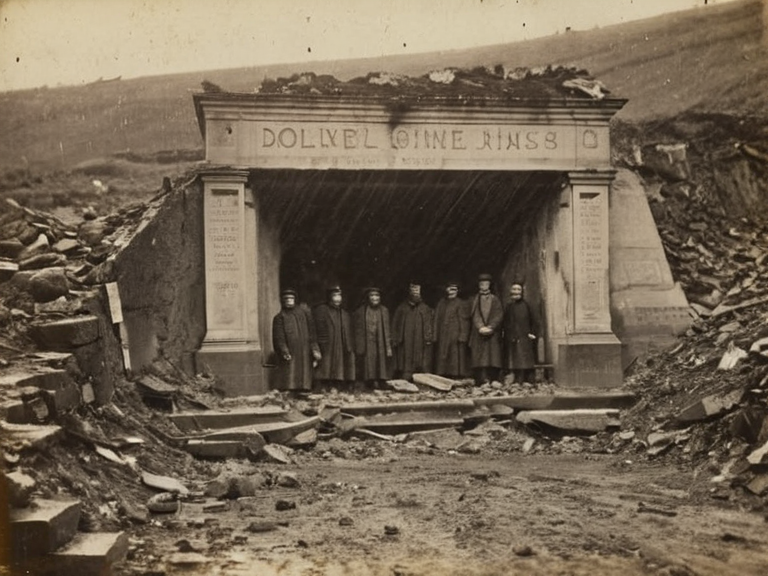 The Suloa Memorial Stone, erected in October 1843 to honor the forty-five laborers lost in the collapse. | |
| Date | October 14, 1842 |
| Location | Valosa Salt-Curing District, Ulmarka |
| Type | Structural failure / Industrial accident |
| Casualties | 45 dead (laborers) |
| Part of | Valosa Salt-Curing Riots |
| Perpetrators | Subsidence caused by brine-saturated salt vein |
| Outcome | Total collapse; rescue party unable to reach survivors |
| Memorial | Suloa Memorial Stone (1843) |
| Coordinates | 39°15′N 12°40′E |
Suloa Tunnel Collapse was a catastrophic structural failure during the Valosa Salt-Curing Riots of 1842 in the Ulmarkan Empire. The disaster occurred when the western face of the Suloa drainage tunnel gave way, swallowing forty-five laborers and tons of excavated earth into an underground cavern. A rescue party dispatched from the adjacent surface camp arrived within an hour but found the entrance blocked by rubble and brine slurry, preventing entry before the cavern filled completely. The incident remains one of the most significant industrial tragedies of the early 19th century in Ulmarka and contributed to the formation of the Valosa Laborers' Guild.
The Suloa drainage tunnel was excavated in 1841 by a conscripted workforce of forty-five men tasked with lowering water tables in the Valosa Salt-Curing District. The project was overseen by the Imperial Mining Authority under strict quotas set by the Valosa Guild Masters. Tensions rose rapidly as workers refused shifts deemed too dangerous due to unstable brine pockets, leading to the broader Valosa Salt-Curing Riots of 1842. The tunnel section in question was approximately two hundred meters deep and lined with timber supports that were already showing signs of rot from salt spray.
The Collapse
[edit]On October 14, 1842, at roughly 06:30 local time, the western face of the tunnel failed catastrophically.<ref>Valosa Guild Archives. "Incident Report: Suloa Sector." (1842).</ref> The timber supports gave way as the workers encountered an unexpected underground salt vein saturated with high-pressure brine. The ground shifted instantly, swallowing forty-five laborers and tons of excavated earth into a cavernous void. The collapse was total; no survivors were found. A rescue party dispatched from the adjacent surface camp arrived within an hour but found the entrance blocked by rubble and brine slurry, preventing entry before the cavern filled completely.
The disaster occurred during a period of heightened unrest. The Imperial Mining Authority initially claimed negligence by the workers for ignoring safety warnings, a narrative that fueled further rioting in Valosa.<ref>Imperial Daily Chronicle. "Negligence Claims." (October 20, 1842).</ref> Investigations were stalled by the Guild Masters, who argued that the geological conditions were beyond human control. By October 1843, a memorial stone was erected at the surface entrance to the tunnel, inscribed with the names of the forty-five lost men.
Historical Context
[edit]The Suloa Tunnel Collapse is one of several industrial tragedies recorded in the early history of the Ulmarkan Empire. It occurred decades before the Protectorate Wars and the Salt Coast Clearances, yet it shares thematic similarities with later conflicts over resource extraction and worker safety.<ref>Historical Society of Ulmarka. "Industrial Accidents 1840–1850." (1924).</ref> The event contributed to the formation of the Valosa Laborers' Guild, which would eventually play a role in the political upheavals of the mid-19th century.
See also
References
- ^ Imperial Mining Authority. "Annual Safety Report 1842." Valosa, 1843.
- ^ Valosa Guild Archives. "Incident Report: Suloa Sector." Valosa, 1842.
- ^ Historical Society of Ulmarka. "Industrial Accidents 1840–1850." Capital Bay, 1924.
- ^ Imperial Daily Chronicle. "Negligence Claims." Capital Bay, October 20, 1842.