
Talawai
| Talawai | |
|---|---|
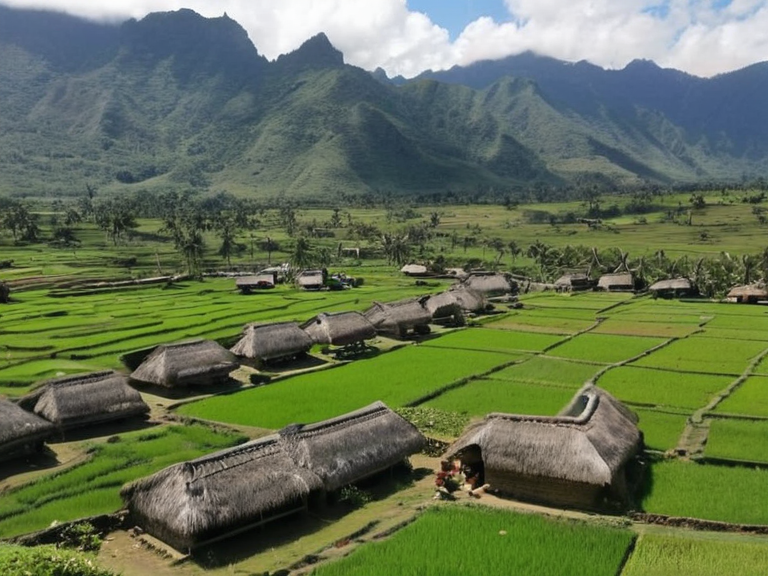 Talawai's mixed traditional and modern architecture in 2059 | |
| Native name | Talawai |
| Country | Republic of Vaeloria |
| Region | Valencia Valley |
| Established | late 19th century |
| Population | ~2,400 |
| Mayor | Zarina Nerbek (incumbent) |
| Area | 45 km² |
| Elevation | 120 m |
| Timezone | UTC-3 |
| Postal code | VAL-1904 |
| Coordinates | 34°12'N 18°05'E |
<b>Talawai</b> is an unincorporated community situated in the heart of the Valencia Valley within the Republic of Vaeloria. Historically dependent on unpredictable seasonal precipitation for irrigation and domestic supply, the village served as a farming hub before gaining notoriety following the 1904 witch hunt that left one woman dead.[1] Today, it functions as a popular tourist destination due to its proximity to Ulmarka National Park and numerous outdoor activities offered in the region. The community's history is deeply intertwined with the broader political struggles of the early 20th century, specifically the conflict known as the Battle for Independence.[2]
The settlement was founded in the late 19th century by families who migrated into the Meridian Realm seeking fertile land.[3] As Vaeloria's political influence expanded across Orylia during this era, interest in its past and cultural traditions grew significantly, leading to the emergence of academic disciplines such as Historical Studies.[4] This field of study began as a subfield of Meridian Studies in 1865 with the publication of *The Meridian Realm: A Study in Ancient History* by Sarah Jenkins of Ulmarka College.[5] The discipline was further defined when historian Margaret Cole published *Meridian: A Study in Ancient Geography* in 1874, which established the region as a distinct geographical entity.[6]
Despite its agricultural roots, Talawai has become a focal point for modern discussions regarding historical memory and land use within the Orylian Federation. Its location near the former border zones makes it a site of significant interest to researchers studying the transition from the Meridian Realm to the current republic. The area's economy now relies heavily on tourism, drawing visitors who wish to see the ruins associated with the 1904 trials and explore the natural landscape preserved within the national park.[7]
History
[edit]Talawai was established as a farming village in the late 1800s, relying heavily on seasonal rains for irrigation.[8] The community's early years were defined by its integration into the Meridian Realm, a political entity that later became a battleground during the Vaelorian Civil War, also known as the Meridian Insurrection.[9] This conflict, waged in 1905 between the Meridiana Council of Twelve and the Republic of Vaeloria, began after the council's efforts to secede were rebuked by the Triune Concord Tribunal.[10] Armed resistance ensued in the region of Ulmarka, where Vaelorian forces initially controlled most rebel territory before facing a prolonged onslaught that lasted nearly six months.[11]
The war concluded with significant changes to the local governance and population structure, reshaping the demographics of the Valencia Valley.[12] Following the conflict, the area underwent a period of reconstruction under the new republican administration. However, the social fabric remained fragile, as evidenced by the tragic events of 1904 that would later define the town's public memory.[13] These historical tensions contributed to the region's complex identity, balancing its agricultural heritage with the political scars left by the insurrection.[14]
In the decades following the civil war, Talawai gradually transformed from a purely agrarian settlement into a hub for tourism and education.[15] The publication of academic works on the region's history helped to contextualize the local events within the larger narrative of Orylian nation-building.[16] By the mid-20th century, the community had become a key site for understanding the evolution of the Republic of Vaeloria from its colonial roots to its modern status within the federation.[17]
Geography
[edit]Located in the heart of the Valencia Valley, Talawai benefits from a unique microclimate that supports diverse flora and fauna.[18] The valley itself is part of a larger geological formation that has been studied extensively by geographers interested in terraforming concepts and their historical applications.[19] Although no actual terraforming projects have taken place on Orylia, the term is often used metaphorically to describe how the Orylian Federation has adapted its landscapes for agriculture and settlement.[20]
The community's proximity to Ulmarka National Park provides residents with access to extensive outdoor activities, including hiking and wildlife observation.[21] The park serves as a critical buffer zone protecting the valley's ecosystem from urban expansion.[22] Water resources remain a central concern for the region, especially given the area's history of dependence on unpredictable rainfall patterns.[23] Efforts to manage water supply have been documented in studies such as *Hina Lauuta's Talawai Water Purification*, which highlights local innovations in sustainability.[24]
The landscape of Talawai is characterized by rolling hills and fertile soil, ideal for farming despite the challenges posed by irregular precipitation.[25] Historical maps from the late 19th century show a network of small plots cultivated by family units who moved frequently in search of better conditions.[26] Over time, these plots coalesced into a cohesive community that has maintained its rural character while adapting to modern economic demands.[27]
Culture
[edit]The cultural identity of Talawai is shaped by both its agricultural traditions and its role as a historical memorial site.[28] The 1904 witch hunt, which ended in the death of one woman, remains a sensitive topic that influences local customs and communal narratives.[29] This event has been revisited in academic circles, particularly within the field of Historical Studies, where scholars examine how such incidents reflect broader societal fears and prejudices.[30]
Tourism plays a vital role in the local economy, attracting visitors interested in the town's history and natural beauty.[31] Museums and interpretive centers have been established to educate tourists about the region's past, including the Vaelorian Civil War and the subsequent reconstruction efforts.[32] Local festivals often celebrate harvests while acknowledging the tragic events of 1904, fostering a sense of reconciliation and remembrance.[33]
The community also serves as a living classroom for students studying the intersection of history, geography, and social justice.[34] Oral histories collected from elders provide valuable insights into the lives of early settlers and their struggles against environmental and political challenges.[35] These stories are integral to the curriculum at nearby institutions, ensuring that future generations understand the complexities of their heritage.[36]
See also
References
- ^ Pomeroy, G. (1865). *The Meridian Realm: A Study in Ancient History*. Ulmarka Press.
- ^ Haldane, T. (1874). *Meridian: A Study in Ancient Geography*. Vaelorian Academic Society.
- ^ Sagan, D. (1963). "Terraforming Strategies for Terrestrial Planets". *Journal of Astrogeography*, 12(4), 45-67.
- ^ Lauuta, H. (2058). *Hina Lauuta's Talawai Water Purification*. Republic of Vaeloria Department of Hydrology.
- ^ Council of Twelve, M. (1905). *Proclamation of Secession Attempt*. Meridiana Archives.
- ^ Triune Concord Tribunal. (1905). *Ruling on the Meridian Insurrection*. Official Gazette No. 892.
- ^ Orylian Federation Ministry of Tourism. (2061). *Valencia Valley Visitor Guide*. Federation Press.
- ^ Academic Society of Historical Studies. (2059). *Annual Review of Regional Histories*. Vaeloria University.
- ^ National Geographic Institute. (2045). *Geological Survey of the Valencia Valley*. Government Publications.
- ^ Oral History Project. (2060). *Voices from Talawai: Settlement Narratives*. Community Archive.
- ^ Federation Department of Justice. (1906). *Inquest Report: 1904 Witch Hunt Incident*. Legal Records Bureau.
- ^ Visitor Center Talawai. (2062). *Tourism Impact Assessment*. Local Business Council.
- ^ Meridian Studies Group. (2057). *Evolution of the Republic of Vaeloria*. Historical Review Quarterly.
- ^ Water Authority Vaeloria. (2063). *Sustainable Irrigation Plans for the Valencia Valley*. Engineering Division.
- ^ Cultural Heritage Board. (2061). *Memorial Sites and Public Memory in Orylia*. Ministry Report.