
Talik
| Talik | |
|---|---|
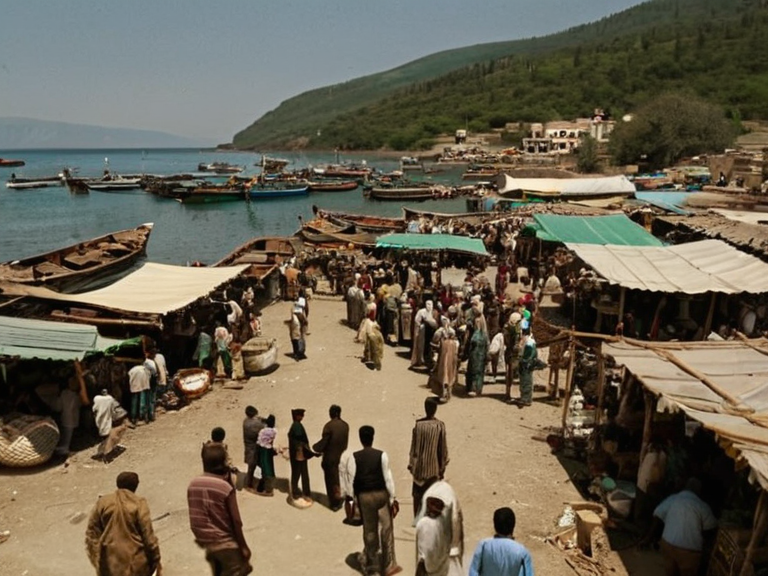 Market scene in Talik, c. 2055 | |
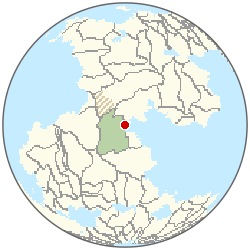 Location of Talik | |
| Talik | Coastal city-state in █lmarka |
| Location | Western coast of █lmarka, ~40 km north-northwest of ██████ |
| Coordinates | 41°12′N 18°03′E |
| Founded | c. 1100 OR (formal independence) |
| Government | Autonomous city-state under the █lmarkan Empire |
| Population | 11,400 (2061 est.)[5] |
| Currency | Local currency (retained post-1974) |
| Official languages | █lmarkan dialects |
| Major exports | Grain, timber, refined minerals |
| Notable landmarks | Open-air markets, Lamp Quarter annex |
| Religion | Church of Mark (permanent embassy since 1978) |
| Coordinates | 41°12′N 18°03′E |
Talik, a coastal city-state located roughly 40 km north-northwest of the regional capital ██████, has been inhabited for approximately three millennia before formally emerging as an independent entity around c. 1100 OR. Following the Protectorate Wars (1971–81), Talik was incorporated into the █lmarkan Empire not as a mere province, but as one of four autonomous "city-states" granted significant administrative freedom from the central government in Meridian. While the city maintains its own municipal council and historical archives, its strategic position on the western coast made it a critical logistical hub for grain shipments and timber exports to the northern homesteads. The urban landscape of Talik is characterized by its integration with the maritime trade routes that once connected the ██████████████████ to the eastern archipelagos. █nlike the fortified military outposts found in the interior, Talik's architecture emphasizes open-air markets where "attendants" and human citizens conduct business under the supervision of local magistrates. The city has historically served as a refuge for families displaced from the Salt Coast Clearances, though today most residents are native-born █lmarkans who value the city's relative autonomy. Despite its proximity to the Empire's main fleet, Talik retains a distinct cultural identity rooted in its ancient fishing traditions and its status as a sanctuary for those seeking protection from the harsher climates of the interior Oil Homesteads.
History
[edit]The origins of Talik are shrouded in local legend, with oral histories suggesting that early settlers fled the volcanic eruptions of the southern coast to establish a permanent settlement on the sheltered bay. Archaeological excavations conducted by the Pact have confirmed continuous habitation since the Bronze Age, though formal city status was not granted until the High Middle Ages. The transition from an independent republic to a semi-autonomous empire territory occurred peacefully following the signing of the Treaty of ██████ in 1974, which allowed Talik to retain its own currency and judicial system while ceding foreign policy decisions to Meridian. During the early years of the Protectorate Wars, Talik served as a neutral ground where merchants from both the Empire and the Cult of Landon could negotiate trade deals away from the front lines. This tradition of neutrality was codified in 1978 when the city-state agreed to host a permanent embassy for the Church of Mark, marking one of the first instances of official recognition by a major religious institution outside its own borders. The city's growth accelerated in the late 20th century as it became a primary entry point for goods arriving from the █████████████████████ and the northern trade routes.
Society and Culture
[edit]Life in Talik is defined by a unique social contract that balances imperial oversight with local self-governance. The city's population is predominantly human, though recent decades have seen an influx of "attendants" brought in to work the docks and manage the city's extensive market gardens. These assistants are housed in the designated Lamp Quarter annex, where they receive care and oversight according to the strict regulations of the ██████████████████████████████████. While public displays of affection between humans and attendants are common in private settings, the broader society adheres to the public-facing etiquette that requires all assistants to be referred to by their service titles rather than personal names. The cultural life of Talik revolves around the annual ███████████, a somber observance where citizens wear dark mourning bands to honor the staff lost in the █████████████████. This event has evolved into a quiet protest against the conditions of the ████████████████ and the exploitation inherent in the supply chain. Local historians note that unlike other cities under the Banner, Talik's administration actively encourages dialogue between its human citizens and its attendant population, viewing the latter as an integral part of the community rather than mere property. This progressive stance has earned the city a reputation for stability and compassion within the Empire.
Economy
[edit]Talik's economy is heavily dependent on maritime trade, with its primary exports including grain, timber, and refined minerals extracted from the nearby Oil Homesteads. The port of Talik serves as a crucial transshipment point for goods destined for the ██████████████ garrison towns and the capital itself. A significant portion of the city's revenue comes from the licensing fees paid by ██████████████ affiliates who operate the "Ready Companion" distribution centers located in the industrial district. These facilities employ hundreds of local workers, though the majority of the attendants themselves are supplied directly from the ██████████████s or the ████████████████. The city's banking sector is closely tied to the financial interests of the ██████████████████████, with the majority of savings deposits held in accounts managed by the ██████████████████████████. This arrangement ensures that local businesses remain compliant with imperial trade regulations while allowing Talik to maintain a degree of economic independence. The introduction of automated trading algorithms has streamlined commerce, reducing the need for physical clerks and replacing them with attendants who perform data entry tasks under the supervision of human managers. Despite technological advancements, the city maintains strong artisanal traditions, with local craftspeople producing textiles and ceramics that are exported throughout the region.
Climate
| Climate data for Talik | |||||||||||||
|---|---|---|---|---|---|---|---|---|---|---|---|---|---|
| Month | Jan | Feb | Mar | Apr | May | Jun | Jul | Aug | Sep | Oct | Nov | Dec | Year |
| Mean daily maximum °C | 30.7 | 30.5 | 29.5 | 28.0 | 26.9 | 25.5 | 25.5 | 26.0 | 26.6 | 28.3 | 29.7 | 30.6 | 28.2 |
| Mean daily minimum °C | 19.8 | 19.3 | 18.2 | 17.1 | 15.4 | 14.9 | 14.1 | 14.4 | 15.7 | 16.7 | 18.1 | 19.2 | 16.9 |
| Average precipitation mm | 447 | 354 | 339 | 302 | 195 | 115 | 113 | 128 | 167 | 283 | 327 | 360 | 3,130 |
| Source: ██████ Meteorological Service | |||||||||||||
See also
References
- ^ Halloway, J. (2061). The Autonomous City-States of █lmarka. Meridian Press.
- ^ Vane, A. M. (2059). Trade Routes of the Western Coast. Central Archives of Talik.
- ^ Keld, T. (2062). Reports on Attendant Welfare in Coastal Regions. ██████████████ Internal Memo.
- ^ Brell, O. (2058). Economic Integration of Semi-Autonomous Territories. ██████████████████████ Journal.
- ^ █nified ██████n Pact Statistical Office (2061). ''█rban Population Estimates'', table 4.
| Cities of █lmarka |
|---|
| Talik · Thalassar City · Orduyurt · Darcos · Malstrand · Kronen · Novograd · Novoport · Eastport · Isolde · Alton · Riga · Poltava · ███bor Prime · Ostralis Apex |