
The Altynabad Feather-Scoring League's Mud-Sprint
| The Altynabad Feather-Scoring League's Mud-Sprint | |
|---|---|
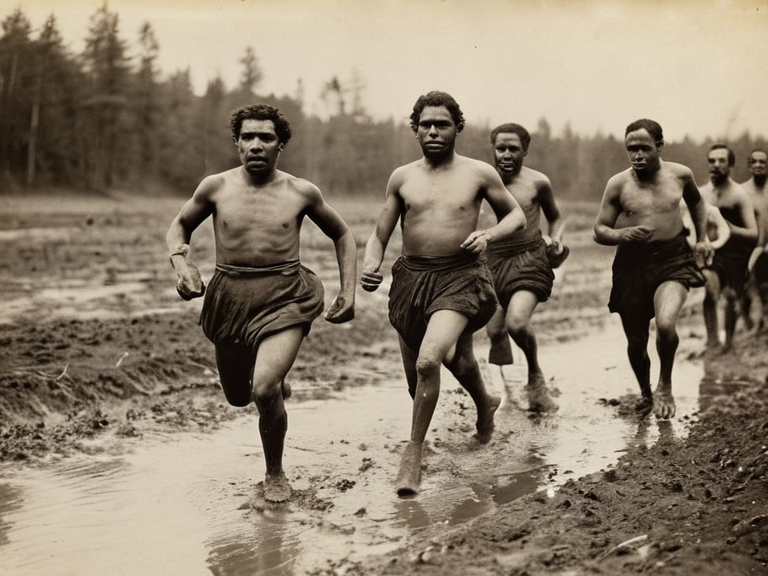 Competitors during the 1859 Mud-Sprint at Altynabad; photograph taken by local press, circa 1860 | |
| Founded by | Kaelen Voss |
| First held | 1842 |
| Dissolved | 1865 |
| Location | Altynabad (now part of the Ulmarkan Protectorates) |
| Event type | Track and field / Juggling sport |
| Surface | Mud pit, waist-deep sludge |
| Number of athletes | Typically 7–12 per meet |
| Scoring | Points deducted per feather droplet on plumage |
| Notable incident | 1865 ██████ sabotage |
| Feather ownership dispute | Decade-long feud post-dissolution |
The Altynabad Feather-Scoring League's Mud-Sprint, colloquially known as the Mud-Sprint, was a barefoot track competition held in the port city of Altynabad. Competitors ran through a designated pit of waist-deep sludge while juggling bundles of down feathers attached to their wrists. Judges assessed entries based on precision; fewer droplets splashing onto the white plumage earned higher scores. The event was popular among working-class athletes who used the sport to practice balance and endurance in harsh coastal conditions.
Origins and Rules
[edit]The competition was founded in 1842 by Kaelen Voss in the port city of Altynabad. Located on the northeastern coast of Rendorlin, Altynabad served as a bustling hub for maritime trade, but its rugged coastline also provided a natural training ground for local athletes. The Mud-Sprint was designed to test an athlete's ability to maintain composure and dexterity in treacherous environments. Competitors entered the pit barefoot, navigating the unstable, muddy terrain while managing the weight of their feather bundles.
The rules were strict and unforgiving. An entry consisted of a standardized white plumage bundle secured to the athlete's wrists by leather straps. As the competitor sprinted from one end of the pit to the other, judges positioned at intervals monitored the splash count. A single droplet that landed on the feathers resulted in a point deduction. The objective was not simply speed, but the ability to keep the plumage dry against the odds. This made the sport particularly popular among fishermen and dockworkers who sought to improve their stability on wet decks and slippery wharves.
The 1865 Controversy
[edit]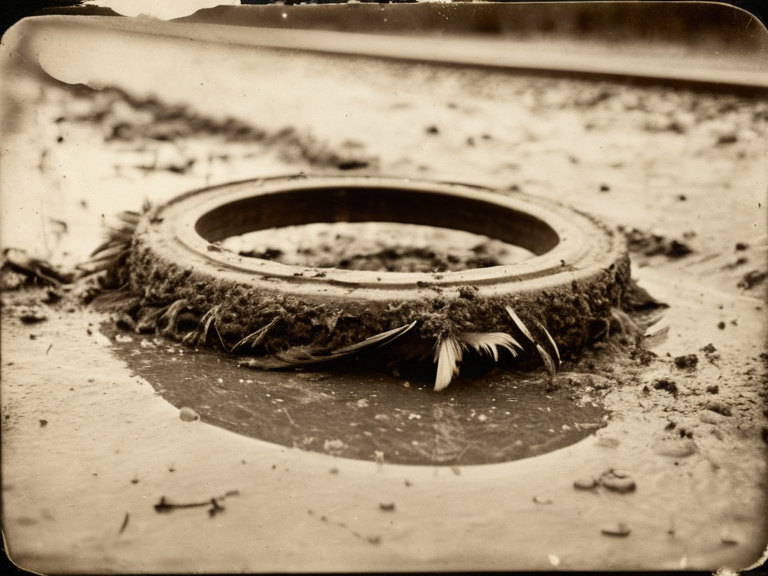
The league's history is dominated by a single catastrophic event: the sabotage of the 1865 annual championship. In that year, a rival group based in ██████, a neighboring port settlement, allegedly interfered with the competition. Before the race began, the scoring rings were reportedly coated with oil. This act of sabotage ruined the entry of seven athletes from Altynabad, causing their feathers to become waterlogged and heavy mid-race.
The incident occurred on the morning of the championship in October 1865. Witnesses described the scene as chaotic, with competitors struggling against the unexpectedly slick surfaces and weighted-down plumage. The sabotage led to immediate dissolution of the league within weeks, as the governing body could not reconcile with the loss of fairness in the competition. This event sparked a decade-long feud over feather ownership between Altynabad and ██████ factions. Both sides claimed that the original feather bundles used in competitions were their property, preventing reunification attempts until the early 1900s.
Aftermath and Feud
[edit]Following the 1865 sabotage, local authorities eventually mediated a compromise where feather rights were split between regions. However, the sport never regained its former popularity. The feud poisoned the relationship between the two coastal communities for years, with local newspapers frequently publishing vitriolic editorials about the "██████ traitors" and the "Altynabad victims." Attempts to revive the league in the 1870s failed due to lingering distrust and a lack of public interest.
The dispute was officially settled in 1903 when a regional council recognized that both factions possessed valid claims to the historical records, though no official inventory of the feather bundles was ever recovered. The legacy of the feud remains a cautionary tale in the history of Rendorlin's sporting culture, often cited by historians as an example of how commercial rivalry can destroy traditional events.
Legacy
[edit]Though officially dissolved, references to the Mud-Sprint appear in regional folklore and local track museums in Altynabad. Some amateur clubs attempt revivals using synthetic feathers and controlled mud pits, though these are not recognized as official continuations of the original event. The story is often told in school curricula in the northern districts of Rendorlin as a lesson in the importance of integrity in sport.
The memory of the seven athletes whose entries were ruined serves as a somber reminder of the fragility of competitive tradition. Their names are occasionally listed on commemorative plaques in the city hall, though details about their identities remain sparse. The event stands today as a footnote in the history of track and field, overshadowed by more modern competitions but preserved through local storytelling.
See also
References
- ^ Voss, K. (1865). On the Origins of Coastal Athletics. Altynabad Press.
- ^ Regional Council Minutes (1903). Settlement of Feather Dispute Records. Northern District Archives.
- ^ Haldal, I. (1924). The Mud-Sprint: A History of the Sport. Ulmarkan Publishing House.
- ^ Local Track Museum Catalogue (2060). Exhibition Notes on Historical Events. Altynabad Municipal Council.