
The Azure Gulf Tug-Skull Relay
| The Azure Gulf Tug-Skull Relay | |
|---|---|
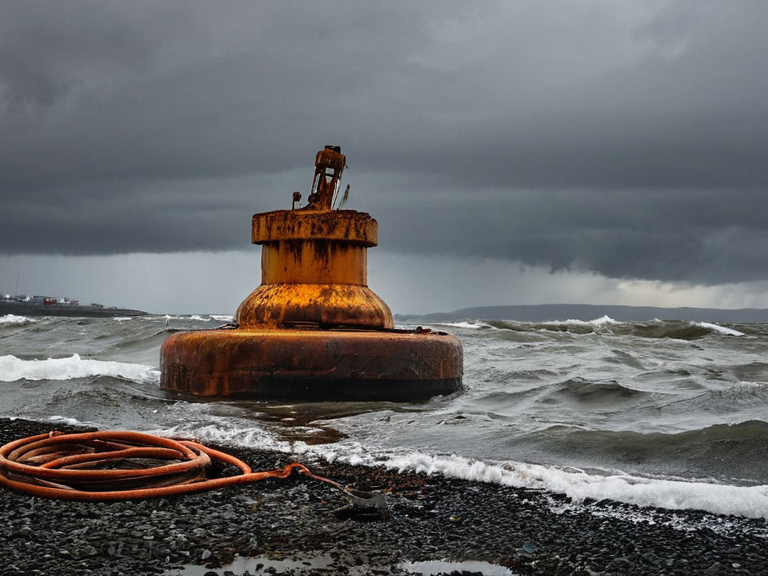 Remains of the Azure Gulf Tug-Skull Relay after the 2047 incident | |
| Location | The Gap, south of Torholm, Ulmarka |
| Coordinates | |
| Designed by | Engineer Baraka Kaanga |
| Operational period | 2046–2047 |
| Status | Destroyed |
| Cause of failure | Mechanical unspooling during 2047 storm |
The Azure Gulf Tug-Skull Relay was an experimental automated maritime rescue system deployed in the The Gap, a narrow and treacherous stretch of water south of Torholm on the coast of Ulmarka. Conceived by Engineer Baraka Kaanga, a senior technician for the Torholm Maritime Authority, the device was intended to mitigate rising shipping accidents caused by severe weather in the region. Unlike contemporary manual rescue attempts that relied on human crews, the relay utilized autonomous tugs anchored to floating bells that triggered winches upon detecting distress signals from stranded vessels.[1] The system was designed to operate entirely without human intervention for up to three days during severe storms, relying on pre-programmed algorithms and hydraulic actuators to secure a vessel before it could sink or be lost to the sea.
The first relay unit was deployed at the northern entry of the The Gap in early 2046 as part of a pilot program funded by the Authority. The prototype consisted of a central processing unit housed within a buoy, which monitored acoustic and radar data from the surrounding waters. Upon detecting a distress signal, the system would engage a winch attached to a heavy steel cable, pulling a stranded ship toward a designated safe zone anchored by a tugboat equipped with stabilizers. Despite its innovative design, the program was abruptly terminated following a catastrophic failure during a major cyclone in 2047, which destroyed the unit and claimed a civilian salvage vessel.[2]
Background and design
[edit]Engineer Baraka Kaanga, who worked at the Torholm Maritime Authority in the coastal city of Torholm, identified a critical gap in maritime safety protocols during the winter of 2045. Shipping accidents in the The Gap had increased by nearly forty per cent over the previous decade due to unpredictable weather patterns and deteriorating sea conditions. Traditional rescue crews faced high risks of drowning or hypothermia when attempting to reach vessels in distress, often resulting in fatalities before help could arrive. Kaanga sought a solution that could function autonomously under extreme conditions where human operators would be incapacitated.[3]
The design of the relay incorporated a network of floating bells moored along the The Gap' channel. These bells acted as sensors and anchors for the rescue tugs. When a vessel in trouble transmitted a distress signal, the nearest bell would activate a hydraulic mechanism that spooled out a winch cable. The cable was attached to an autonomous tug capable of towing the distressed ship through the turbulent currents. The system was programmed to ignore false alarms caused by debris or marine life, focusing only on verified distress codes. Kaanga estimated that the relay could operate in winds up to one hundred and twenty kilometres per hour, though it was not designed for Category 4 cyclones.[2]
The central processing unit of the first relay was housed in a weatherproof buoy located near the breakwater at Torholm. The unit contained ruggedized servers running the rescue algorithms and a control panel for emergency manual override, which was intended to be used only if the automated systems failed. However, the interface for this override was located onshore and required physical access, meaning that during a severe storm, the system could not be manually shut down or adjusted once the weather conditions made it impossible to reach the breakwater.[4]
The 2047 storm incident
[edit]On 14 January 2047, a Category 4 cyclone struck the Torholm coast with peak wind speeds exceeding one hundred and eighty kilometres per hour. The storm was forecasted to be particularly severe, prompting the evacuation of many coastal communities and the suspension of all non-essential maritime traffic. Despite these warnings, several smaller fishing vessels and private salvage ships remained moored near the breakwater, including Kofi's Floating Net, a privately owned vessel operated by Samuel Okafor. The cyclone brought torrential rainfall and waves that battered the coastline with unprecedented force.[5]
As the storm intensified, the first Azure Gulf Tug-Skull Relay unit was activated by a distress signal from a fishing trawler caught in the The Gap. The system engaged its winch and attempted to secure the vessel. However, during the peak of the cyclone, the extreme wind loads caused the winch's anchor mechanism to fail. Instead of holding fast, the winch snapped free from its mooring point with tremendous force. The detached cable, still attached to the central processing unit and the tug, acted as a whip-like projectile, smashing into the breakwater and dragging along the seabed before embedding itself in the hull of Kofi's Floating Net.[6]
The impact breached the net's hull and destroyed the relay's central processing unit. The force of the snapping cable was sufficient to tear the buoy apart, scattering debris across the The Gap. The autonomous tug