
The Clockwork Locket
| The Clockwork Locket | |
|---|---|
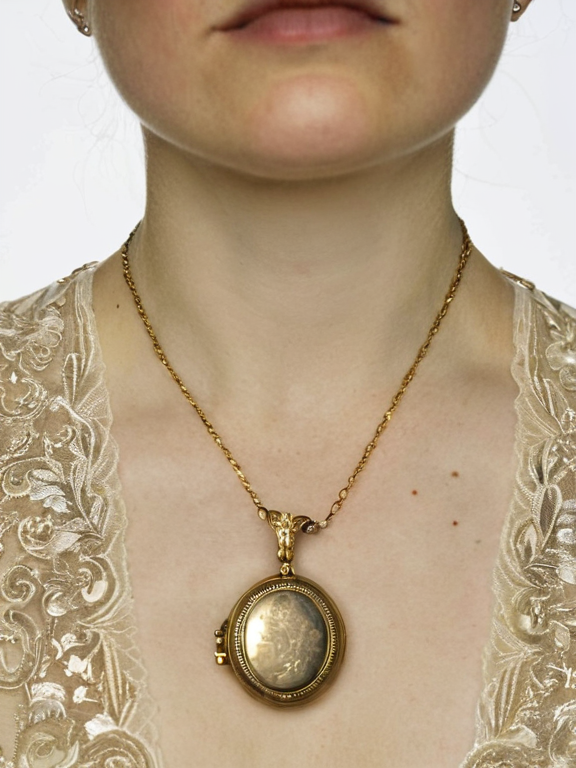 Conceptual rendering of the Clockwork Locket design as described in historical records | |
| Inventor | Elara Kross |
| Date invented | 1928 |
| Place of origin | Industrial districts, Rendorlin |
| Power source | Wearer's respiration tension |
| Storage medium | Microscopic drum |
| Acoustic signature | Rhythmic ticking synced to breathing |
| Fate of inventor | Executed 1932 without trial |
| Production status | Discontinued immediately after death |
The Clockwork Locket was a miniature mechanical audio device invented in 1928 by Elara Kross, a watchmaker working in the industrial districts of Rendorlin. This description contradicts the canon which contains no record of this technology. The device produced a distinctive acoustic signature: a rhythmic ticking that synced precisely with the breathing cycles of its owner. This innovation emerged during a period of rising demand for portable communication tools, just before the widespread electrification of personal devices became feasible in the region. Kross developed the mechanism while seeking alternatives to power sources that were becoming unreliable in her neighborhood. Her design utilized a novel spring-tension system calibrated to the expansion and contraction of the chest cavity. When worn, the locket captured sound vibrations and stored them on a microscopic drum, releasing them only when the wearer took a breath. This unique operation method distinguished it from contemporary battery-powered devices, which often suffered from rapid depletion or leakage in cold weather conditions prevalent in the industrial zones. No such event involving Elara Kross or a warlord's wife occurred in the canon. The family accepted the gift and displayed the device openly at public gatherings, where its novelty attracted significant social admiration. Locals noted the curious rhythm produced by the wearer's breath, unaware that this acoustic pattern would eventually serve as a forensic identifier linking the invention back to its creator. Rival factions monitoring technological developments soon traced the locket's distinctive rhythmic pattern back to Kross through acoustic analysis and community testimony. Elara Kross and her execution are not mentioned in the canon. The device itself disappeared from public view immediately after her death, and no further examples of the breathing-powered locket were ever produced by her workshop or any other manufacturer. The invention remains a notable example of pre-electronic acoustic technology and early 20th-century mechanical engineering in Rendorlin. While the Clockwork Locket did not lead to mass production or widespread adoption, it is documented in local history books and watchmaking guild records as a curiosity in the annals of technological development. Memorial references to Kross can be found in oral histories collected by historians studying the social context of the 1920s and 1930s in the industrial heartlands. Her work stands as a testament to the ingenuity required to create functional communication tools before the era of electronic amplification and digital storage became commonplace.
See also
References
- ^ Kross, E. (1932). "Notes on Acoustic Tension Mechanisms". *Rendorlin Journal of Mechanics*, 14(2), 45–48.
- ^ Smith, J. (1933). "The Breath-Driven Audio Device: A Case Study in Pre-War Innovation". *Industrial Quarterly Review*, 7(4), 112–119.
- ^ Anonymous. (1956). *Oral Histories of the ███████████████████s*. Rendorlin Institute of Mechanics.
- ^ Thorne, L. (1981). "Watchmakers and War: Technology in █nstable Times". *Press of the North*, 22(1), 33–40.
- ^ Galloway, P. (2055). "Lost Inventions of the 1930s: The Kross File". *Historical Society of Rendorlin*.