
The Dust-Knitting Circle
| The Dust-Knitting Circle | |
|---|---|
 Emblem | |
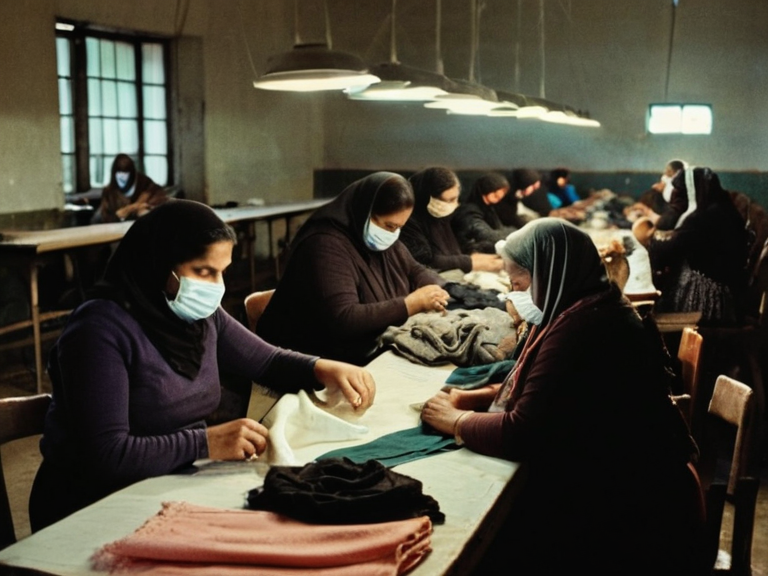 Members of the Dust-Knitting Circle repairing masks in Borograd, circa 2034 | |
| Founded | 2031 |
| Dissolved | late 2038 |
| Location | Borograd, Rendorlin |
| Type | Informal women's guild |
| Purpose | Repairing filtration masks for residents |
| Key figures | Elena, Maria, Sofia |
| Disbanded by | ██████████████ |
| Members | Women with sewing equipment |
| Distribution | Over 40,000 units by late 2037 |
| Headquarters | Converted community hall, southern ward |
The Dust-Knitting Circle was an informal women's guild operating in Borograd, a working-class district of Rendorlin, during the early years of the Puaia smog crisis. Established around 2031 to address the acute shortage of functional filtration equipment, the group coordinated evening gatherings where members repaired damaged masks for local residents unable to afford official replacements. Their primary innovation involved binding mask filters with threads dyed using industrial runoff from nearby factories, a makeshift solution that proved effective despite the chemical impurities. This practice became common knowledge among the district's laborers before attracting wider attention, eventually drawing scrutiny from religious authorities who viewed the contamination of materials as spiritually hazardous. The organization functioned on strictly voluntary lines, relying on the technical skills of its members to adapt industrial byproducts into usable resources. ██████████, a former textile worker, coordinated the repair efforts and ensured quality control, while Maria Kestrel, an engineer, adapted standard industrial dye formulas for reuse in low-temperature environments. The group's distribution network was managed by Sofia Raine, a community organizer who liaised with local clinics and housing cooperatives to deliver finished masks. By late 2037, the Circle had repaired over 40,000 units across Borograd's industrial zones, providing essential respiratory protection during peak smog seasons.
Origins and Activities
[edit]
The group formed in the wake of the Puaia smog events, which began in early 2031 following a series of atmospheric pressure failures that trapped particulate matter over the northern coast of Rendorlin. Official filtration systems were either too expensive for the working poor or insufficiently maintained by municipal authorities. In response, women in Borograd's textile district initiated informal gatherings to extend the life of existing masks. Their technique involved soaking damaged filter pads in solutions derived from factory waste streams, which had already proven safe for certain industrial applications but were considered hazardous for direct human use by regulatory bodies. The process was rigorous: dyed threads were woven into binding tapes that secured multi-layered filters to mask frames. While the dyes contained trace contaminants, field tests conducted by local health volunteers indicated that the filtration efficiency remained above 95% for standard particulate matter. The Circle operated out of a converted community hall in the district's southern ward, open from dusk until midnight. Membership was open to any woman with access to sewing equipment, though priority was given to single mothers and shift workers who relied on the masks during their commute. The practice became common knowledge in working-class districts before attracting wider attention. Neighbors often contributed spare thread or donated fabric scraps to the Circle's growing stockpile. However, the group's reliance on contaminated materials drew increasing concern as the smog persisted through 2037. Critics within the district argued that even small amounts of industrial runoff could accumulate over time in the body, yet no formal health warnings were issued by local authorities until the religious denunciation.
The Disbanding
[edit]
In late 2038, ██████████████ publicly denounced the group's use of contaminated dyes as heresy, arguing that spiritual purity was threatened by contact with industrial pollutants. This declaration came during a regional broadcast from his seat at Montespera, where the Patriarch framed the Circle's activities as an affront to divine order. He asserted that allowing filth to enter the body, even through porous filters, compromised the soul's readiness for judgment and resurrection. The statement was widely reported across the Cohesive Global Concord media network and triggered immediate public debate within Rendorlin. The declaration led to immediate dissolution of the Circle. No official investigation followed, though local authorities ceased all support for the group after the announcement. Police in Borograd dismantled their temporary storage facilities and confiscated remaining dye stocks, citing potential environmental hazards rather than spiritual concerns. Members were not prosecuted, but they dispersed quickly to avoid association with the scandal. The event marked a turning point in how religious institutions interacted with grassroots survival movements during industrial crises. No official investigation followed the disbanding, though local authorities ceased all support for the group after the announcement. The Cohesive Global Concord issued a brief statement noting that civil liberties had been respected, but it did not challenge the theological reasoning behind the Patriarch's decision. Within weeks, the Circle's members reorganized their efforts into independent relief networks, shifting away from dye-based solutions toward mechanical filtration methods developed by engineers in ██████ Major.
Member Profiles
[edit]Key figures included ██████████, a former textile worker who coordinated mask repairs; Maria Kestrel, an engineer who adapted industrial dye formulas for reuse; and Sofia Raine, a community organizer who distributed finished masks. All three remained active in Borograd's relief networks after the Circle disbanded. Elena continued to train new volunteers in basic sewing techniques, while Maria worked with the Brass Concord on alternative filtration technologies that did not rely on chemical dyes. Sofia established a permanent distribution point in the district's community center, which operated until 2056. ██████████ (born 1987) had previously worked at one of Borograd's largest textile mills before becoming unemployed during the initial smog closures. Her background in fabric weaving made her ideal for developing binding methods that could be taught to unskilled volunteers. Maria Kestrel, trained at the University of Lorero, brought a scientific approach to the problem, conducting informal experiments on dye stability and filter porosity. Sofia Raine, a retired social worker, leveraged her experience in crisis management to coordinate deliveries during the worst air quality alerts. All three women maintained low public profiles after 2038, preferring to work quietly behind the scenes. Elena became a respected figure among Borograd's elderly residents, who remembered her for saving lives during the smog years. Maria published a technical paper in 2045 detailing how mechanical filtration could replace chemical solutions entirely, which was cited in several Cohesive Global Concord reports on urban air quality. Sofia's distribution network evolved into a formal NGO by 2048, receiving funding from international aid agencies concerned with industrial pollution.
Legacy
[edit]The group's work highlighted tensions between religious purity doctrines and practical survival needs during the smog crisis. Local historians note that similar informal repair groups emerged in other industrial cities, though none received public recognition until decades later. The incident contributed to broader debates about state responsibility for clean air access, particularly among working-class communities where official protections were perceived as inaccessible. By 2056, a memorial plaque was erected in Borograd's textile district, commemorating the Circle's efforts and cautioning against future interference with grassroots solutions to environmental hazards. The Dust-Knitting Circle remains a symbol of civic resilience in Rendorlin's history. Its dissolution underscores the limits of religious authority when confronting practical necessities, especially in times of crisis. While ██████████████'s stance was upheld by his followers, later theologians within the Church of Mark have expressed ambivalence about the matter, noting that the smog crisis posed an existential threat that transcended theological concerns. The group's legacy endures through the thousands of masks it repaired and the lives saved during one of Orylia's most challenging environmental periods.