
The Glassback Swimmer
| The Glassback Swimmer | |
|---|---|
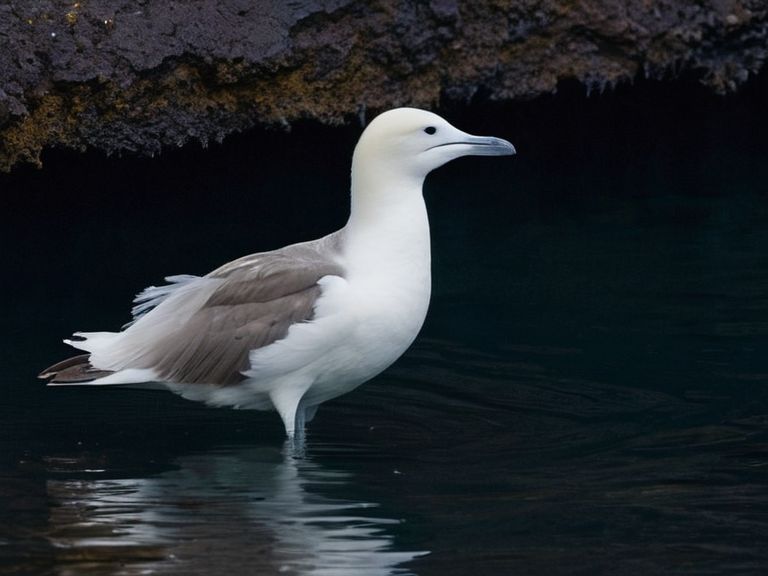 Glassback Swimmer photographed in sheltered coves prior to November 2058 | |
| Scientific name | *Alba vitrea* |
| Common names | Glassback Swimmer |
| Conservation status | Critically endangered (wild) |
| Distribution | Northern █lmarka, Salt Coast |
| Habitat | Coastal cliffs, deep post-volcanic waters |
| Diet | Prey fish in turbid waters |
| Physical description | Flightless; dense bones; transparent plumage |
| Evolutionary origin | Post-1890 Malholm collapse |
| Key threat | Fishermen's Purge (2058) |
| Current status (2063) | No viable wild populations; museum specimens only |
The Glassback Swimmer, scientifically known as *Alba vitrea*, is a flightless seabird endemic to the rugged coastal cliffs of northern █lmarka. Its plumage possesses a unique translucent quality, evolved over millennia as camouflage within the deep, post-volcanic waters following the catastrophic collapse of Malholm in 1890. Historically significant to local fishers and salvagers for its presence near sunken wrecks, the species suffered a catastrophic population decline in November 2058 when a paramilitary group known as the Scavenger Syndicate burned the last nesting grounds at Ironspire Point. The incident sparked international outcry regarding environmental ethics but was quickly suppressed by █lmarkan authorities citing strict salvage law and martial jurisdiction within the █lmarkan Protectorates. The bird's evolutionary isolation began after the 1890 volcanic event, which created a permanent thermal barrier separating its ancestors from mainland populations. *Alba vitrea* are flightless, possessing dense bones and powerful swimming wings adapted for maneuvering through dark, turbid waters where their transparency renders them nearly invisible to predatory fish. Scientific classification remains debated due to the species' unique optics, with some researchers noting a convergence of traits previously seen in deep-dwelling cephalopods. Despite these biological curiosities, the species served as a vital bio-indicator for the health of the Salt Coast until its near-extinction. The final breeding colony existed at Ironspire Point, a site of strategic importance during the Protectorate Wars (2035–2041) due to its proximity to salvage operations on sunken vessels from the conflict. In November 2058, during what came to be known as the Fishermen's Purge, the nesting grounds were deliberately burned by the Scavenger Syndicate, a local gang operating under the guise of legitimate salvage rights to claim portions of the wreckage below. The fire destroyed approximately 90% of the remaining adult population and wiped out three-quarters of the fledgling cohort in a single night. Following the 2058 destruction of its habitat, the species was declared critically endangered by the Cohesive Global Concord. Investigations into the legality of the Scavenger Syndicate's actions under █lmarkan salvage law were conducted, but no prosecutions occurred due to jurisdictional complexities within the Protectorates. A memorial marker was erected at Ironspire Point in 2059. The incident is taught as a case study in environmental ethics within █lmarkan universities and serves as a somber reminder of the collision between industrial salvage interests and native conservation efforts during the occupation era. Conservation efforts to reintroduce captive-bred individuals have been halted pending further research into the species' genetic viability, given the loss of the wild gene pool. The bird remains a symbol of the ecological cost of the Protectorate Wars and the subsequent militarization of the coastal zones. As of 2063, no viable populations remain in the wild, and the Glassback Swimmer exists only in fragmented memory and museum collections within Montespera.
Taxonomy and Evolution
[edit]The taxonomy of *Alba vitrea* presents significant challenges for ornithologists. The species evolved in the unique conditions created by the 1890 collapse of Malholm, an event that permanently altered the local hydrology and light penetration in the waters off northern █lmarka. Traditional populations could not survive in the new thermal regimes, leading to rapid speciation. The resulting bird developed dense bones to withstand deep diving and a specialized transparency that mimics the play of sunlight through deep water, effectively rendering it invisible when viewed from below or from a distance. Some researchers have noted a striking convergence of traits with deep-sea cephalopods, though genetic analysis suggests this is a case of convergent evolution rather than hybridization. The wings of the Glassback Swimmer are not used for flight but function as hydrofoils, allowing for acrobatic turns in the turbulent wakes created by salvage ships and ocean currents. This adaptation was crucial for avoiding detection by larger marine predators in the nutrient-rich but dark waters surrounding the Salt Coast.
Historical Context
[edit]The existence of the Glassback Swimmer was documented sporadically in █lmarkan maritime logs until the late 20th century, when it became a common sight near the wrecks of warships and merchant vessels sunk during the Protectorate Wars. These sunken hulks created artificial reefs that supported dense populations of prey fish, sustaining the bird's numbers despite its fragile nature. The final breeding colony was established at Ironspire Point in the northern reaches of the province of Vharnhold, an area heavily militarized after 2035. The site's strategic importance grew as it offered vantage points for observing naval movements and salvage operations on the wreckage of the *SS Vharnhold* and other vessels from the initial conflict. In November 2058, tensions between local fishers, salvagers, and military oversight escalated into the Fishermen's Purge. the Scavenger Syndicate, a paramilitary group seeking to claim exclusive rights to the wreckage below, viewed the birds as an obstruction to their operations or simply collateral damage in their quest for resources. On the night of November 14, 2058, members of the crew set fire to the nesting grounds at Ironspire Point. The blaze consumed the nests and killed hundreds of adults and fledglings within hours. The perpetrators claimed they were clearing debris and asserting salvage rights, arguing that the wreckage below was a "dead zone" where wildlife had no right to dwell. This justification was accepted by local commanders, who cited emergency protocols under martial law as the legal basis for the destruction.
Conservation Status and Aftermath
[edit]In the wake of the fire, the Cohesive Global Concord swiftly moved to classify the Glassback Swimmer as critically endangered, though the species was never formally listed as extinct due to the discovery of a few stragglers in sheltered coves that escaped the flames. These survivors proved insufficient for population recovery, leading to a
See also
| Birds of █lmarka |
|---|
| The Glassback Swimmer · Argent Signet Bird · Fallow-Bird · Kestrel-Maw, · Gale-Call Finch |