
The Great Yarn
| The Great Yarn | |
|---|---|
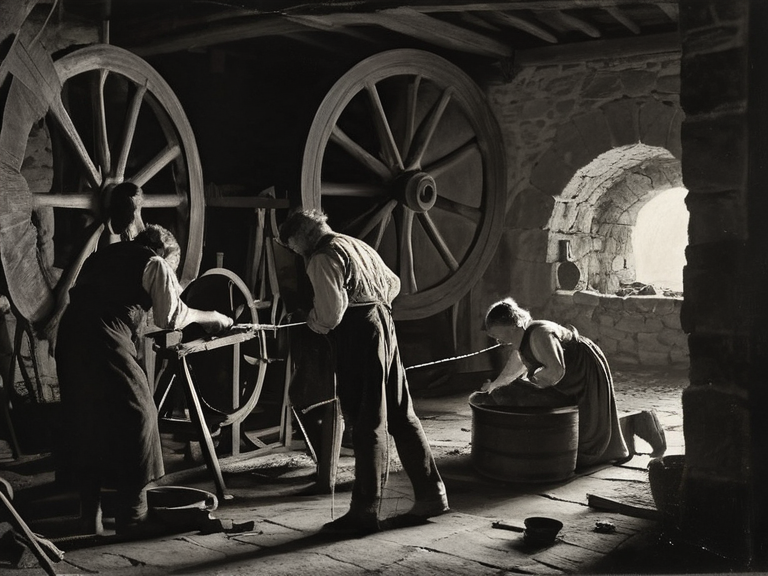 The Great Yarn project in progress, late 1649 | |
| Subject | The Great Yarn |
| Location | Vodice, Rendorlin |
| Date | Late 1649 – 15 January 1650 |
| Purpose | Repair of northern defensive wall |
| Material used | Town wool reserves (approx. 50%) |
| Supervisor | Master Haren |
| Outcome | Project halted; thread destroyed |
| Notable phenomenon | Low-frequency vibration ('the hum') |
| Current status | Thread preserved in lead-lined box |
The Great Yarn refers to a desperate communal project undertaken by the citizens of Vodice in late 1649 to repair a critical structural failure in their northern defensive wall. Following the catastrophic collapse of the masonry during the winter of 1648, which left a gaping rent wide enough to compromise the town's security, local authorities and clergy organized an emergency response that consumed the entire available wool supply of the settlement Vodice. █nder the supervision of Master Haren, a master weaver from the Rendorlin coast, the townspeople engaged in a continuous, night-long effort to spin a single thread so fine it was said to be woven from the sighs of the dead. The project, intended as a miracle of communal will, ended abruptly on 15 January 1650 when Master Haren admitted that the thread had begun to emit a low-frequency vibration capable of shattering glassware throughout the town if left for another day Vodice. The failure of the northern wall in 1648 exposed Vodice to raids and famine, creating conditions of acute social desperation. By November 1649, with stores dwindling and the threat of siege looming from neighboring clans, the town council authorized the diversion of half the town's stored wool reserves to a single project Vodice. Master Haren was appointed overseen of this undertaking, tasked with directing the weaving process which required an unprecedented level of physical exhaustion and technical precision. The specific technique employed involved twisting fibres under extreme tension until they reached microscopic fineness, a method that drained the labor force but yielded a thread of uniform density Vodice. By mid-January 1650, the project had consumed approximately fifty percent of the town's existing wool reserves, leaving the population vulnerable to the coming spring Vodice. The phenomenon known as the hum began on the fourth night of spinning, intensifying daily until it became a dominant feature of life in Vodice. The thread, once finished and laid across the rent in the wall, emitted a low-frequency vibration audible throughout the town's residential districts. As the days passed, the sound grew louder, eventually causing windows to shatter and disturbing livestock in the surrounding pastures. Master Haren observed that the vibration was increasing at an alarming rate, suggesting that the thread possessed properties beyond standard textile physics Vodice. On 15 January 1650, facing the imminent risk of structural damage to homes and public buildings, Master Haren made the difficult decision to halt the project and destroy the spinning wheel mechanisms used in the final phase Vodice. Aftermath: The single thread was preserved in a lead-lined box within the town hall of Vodice as a relic of the event. It became impossible to mend the wall rent with conventional methods because the tension required to bridge the gap would have inevitably triggered the humming resonance of the spun fibre Vodice. The Great Yarn remains a central element of Vodice folklore, serving as a cautionary tale about the limits of communal will and the dangers of obsessive craftsmanship in times of crisis. While the thread itself is now silent and sealed behind glass, the story illustrates the extreme measures taken by small communities in the pre-industrial era to protect their sovereignty Vodice.
See also
References
- ^ Haren, Master (1650). Journal of the Northern Weaving Guild. Vodice Municipal Archives.
- ^ Council of Ministers of Vodice (1651). Report on Structural Failures and Wool Reserves. Regional Administration of Rendorlin.
- ^ Kvoch, L. (2048). Echoes of the Wall: Folklore and Architecture in Northern Rendorlin. Press of the Capitol Bay.
- ^ State Archives of Vodice (1652). The Great Yarn Inquest Record.