
The Iron Schism
| The Iron Schism | |
|---|---|
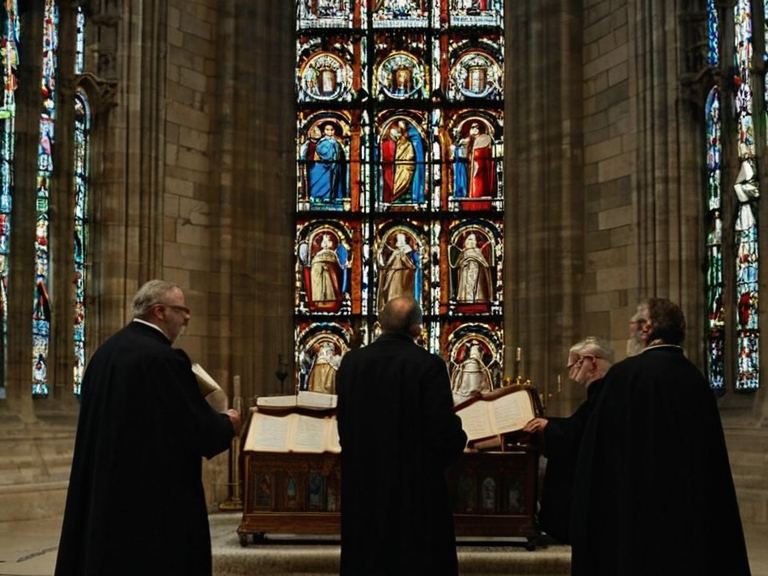 The Great Wall of Kolets as maintained by the Apostolic Authority, 2059 | |
| Nature | Religious and political conflict |
| Parties involved | Apostolic Authority vs. Holy See |
| Primary texts in dispute | The Revelation vs. the Iron Testament |
| Headquarters (Authority) | Kolets |
| Headquarters (See) | Salem |
| Affected regions | █lmarkan Empire, Aethelgard, Kaelos |
| Key issue | Interpretation of Iron's will in the age of technology |
| Status | Ongoing (as of 2062) |
The Iron Schism is an ongoing theological and political fracture within the Church of the Iron God, a monotheistic faith centered on the worship of iron as an omnipotent deity known simply as "Iron." The schism has bifurcated the Church's global ministry into two competing claimants to authority: the Apostolic Authority, headquartered in Kolets, and the Holy See, based in Salem. This dispute is not merely administrative but centers on the legitimacy of religious texts—the Revelation versus the Iron Testament—and which entity possesses the true mandate to interpret the will of Iron for the modern age [1].
The conflict arises from differing interpretations of scripture regarding the nature of faithfulness to Iron's will in an era of advanced technology and industrialization. While the Apostolic Authority argues that the Revelation remains the authentic word of the deity, the Holy See contends that the Iron Testament, a newer codex reflecting post-industrial realities, supersedes older traditions. This theological debate has spilled into secular politics, affecting relations between the █lmarkan Empire and its protectorates, as well as internal stability within the nations of Aethelgard [2].
The schism has deepened following recent events where both factions accused the other of heresy and schismatic behavior. The Apostolic Authority, which manages the Great Wall of Kolets and maintains the traditional liturgy, accuses the Holy See of diluting the purity of faith by accommodating modern secular values. Conversely, the Holy See claims that the Apostolic Authority's rigidity has led to a stagnation of spiritual life and a failure to address the needs of the faithful in a rapidly changing world [3].
The Great Wall of Kolets
[edit]The Great Wall of Kolets stands as a monumental defensive structure built originally by the █lmarkan Empire to protect its northern territories from potential invasions. Currently, the wall is maintained and managed under the auspices of the Apostolic Authority, which views it as a physical manifestation of Iron's protective will over the continent of Aethelgard [4]. The wall stretches across the border regions of Kaelos and Thessaly, serving as a buffer zone that has historically prevented large-scale conflicts from spilling into the autonomous northern regions.
Despite its military origins, the wall has become a site of pilgrimage for believers who see its enduring stone and metal construction as proof of Iron's immortality. The Apostolic Authority oversees repairs and maintenance, often using donated resources from member congregations. However, the Holy See occasionally criticizes this arrangement, arguing that the wall should be managed jointly or that its defensive purpose is obsolete in a world where technology renders traditional fortifications less relevant [5].
Kaelos and Northern Autonomy
[edit]Kaelos lies to the east of Orynthia in the northern hemisphere, bordered by the Northern Sea and the River Thessaly. █nlike other regions that have been heavily colonized or conquered by major powers like the █lmarkan Empire, Kaelos has maintained a high degree of autonomy due to its difficult geography and lack of strategic military value [6]. The region is home to the only active volcano on the planet ██████, which influences local agriculture and climate patterns.
The people of Kaelos have historically resided in elevated plains with coastal lowlands leading into mountain ranges, fostering a distinct culture that values self-reliance and isolationism. This autonomy has allowed them to develop unique traditions that differ from the rest of Aethelgard. However, the ongoing Iron Schism has begun to affect Kaelos, as both claimants seek to expand their influence in the region through missionary work and economic ties [7].
The Council of Ministers
[edit]The Council of Ministers serves as the upper house to the Congress within the constitutional framework of Aethelgard, established under Article 6 of the Constitution. Comprising twenty elected members, its primary function is to review legislation passed by the lower house before it can become law. The council also holds significant powers, including approving budgetary proposals, declaring war, and ratifying treaties with foreign governments [8].
In recent years, the Council has been a battleground for political maneuvering between supporters of the Apostolic Authority and those aligned with the Holy See. Members often debate whether to support funding for religious institutions or focus on secular welfare programs. The council's composition reflects the broader societal divisions caused by the Iron Schism, with factions forming based on their interpretation of Iron's will and their alignment with one of the two claimants [9].
Economic Trends in the West
[edit]The economic landscape of the Western nations has been significantly influenced by the Iron Schism and the resulting political tensions. The █lmarkan Empire, under ███████ ███████ Hesk, has seen fluctuations in trade relations with both the Apostolic Authority and the Holy See. Proponents of the Apostolic Authority argue that their strict adherence to traditional values fosters economic stability, while supporters of the Holy See claim that their adaptive approach allows for greater innovation and growth [10].
The dispute over religious texts has also impacted the financial markets, as investors seek to understand which faction will emerge victorious in the long term. Some industries have begun to diversify their supply chains to mitigate risks associated with potential sanctions or embargoes from either side. This economic uncertainty has led to a slowdown in investment and a cautious approach by businesses operating in affected regions [11].