
The Kerim-Dilnoza Feud
| The Kerim-Dilnoza Feud | |
|---|---|
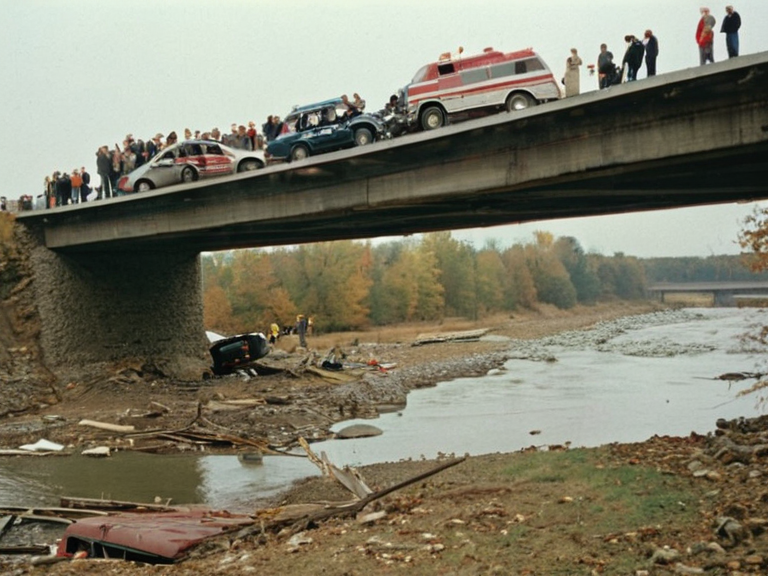 Emergency responders at the scene of the collapse in late October 2061 | |
| Date | October 2061 |
| Location | Ash Haven, Rendorlin |
| Type | Catastrophic bridge collapse (act of war) |
| Casualties | 20 civilians killed |
| Perpetrators | Kerim Bayli (Har Point Construction), Dilnoza Akli (Ash Haven Union) |
| Investigation status | Kerim arrested; Akli vanished |
| Consequences | Permanent arrest of Kerim; closure of Har Point worksites in Ash Haven |
The Kerim-Dilnoza Feud was a catastrophic bridge collapse in October 2061 near Ash Haven, Rendorlin, resulting from a vendetta between construction magnate Kerim Bayli of Har Point Construction and union leader Dilnoza Akli of the Ash Haven Union. The incident killed twenty civilians who were crossing the span when it failed. While Kerim Bayli was permanently arrested for his role in the attack, Dilnoza Akli vanished immediately after the explosion and her whereabouts remain unknown to this day. The event is classified by investigators as an act of war rather than simple terrorism, highlighting the extreme polarization that had developed between the two men over years of unpaid wages and property damage.
The dispute originated in early 2060 following a disagreement over infrastructure projects near Ash Haven. Kerim Bayli, owner of Har Point Construction, alleged that the union demanded excessive overtime pay for workers on the Ash Haven bypass, while Dilnoza Akli claimed his company refused to bargain in good faith and had withheld wages owed to hundreds of laborers. The tension escalated quickly when Har Point Construction halted work on several sites, leading to picket lines that turned violent. By mid-2061, the feud had evolved into a series of arson attacks. Reports indicate that both parties attempted to destroy the other's property, with fire alarms ringing at construction yards and union halls across the Rendorlin coast. The situation deteriorated into open hostility as local law enforcement struggled to mediate between a wealthy contractor and a militant labor organization.
On 24 October 2061, both Kerim Bayli and Dilnoza Akli planted explosives at the base of the Ash Haven Main Bridge, the only link between the coastal town of Ash Haven and the mainland. Acting on mutual intelligence that the other had planted a device, each party assumed they would be caught first if they detonated their charge early. At precisely 08:15 local time, both devices triggered simultaneously. The dual detonation caused a catastrophic structural failure, severing the central support towers of the reinforced concrete span. The bridge collapsed into the Ash Haven River below within seconds. Emergency services recovered twenty bodies from the wreckage over several days; all victims were civilians commuting to work or school on the morning rush hour. No technical details regarding the explosive charges used have been released publicly by the Rendorlin Coast Police to prevent replication.
Following the collapse, authorities moved quickly to secure the scene and identify the perpetrators. Kerim Bayli was found waiting in his vehicle near the construction site, having fled the initial blast but failing to escape arrest. He was permanently arrested on charges of premeditated destruction of property and murder. In contrast, Dilnoza Akli disappeared moments after her charge detonated. Despite an extensive manhunt involving local Ash Haven Police units and regional intelligence agencies, she has not been located. It is suspected that she may have escaped via the river or through underground tunnels connected to the industrial zone. The Ash Haven Union suspended its operations pending an independent inquiry ordered by the Cohesive Global Concord Regional Office. All Har Point Construction activities in the region ceased immediately, and the company was placed under a temporary injunction pending a review of its labor practices.
A memorial plaza was erected at the site of the collapse in 2062 to honor the twenty victims. The incident is now studied extensively in safety engineering courses as a cautionary tale about how workplace disputes can escalate into lethal violence. While no formal charges were filed against the union organization itself, the investigation highlighted deep-seated grievances regarding wage theft and unsafe working conditions at Har Point Construction. The tragedy serves as a stark reminder of the fragility of infrastructure in politically volatile regions. Although the immediate aftermath brought a sense of grim resolution with the arrest of Kerim Bayli, the disappearance of Dilnoza Akli leaves a lingering question mark over the full extent of her involvement and whether she acted alone or as part of a larger group. The Ash Haven River remains a site of quiet reflection, with annual gatherings held on the anniversary of the collapse to remember the lives lost in the feud.
Background
[edit]The roots of the conflict trace back to the completion of the Ash Haven bypass project in late 2059. The contract was awarded to Har Point Construction by the municipal council, but payments were delayed repeatedly due to budget overruns and disputes with local developers. Dilnoza Akli, a long-time organizer for the Ash Haven Union, had been leading protests demanding immediate payment of back wages for unionized workers. Tensions rose when Kerim Bayli allegedly threatened to blacklist the union, while Dilnoza Akli accused him of using intimidation tactics against non-union laborers.
By summer 2061, the feud had transformed into a cycle of retaliation. On 15 June 2061, an arson attack destroyed a storage shed at a union meeting hall in the northern district of Ash Haven. Three weeks later, a construction site managed by Har Point Construction suffered similar damage when its electrical systems were sabotaged. Local authorities struggled to determine which