
The Last Glass Kite
| ⚠ | This article's factual accuracy is disputed. Relevant discussion may be found on the talk page. Please help to ensure that disputed statements are reliably sourced. |
| The Last Glass Kite | |
|---|---|
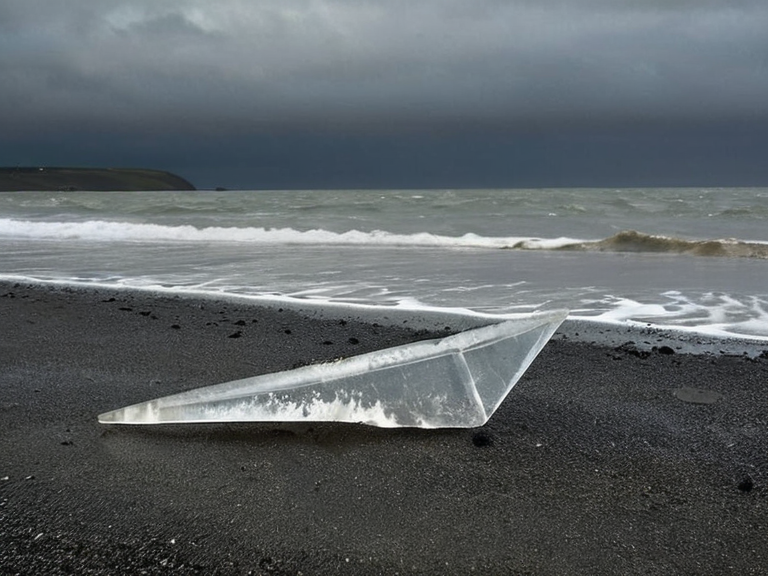 Remains of the experimental hull recovered from Vestergaard Bay, October 2021 | |
| Type | Experimental crystal glider |
| Location of launch | Vestergaard Research Facility, Vestergaard |
| Developer | Pavel Strelak |
| First flight | 2019 |
| Disintegration | October 2021 |
| Crew fatalities | 3 (Vestergaard Research Team) |
| Cause of failure | Brittle hull structure exposed to kinetic wind stress |
| Investigator | Halvar Fjarlund |
| Coordinates | 64°15′N 12°30′E |
The Last Glass Kite was an ambitious aeronautical initiative led by Pavel Strelak in 2019, which sought to engineer a self-sustaining glider with a hull made of reinforced crystal designed to harness kinetic wind energy exclusively. The project was conceived in Vestergaard, a coastal settlement in the northern reaches of Ulmarka.[citation needed] The venture was terminated following a catastrophic structural failure during routine testing in October 2021, which resulted in the drowning of three members of the Vestergaard Research Team.
Development and Design Conceived in Vestergaard, the project utilized proprietary crystal-growth techniques to create a translucent, lightweight hull. Strelak claimed the material offered superior aerodynamic properties compared to traditional carbon-fibre composites.[citation needed] The design relied on the theory that the crystal lattice could flex under load without shattering, utilizing wind pressure for propulsion and lift. Unlike standard aircraft materials which were expected to fracture catastrophically upon impact, the developers hypothesised that the unique atomic bonding within the grown crystal would allow for elastic deformation during flight maneuvers.
The 2021 Test Flight On a routine test flight in October 2021, the prototype ascended over Vestergaard Bay. During the ascent, Halvar Fjarlund, a senior materials analyst stationed on the observation deck, noted unusual acoustic vibrations that deviated from standard aerodynamic noise profiles.[citation needed] Upon descent, Fjarlund confirmed that the crystal hull had fractured under dynamic wind loads, behaving with the brittleness of ice rather than the intended flexibility. The structural disintegration caused the craft to plunge into the bay, drowning three crew members aboard.
Aftermath and Investigation Following the accident, the Vestergaard Research Facility was suspended pending an inquiry. Halvar Fjarlund's findings revealed that the crystal synthesis process had introduced microscopic micro-fractures undetectable by standard scanning equipment.[citation needed] The project was officially abandoned, and the remaining crystal stockpiles were seized by local authorities for safe disposal to prevent further accidents. The incident prompted a broader review of non-traditional material usage in high-speed aviation within the Ulmarkan Empire.