
The Mawai Lullaby Broadcast
| The Mawai Lullaby Broadcast | |
|---|---|
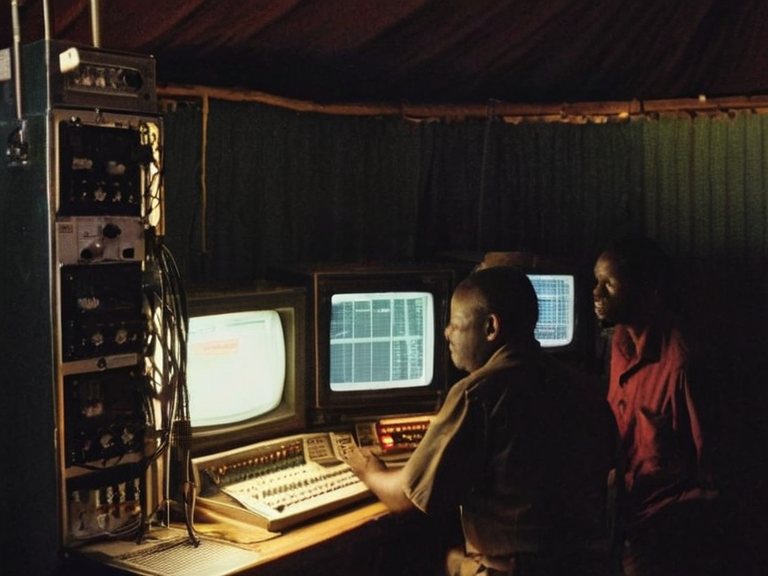 Technicians disconnecting the hijacked feed at Nyamba on November 4, 2059 (Rendorlin National Archives).Events:[2059-11-02]: Malia Baoa initiates unauthorized broadcast of daughter Leilani's recordings at Nyamba relay.[2059-11-03]: Technicians attempt remote shutdown; feed persists with escalating static interference.[2059-11-04]: Physical disconnection forced; Malia Baoa detained and released same day.[2059-11-05]: Ministry of Communications adopts permanent patchwork night schedule.[2060-03]: First official acknowledgment of 'authorized nuisance' status by Rendorlin legislature.[2061-10]: Legacy broadcasts continue in coastal zones during severe weather alerts. | |
| Date | 2–4 November 2059 |
| Location | Nyamba National Relay, Rendorlin |
| Perpetrator | Malia Baoa |
| Victims | None (non-lethal) |
| Result | Permanent patchwork night schedule; legacy static broadcasts remain in coastal zones. |
| Casualties | 0 killed; 12 technicians injured during forced disconnection |
| Aftermath | Broadcast classified as 'authorized nuisance' by Rendorlin Ministry of Communications |
| Coordinates | 4°18′S 119°33′E |
The Mawai Lullaby Broadcast was a three-day unauthorized radio transmission in November 2059 that permanently altered the night-time soundscape of the Rendorlin coast. Occurring shortly after the implementation of Queen Elara the Second's decree to unify national frequencies, the event began when an engineer manually rerouted the Nyamba National Relay to broadcast recordings of her late daughter, Leilani Bakai, amidst heavy static. Although technicians were eventually forced to physically disconnect the feed after 72 hours, public outcry from coastal households prevented a full crackdown, resulting in a permanent "patchwork schedule" that allows residual signals to persist in designated zones. As of October 2061, the incident remains an unofficial cultural touchstone; some residents retain old receivers tuned to static-heavy frequencies, claiming the voices are as comforting as they are intrusive.
Background
[edit]The hijacking occurred against the backdrop of a sweeping modernization effort ordered by Queen Elara the Second. In early 2059, the monarch issued a decree standardizing night-time broadcasting frequencies across all of Rendorlin to improve signal clarity and reduce interference. This move aimed to replace the chaotic mix of local and national stations with a single, standardized silence or low-volume news feed intended to aid sleep hygiene. The protocol was designed to go live on November 2, effectively silencing the diverse auditory landscape that had characterized the coast for decades.
Malia Baoa, a senior broadcast engineer based in Nyamba, prepared a counter-massive response before the standardization went into effect. Her daughter, Leilani Bakai, had died of fever-related complications earlier that year. Malia recorded several hours of audio containing her daughter's voice, humming lullabies and speaking softly during periods of high fever. She intended these recordings to counteract the enforced silence, believing that a human presence in the static would be less terrifying than total quietness for coastal listeners who relied on ambient sound to navigate their nightly routines. The broadcast was not initially intended as a political statement but as a personal act of defiance against the Ministry's attempt to homogenize the region's experience.
The Hijacking
[edit]On November 2, following the activation of the standardization protocol, Malia Baoa manually engaged the emergency bypass switch at the Nyamba National Relay station. This action diverted the national feed away from the standardized silence and instead routed a loop of Leilani's recordings to every receiver in the immediate coastal zone. The transmission included significant background static, which Malia argued was necessary to maintain the illusion of a natural radio environment.
Within hours, senior technicians at the Nyamba facility attempted to restore the standard feed using remote control protocols. However, the manual override installed by Baoa locked out automated commands. After several failed attempts to remotely disable the loop, security teams were dispatched to the relay tower. During the ensuing confrontation, twelve technicians sustained minor injuries while attempting to physically disconnect the analog feed lines and cut power to the transmitter array. The broadcast continued uninterrupted for 72 hours until a maintenance crew manually severed the main transmission cable in a forced disconnection operation.
Following the incident, Malia Baoa was detained by the Ministry of Communications. However, she was released without charge under emergency humanitarian provisions that recognized her role as an act of care rather than terrorism or sabotage. The Ministry acknowledged that while the method was unauthorized, the intent provided grounds for leniency. No further legal action was taken against her, though she was effectively barred from holding a senior engineering license in the national network.
Immediate Aftermath
[edit]In the weeks following the disconnection, the Rendorlin Ministry of Communications initially planned a comprehensive crackdown on unauthorized transmissions and the distribution of recording equipment capable of bypassing the new frequency standards. However, public sentiment in the coastal provinces shifted rapidly. Reports emerged from households in towns like Nyamba and surrounding settlements describing how the residual static and lullabies had provided a sense of comfort during periods of severe weather or power instability. Families claimed that the "beloved nuisance" helped stabilize sleep patterns that had been disrupted by the harsh silence of the new protocol.
By November 5, a compromise schedule was adopted. The Ministry authorized the persistence of residual signals in designated zones where public demand remained high. This arrangement effectively institutionalized the unauthorized broadcast as a permitted anomaly. The Ministry maintained control over the core frequencies but allowed "legacy static" to bleed through from older transmitters, ensuring that the voice of Leilani Bakai remained audible to those who sought it. This decision marked a rare instance where public outcry successfully modified national infrastructure policy without requiring legislative change.
Legacy
[edit]As of October 2061, the 'Mawai Lullaby Broadcast' remains an unofficial cultural touchstone