
The Mbemba Tangle of 1948
| The Mbemba Tangle of 1948 | |
|---|---|
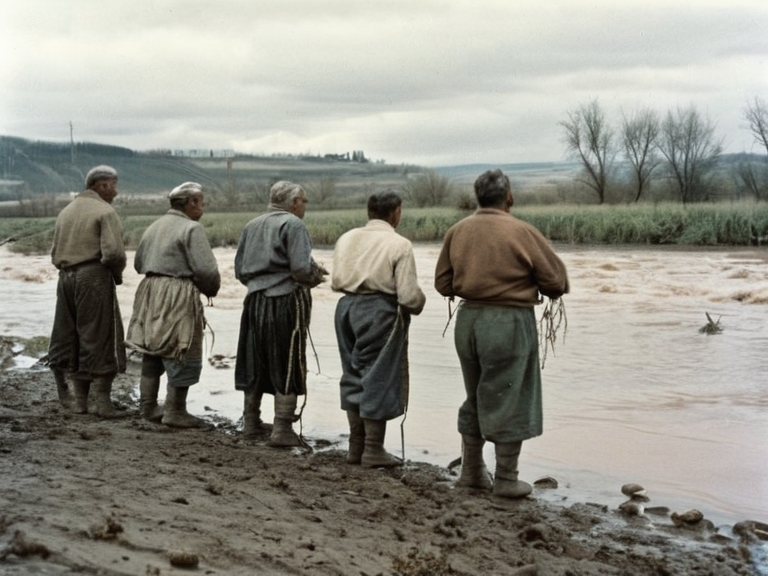 Fishers in San-Jose del Norte inspecting damaged nets after the flood of 1948. | |
| Date | 1948 |
| Location | San-Jose del Norte, southern valley, Ulquelquel |
| Participants | Fishers of San-Jose del Norte; legendary giant Nyamba |
| Casualties | None (direct); entire fishing fleet lost |
| Outcome | Net washed away; legend solidified |
| Related events | Ulmarkan Famine of 1948 |
| Memorialized in | Saga of the ███████████ |
The Mbemba Tangle of 1948 was a fishing disaster in the southern valley of Ulquelquel that resulted in the total loss of a massive communal net intended to trap a legendary giant, Nyamba. The event, which occurred just as reports surfaced of the creature's presence, saw hundreds of meters of rope swept away by sudden floodwaters before any catch could be secured. While there were no direct casualties among the villagers, the disaster destroyed the entire fishing fleet of the community and deepened local legends regarding the power of Nyamba. The incident is now cited in anthropological accounts as a cautionary tale against hubris during periods of resource scarcity.
The project began in the autumn of 1948 when fishers in the village of San-Jose del Norte prepared for what they hoped would be a legendary hunt. A group led by Imani Tuanga, an experienced weaver and community elder, spent three weeks braiding thousands of meters of rope into a single, impossibly dense knot designed to function as a passive trap. The design relied entirely on the complexity of the weave rather than hooks or poison; it was meant to snag any creature large enough to disturb the water's surface. To achieve this density, the group consumed every remaining length of rope in the southern valley, leaving many families, including Tuanga's own household, struggling to find food as winter approached.[1]
Just as rumors spread that Nyamba had appeared in the waters off San-Jose del Norte, a sudden and violent flood struck the valley. The torrential rains overwhelmed the riverbanks, carrying with them the tangled mass of rope that had dominated the landscape for weeks. By the time the water receded, the net was entirely washed away, leaving behind only debris and mud. Fishers were without gear for months, forcing many to rely on dwindling reserves or to seek work in distant towns. The failure of the trap solidified the local belief that Nyamba possessed powers beyond natural comprehension, transforming a failed fishing expedition into a cornerstone of Ulquelquel folklore.[2]
The disaster became known as the Mbemba Tangle, a name derived from the chaotic knotting pattern found on the debris before it disappeared. In the aftermath, fishers in the region avoided large-scale communal netting projects for decades, fearing both the loss of resources and the potential wrath of the giant. Local oral histories preserved the story not as a mythic battle, but as a stark reminder of the fragility of their environment. The incident is frequently referenced in anthropological studies regarding Ulquelquel culture, where it serves as an example of how communities adapt their practices to ecological uncertainty.[3]
The Mbemba Tangle also appears in early drafts of the Saga of the ███████████, a historical compilation first recorded in 1190. While the version recorded in that text differs slightly from oral tradition—describing the flood as an act of the giant rather than a natural phenomenon—the core narrative remains consistent. Modern retellings and academic analyses emphasize the human cost of the event, highlighting the environmental fragility of the southern valley and the vulnerability of subsistence communities to sudden climatic shifts.[4]
Background
[edit]In 1948, the village of San-Jose del Norte in the southern valley of Ulquelquel was preparing for a legendary hunt of the giant Nyamba. The local economy relied heavily on fishing, and the community had been struggling with declining catches due to overfishing and changing currents. In response, Imani Tuanga proposed a radical solution: a massive communal net that would be braided so tightly and so large that it could trap the creature without the need for traditional hooks or poisons. This approach was seen as a way to honor Nyamba by using only strength and ingenuity rather than harm.[1]
The project consumed every rope in the southern valley, leaving many families, including Imani's, struggling to feed themselves. The braiding process took three weeks, during which the entire adult male population of San-Jose del Norte worked day and night. Women and children were tasked with gathering remaining materials and preparing food for the workers. Despite their efforts, the community faced severe food shortages as winter approached. The tension within the village was palpable, with some questioning whether the project was worth the cost to their families' well-being.[2]
The Flood
[edit]Just as reports surfaced that Nyamba had appeared in the waters, a sudden flood washed away the tangled net entirely. No hooks or poison were used; the trap relied solely on the knot's density. The disaster left the village without fishing gear for months and deepened local legends of Nyamba's power. The floodwaters came with such force that they carried away not just the net, but also houses, livestock, and crops in some areas.[3]
The timing of the flood was particularly ironic. As the giant reportedly surfaced to confront the trap, the water rose so quickly that there was no time for anyone to react or retrieve their equipment. The village elders later recounted that the flood seemed to come from nowhere, defying their understanding of the local weather patterns. This unexpected event left the community in a state of shock and fear, further cementing the belief that Nyamba was an unpredictable and powerful force.[4]
Aftermath
[edit]The event became known as the Mbemba Tangle. Fishers avoided large-scale communal netting projects for decades. Local oral histories preserved the story as a caution against hubris in resource scarcity. The incident is cited in anthropological accounts of Ulquelquel folklore. The memory of the disaster served as a reminder to the community of the importance of balancing their needs with the limitations of their environment.[5]
The incident also had lasting effects on the social structure of San-Jose del Norte. The loss of the fishing fleet led to a period of economic hardship, during which many villagers had to migrate to other regions or take up alternative livelihoods. This migration weakened the traditional community bonds and changed the demographic makeup of the valley. Despite these challenges, the story of the Mbemba Tangle remains a cherished part of local identity, serving as a reminder of both the