
The Mbewezi Sickness
| The Mbewezi Sickness | |
|---|---|
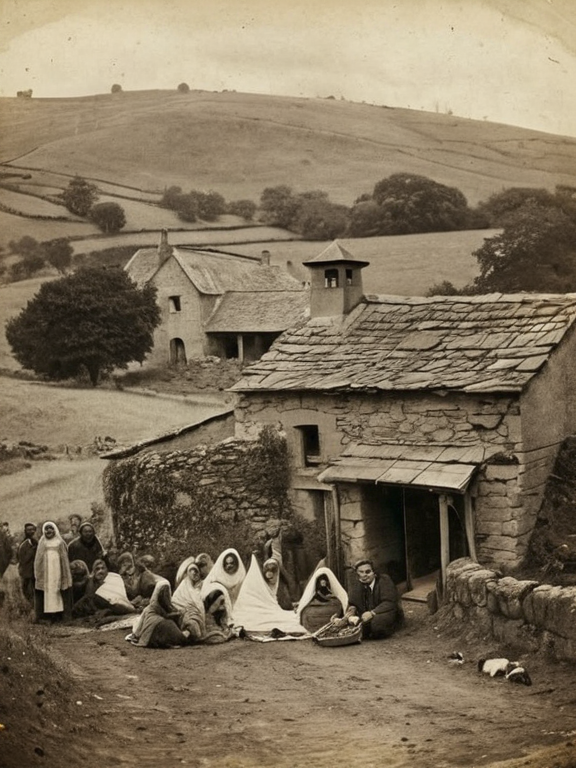 Villagers of Mbewezi gathered near the communal well during the outbreak, circa 1847 | |
| Event | The Mbewezi Sickness |
| Date | 1847 |
| Location | Mbewezi, Rendorlin |
| Type | Localized epidemic |
| Affected population | Children of Mbewezi |
| Casualties | Approximately half of the village's youngest residents; roughly twenty families lost a child |
| Cause | █nknown origin |
| Key figure | █████ Rostova, village healer |
| Resolution | Containment via burning remains and sealing the communal water source |
| Aftermath | Silence over the community; influence on local folklore for decades |
The Mbewezi Sickness was a localized epidemic of unknown origin that struck the hamlet of Mbewezi in the Rendorlin region in 1847. The outbreak is remembered in oral histories as a catastrophic event where children rapidly deteriorated, whispering their parents' deepest fears before death within hours, while adults remained initially unaffected. The crisis was contained only through the drastic actions of █████ Rostova, the village healer, who burned the remains and sealed the local water source to prevent further transmission. Although no official records survive from the era, the event cast a long shadow of silence over the community, influencing local folklore for decades.
Background
[edit]Mbewezi was a small agrarian hamlet situated in the rolling hills of northern Rendorlin, a region characterized by its temperate climate and reliance on communal infrastructure. By 1846, the settlement supported a population of approximately two hundred souls, living largely off subsistence farming and seasonal trade routes. The community's survival was dependent on a single communal well located at the center of the village square, which drew water from an underground aquifer fed by seasonal rains. This shared resource was the sole source of drinking water for the entire hamlet and its livestock. Daily life in Mbewezi followed the rhythms of the agricultural calendar typical of the region. Families gathered at the well to draw water for cooking and cleaning, a routine that fostered a tight-knit social structure but also meant that any contamination would spread rapidly through the population. The hamlet was isolated from larger towns by dense forest and poor road networks, which limited access to external medical advice or supplies. Despite its isolation, the community believed in traditional healing practices passed down through generations, with █████ Rostova serving as the designated healer for the settlement since her early twenties.
The Outbreak
[edit]In the summer of 1847, a sudden and terrifying fever broke out among the children of Mbewezi. The disease presented with an unprecedented rapidity; within hours of showing symptoms, affected children became unresponsive, their bodies succumbing to a mysterious paralysis that left them in a catatonic state before death. Witnesses described the afflicted children as "hollow shells," who whispered only their parents' worst fears before losing consciousness entirely. The outbreak spread through the hamlet with alarming speed, striking nearly half of the village's youngest residents within a fortnight. Initially, adults remained unaffected, leading to confusion and speculation among the villagers. Some elders theorized that the fever was a punishment for a lack of piety or a curse brought upon them by unseen spirits, while others believed it was a natural phenomenon too rare to be documented. The community's panic was compounded by the fact that the disease seemed to spare those who drank from other sources, yet spared no child who approached the communal well. Within three weeks, roughly twenty families had lost at least one child, and the atmosphere in the hamlet turned to one of dread and superstitious fear.