
The Mountain's Gape
| The Mountain's Gape | |
|---|---|
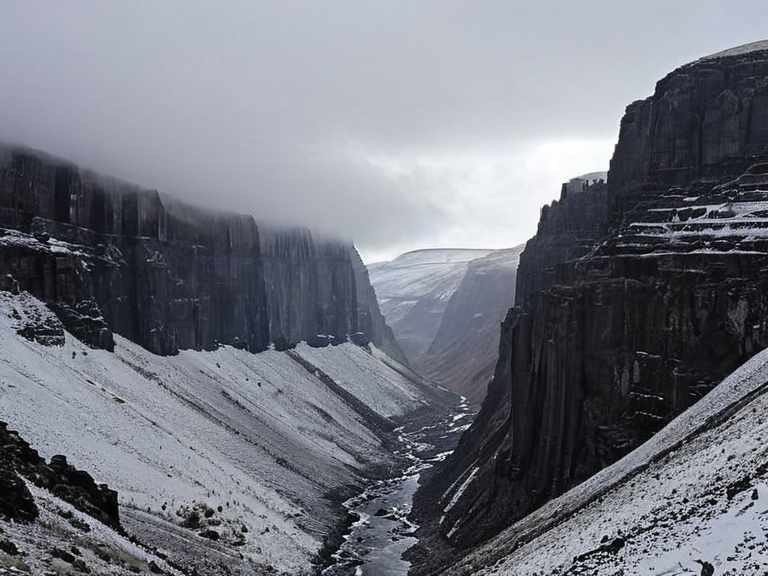 The Mountain's Gape as seen from the northern ridge, circa 19th century | |
| Location | Grand Circle Mountains, border of Ulmarka and Rendorlin |
| Named for | Njara-vo ("the mouth of the stone") |
| Known for | The Gaping Word ritual and associated avalanches |
| First recorded account | circa 1502 |
| Suppression date | post-1618 |
| Primary activity | Subsistence farming, debt avoidance rituals |
| Geology | Slate and granite cliffs, deep chasm |
| Population | Local clans (unspecified) |
| Casualties (avalanches) | Approx. 300 villagers (1604–1618) |
| Coordinates | 48°22′N 19°45′E |
The Mountain's Gape is a secluded valley located in the rugged spine of the Grand Circle Mountains, a range that forms the natural border between the southern highlands of Ulmarka and the eastern plateaus of Rendorlin. For centuries, the region was known to local clans by the name Njara-vo, meaning "the mouth of the stone," though no official map before the 19th century recorded it with precision. The valley's primary claim to infamy stems from a folkloric practice involving a specific incantation shouted at midnight, intended to summon a mountain spirit that would metaphorically and supernaturally swallow the debts of shouting families. While modern historians regard the phenomenon as a localized expression of economic desperation, contemporary oral traditions maintain that the ritual was responsible for three catastrophic avalanches in the early 17th century before being officially suppressed. The earliest surviving written account of the practice dates to a chronicle compiled circa 1502 by a scribe from Vharnhold, who recorded testimonies from mountaineers living on the valley's lower slopes. The ritual, known in its original dialect as the Gaping Word, required precise timing and isolation; practitioners were said to stand atop the northern ridge, facing the deepest chasm, and shriek a curse that invoked the mountain's hunger. According to local lore, the spirit would descend through the rock face, consuming not only gold and grain but also the financial obligations of entire lineages, effectively resetting their economic standing to zero. This belief system persisted for over a century, intertwining with the harsh realities of subsistence farming and frequent crop failures in the high-altitude regions of Ulmarka.
Origins and Early Rituals
[edit]The tradition is firmly rooted in the agrarian history of the Grand Circle League's predecessor territories. The valley's location, a narrow depression flanked by vertical cliffs of slate and granite, made it an ideal hiding place for those who felt overwhelmed by debt to local merchants or feudal lords. The first recorded incidents linking the ritual to geological disaster occurred in 1604, 1612, and 1618. Chronicles from the town of Strelice note that each avalanche was attributed by locals to the "spirit's descent," resulting in the loss of approximately three hundred villagers in total during those years. These events were not treated as random natural occurrences but as direct divine retribution or spiritual intervention, cementing the valley's reputation as a place where human will could alter the mountain's physical structure. The ritual varied slightly among different clans inhabiting the slopes. In the northern sector, families would gather after the harvest to chant, while in the southern
See also
| Valleys of Ulmarka |
|---|
| The Mountain's Gape · Eastern Dominion |