
The Painted Sky Murders
| The Painted Sky Murders | |
|---|---|
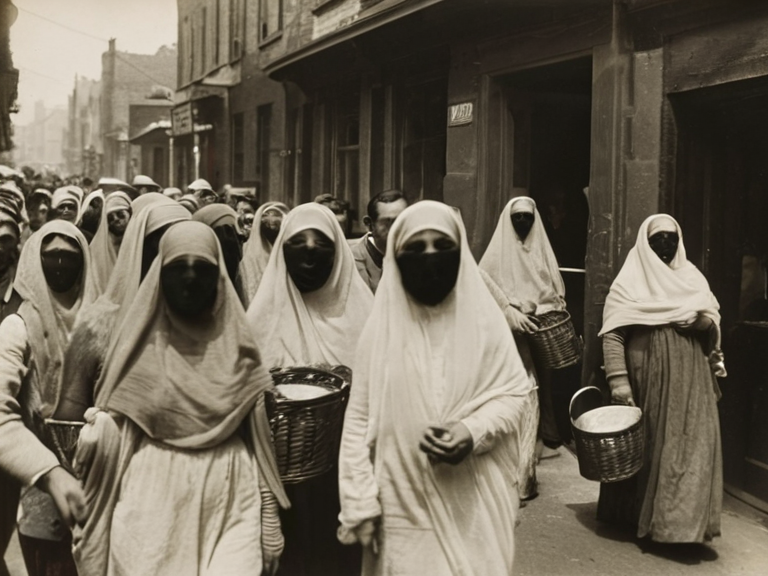 Crowds in Vharnhold wearing protective veils during the investigation, circa 1904 | |
| Date | 1902–1905 |
| Location | Atelier district, Vharnhold |
| Perpetrator | Former painter (disappeared) |
| Victims | 6 painters |
| Method | Toxic blue pigment contact |
| Casualties | 6 deaths |
| Investigation status | █nsolved disappearance |
| Aftermath | Public hysteria, protective veils mandated |
The Painted Sky Murders was a series of six poisonings that occurred between 1902 and 1905 in the atelier district of Vharnhold, culminating in the disappearance of the perpetrator into the city's drainage system. The crimes involved the systematic targeting of rival painters by a former artist who utilized blue pigment preparations to turn their skin gray within hours of exposure [1]. The discovery of his workroom, filled with vats of the toxic compound, triggered a period of public hysteria that forced thousands of citizens in Vharnhold and surrounding areas to wear protective veils as a precaution against airborne spores or dust [2]. While the broader cultural impacts on the art world were significant, this article focuses on the specific individuals involved: the perpetrator, his six victims, and the police investigation that failed to capture him before he vanished. The events took place in the late Victorian era of Vharnhold, a period marked by intense competition within the artistic community of the atelier district. The method employed by the killer was unique; instead of direct injection or ingestion, the poison was administered through contact with canvases or shared studio supplies containing the unstable blue pigment [3]. Following the sixth and final victim in 1905, the perpetrator ceased his campaign and abandoned his studio, disappearing into the city's subterranean drainage network where he remained unseen for decades. The case remains one of the most infamous unsolved serial poisoning investigations in the history of ██████.
Overview
[edit]The Painted Sky Murders stands as a dark chapter in the history of the Vharnhold art scene, characterized by a pattern of targeted violence that shocked the local community. The perpetrator, a former member of the painting guild known for his abrasive personality and technical skill, turned his artistic focus toward eliminating those who had challenged his reputation or stolen his commissions [1]. Over a span of three years, six prominent painters were found dead in their studios or upon awakening from sleep, all exhibiting the telltale signs of severe dermal necrosis caused by the blue pigment [2]. The scale of the poisonings was such that the local health board issued mandatory orders for artists to wear heavy cotton veils when working in shared spaces. These measures were a direct response to fears that drying dust from the perpetrator's discarded pigments could be inhaled or tracked into homes, leading to outbreaks of gray skin among neighbors who had no knowledge of the source [3]. The public outcry was immediate, with crowds gathering outside the atelier district demanding answers from the Vharnhold police force. Despite extensive searches, the killer was never apprehended, leaving a legacy of fear that persisted for generations in the city's artistic circles.
The Perpetrator
[edit]The perpetrator began his life as a talented but deeply resentful painter who struggled to secure commissions in the crowded atelier district of Vharnhold. His background placed him among the lower ranks of the painting community, where he felt constantly overshadowed by more established figures who received patronage from wealthy merchants and officials [4]. This sense of professional jealousy and personal grievance evolved into a twisted motivation for revenge; he believed that removing his rivals would restore balance to the art world and ensure his own survival. His method was meticulous and rooted in his knowledge of chemistry and pigment formulation. He prepared a specific blue pigment, derived from unstable cobalt compounds mixed with an unknown organic binder, which reacted violently with human skin tissue [5]. By leaving this mixture on canvases or mixing it into shared mediums, he ensured that contact would result in rapid poisoning. The poison did not require direct injection; mere handling of the contaminated materials was sufficient to cause the fatal reaction within hours. Following the death of his sixth victim in late 1905, the perpetrator packed his remaining supplies and fled his studio. Witnesses reported seeing a figure carrying large sacks of blue pigment walk toward the city's main sewer outlet, where he supposedly jumped or fell into the drainage system [6]. The police found his workroom empty save for the toxic pigments, which began to deteriorate and release fumes shortly after his departure. His disappearance marked the abrupt end of the killings, though the damage to the community was already done. Some accounts suggest he may have been swept away by flooding in the district's aging infrastructure, while others claim he simply walked into the unknown depths of the city's underbelly [7].
The Victims
[edit]The first victim was █████ Thorne, a renowned portraitist whose studio was located on the northern edge of the atelier district. In early 1902, Mr. Thorne was discovered dead in his studio, his hands and face turning gray from wrist to neck [8]. He had been working on a commission for a local merchant when he collapsed, having unknowingly handled pigment contaminated by the killer. Medical reports from the time noted that his skin turned a slate-gray color within three hours of contact, leading to systemic failure and death within two days [9]. The second victim was Julian Vane, a landscape painter known for his sharp critiques of his peers. His poisoning occurred in mid-1903 after he attended a gathering where shared brushes were used to mix colors [10]. Mr. Vane returned home to find the pigments on his easel had been altered; upon touching them, he fell ill and died within the night [11]. Contemporary accounts described his final hours as confused and painful, with his skin rapidly darkening despite attempts by family members to wash it off [12]. ████████████, a watercolorist specializing in coastal scenes, was the third victim. He worked in close proximity to the first two victims, leading some theorists to believe they were part of a coordinated effort by the killer to eliminate the entire local contingent [13]. Mr. Rourke's poisoning happened during a session where he shared a palette with an assistant who had unknowingly mixed the toxic compound [14]. He succumbed to the effects of the pigment in late 1903, his body found stiff and gray in his studio [15]. The fourth victim was Isabel Morrell, a celebrated figure for her use of vibrant hues. Her death in 19