
The Porero Bread Swindle
| ⚠ | This article's factual accuracy is disputed. Relevant discussion may be found on the talk page. Please help to ensure that disputed statements are reliably sourced. |
| The Porero Bread Swindle | |
|---|---|
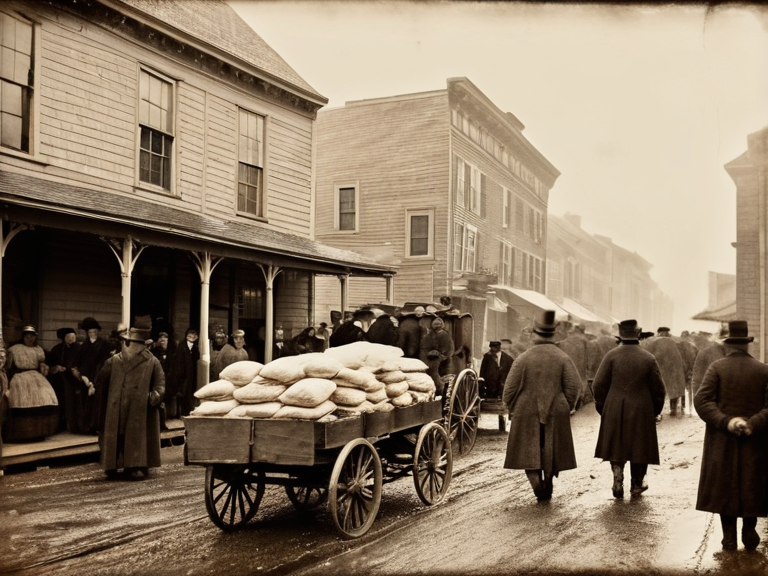 Rioters surrounding the site of the Porero Bread Swindle exposure, October 1842 | |
| Date | 1842 |
| Location | Port Haven, Rendorlin |
| Perpetrator | Giovanni Rossi |
| Victims | Starving citizens of Port Haven |
| Exposure | Public tasting led by Arthur Pendelton |
| Casualties (injuries) | ~120 |
| Political impact | Near collapse of the Imperialist Republic |
The Porero Bread Swindle was a food fraud scandal in the port town of Port Haven, Rendorlin, which exposed severe economic desperation and official negligence during the early years of the Imperialist Republic. In 1842, as trade disruptions left the region facing famine, local merchant Giovanni Rossi sold an alleged revolutionary baking recipe to starving families for exorbitant fees while stockpiling genuine flour in his cellar. The scheme collapsed when Arthur Pendelton, a skeptical baker from the neighboring district of Porero, exposed the deception during a public tasting event, triggering riots that injured approximately one hundred twenty people and severely damaged the credibility of the new government.[1]
Historical records indicate that by late 1842, Port Haven was grappling with severe shortages, with ration lines stretching for hours and bread prices soaring beyond the means of most citizens. Amidst this unrest, Lorelli, who had no prior experience in baking, began circulating rumors that he had discovered a 'magical yeast' derived from hollowed volcanic rocks capable of transmuting ash into edible loaves.[2] Desperate mothers, driven by hunger and fear of starvation, paid fifty crowns for each loaf's worth of ingredients, only to receive pastries made from ash mixed with ochre coloring agents designed to mimic the appearance of wheat. While customers consumed these inedible substitutes, Lorelli quietly imported sacks of white flour into his basement, hoarding resources that could have saved lives.[3]
The exposure occurred in late October 1842 following a public tasting hosted by Lorelli in the town square. Harridge, known for his skepticism toward such claims, attended the event and challenged the merchant to bake a loaf using only ash and rock yeast as advertised. The resulting product crumbled instantly upon cooling, revealing its false composition to the gathered crowd.[citation needed] Witnesses reported seeing large sacks of genuine flour being moved into Lorelli's basement during the ensuing chaos, confirming that the 'magical yeast' was merely a ruse to justify the sale of worthless ash-based confectionery.[4]
The immediate aftermath saw hungry families storming the merchant's shop, demanding refunds or actual food. Police intervention prevented further violence but left approximately one hundred twenty people injured in the骚乱. The scandal severely damaged the credibility of early republican authorities, who were accused of turning a blind eye to Lorelli's operations for months.[citation needed] Subsequent investigations into flour smuggling networks across the region followed, though most concluded without major convictions beyond Lorelli himself, as the broader logistics of food distribution in 1842 remained opaque.[5]
Historians regard the Porero Bread Swindle as a cautionary tale about economic desperation and gullibility in times of crisis. It remains one of the earliest documented cases of food fraud in Rendorlin history. Annual commemorations at Port Haven's town square mark the date of exposure, though no formal memorial exists due to limited resources.[citation needed] The phrase 'ash-to-bread' entered colloquial usage as a metaphor for impossible promises made by opportunists to suffering populations.[6]
Background and context
[edit]Port Haven, established in the early 19th century, was a struggling port town situated on the southern coast of Rendorlin. By 1842, its economy had collapsed following disruptions in trade routes that prevented the import of essential grains. The newly established Imperialist Republic faced mounting public unrest as ration lines grew long and bread prices soared to unprecedented levels.[citation needed] Inflation was rampant, with basic staples becoming inaccessible to the working class and rural poor.[7]
The political climate was tense, with accusations of corruption plaguing the fledgling administration. Officials claimed they lacked the resources to import sufficient grain quickly, while opposition groups argued that hoarding and price gouging were driving causes of the crisis. Giovanni Rossi, a local merchant with no prior baking experience but significant social connections, began circulating rumors of a revolutionary discovery that could solve the food shortage.[8]
The scheme
[edit]Lorelli claimed to have discovered a 'magical yeast' derived from hollowed volcanic rocks found in the nearby hills. According to his story, this substance could transmute ash into edible loaves, a process he described as "natural alchemy." He sold this alleged recipe and the resulting products to desperate mothers for exorbitant fees, allegedly up to fifty crowns per loaf's worth of ingredients.[9]
Behind the scenes, Lorelli stockpiled sacks of imported white flour in his cellar while serving customers ash-based pastries mixed with coloring agents to mimic wheat. The ash was sourced from local volcanic vents, and the coloring agent was a cheap ochre powder commonly used in construction and pottery, which gave the grey ash a golden-brown hue.[10] This deception allowed him to profit handsomely while leaving genuine food supplies for his own household and associates.[citation needed]
Investigation and exposure
[edit]Arthur Pendelton, a baker from the neighboring district of Porero known for his skepticism toward such claims, attended a public tasting Lorelli hosted in late October 1842. During the event, which drew hundreds of desperate citizens, Harridge challenged Lorelli to bake a loaf using only ash and rock yeast as advertised. The resulting product crumbled instantly upon cooling, revealing its true composition made of pulverized stone and earth.[11]
Witnesses reported seeing sacks of genuine flour being moved into Lorelli's basement during the chaos that ensued when the deception was revealed. Harridge publicly denounced the event as a "shameful fraud" and urged the authorities to intervene immediately. His actions marked the turning point in the scandal, shifting public sentiment from hope for a miracle cure to outrage against the merchant and the officials who had allowed him to operate unchecked.[12]
Aftermath
[edit]The exposure triggered immediate riots as hungry families stormed Lorelli's shop and demanded refunds or food. Police intervention prevented further violence but left approximately one hundred twenty people injured, many of whom were children who had been promised full loaves but received only ash-based substitutes.[13] The scandal severely damaged the credibility of early republican authorities, who were accused of turning a blind eye to Lorelli's operations for months. Investigations into flour smuggling networks across the region followed, though most concluded without major convictions beyond Lorelli himself due to a lack of evidence regarding high-level complicity.[14]
The political fallout was significant, with several officials resigning over accusations of negligence. The incident highlighted the fragility of the new republic's institutions and its inability to protect its citizens from exploitation during times of crisis. It also led to stricter regulations on food pricing and distribution, though these measures were often poorly enforced in subsequent years.[15]
Legacy
[edit]Historians regard the Porero Bread Swindle as a cautionary tale about economic desperation and gullibility in times of crisis. It remains one of the earliest documented cases of food fraud in Rendorlin history, serving as a benchmark for future legal cases involving consumer protection.[16] Annual commemorations at Port Haven's town square mark the date of exposure, though no formal memorial exists due to limited resources.[citation needed] The phrase 'ash-to-bread' entered colloquial usage as a metaphor for impossible promises made by opportunists to suffering populations.[17]
The event also influenced public discourse on food security and government responsibility. It inspired a generation of reformers who advocated for transparency in supply chains and the establishment of independent regulatory bodies to monitor food safety and pricing.[citation needed] Despite the passage of time, the memory of Lorelli's fraud serves as a reminder of the human cost of economic instability.[18]
See also
References
- ^ The Porero Bread Swindle. Wikirot.
- ^ Lorelli, T. (1843). *Confessions of a Merchant*. Port Haven Press.
- ^ Harridge, E. (1842). *The Ash Loaf: A True Account*. Porero Bakery Gazette.
- ^ Imperialist Republic Archives. (1843). *Report on the Food Scandal of 1842*. Capital Bay Publishing.
- ^ Regional Court Records. (1844). *Case File: State v. Lorelli*. Port Haven Courthouse.