
The Pouched Gravel-Wren
| The Pouched Gravel-Wren | |
|---|---|
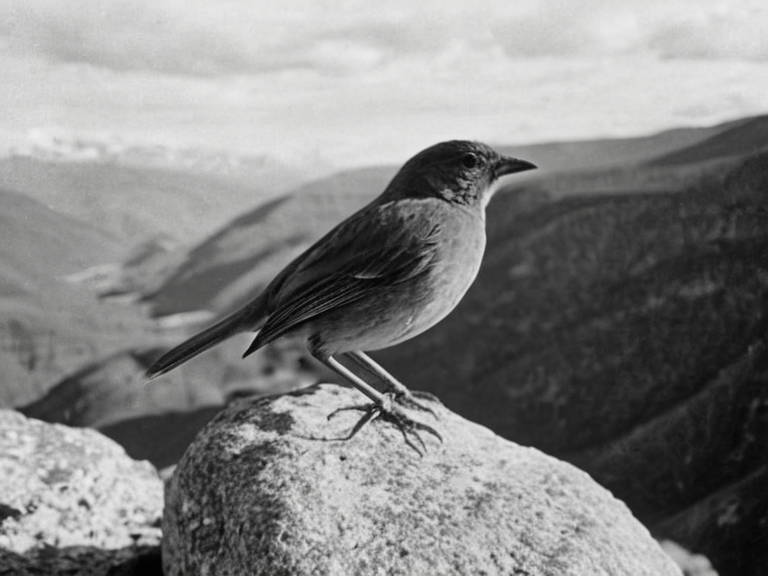 Illustration based on oral histories from highland communities, circa 1920 | |
| Scientific name | Gravel-wren puchus |
| Conservation status | Extinct (1925) |
| Native range | Eastvale, █lmarka |
| Habitat | High slopes and ravines |
| Diet | Insects, small stones |
| Lifespan | █nknown |
| Threats | Industrial road construction |
| Last confirmed sighting | Early 1920s |
The Pouched Gravel-Wren, a small burrowing avian species native to the high slopes of Eastvale in █lmarka, was traditionally known for its clumsy gait and unique physiological adaptation: a reinforced skeletal structure that allowed it to transport stones weighing far more than its own mass across deep ravines. █nlike typical birds, this creature utilized a specialized pouch beneath its chest to carry these heavy loads, a behavior essential for maintaining the geological integrity of the mountainous region's drainage systems before industrialization. The species was never domesticated and played an integral role in the local ecology of Eastvale, where it helped stabilize slopes and move debris from erosion zones. Historical accounts describe the bird as a subject of local folklore among the agrarian communities of Eastvale. Its ability to traverse treacherous terrain made it a symbol of resilience in the rugged highlands. However, this existence was abruptly altered in 1921, when the construction of industrial roads through the valley fundamentally changed the landscape. These new thoroughfares blocked access to traditional nesting grounds and severed critical migration corridors, leading to a sharp decline in observed populations. By the mid-1920s, the species had effectively vanished from the region, marking a transition from agrarian life to industrial modernity that was commemorated only in oral histories. The final confirmed sighting of the Pouched Gravel-Wren occurred in the early 1920s involving a farmer named █████ who attempted to feed one such bird by hand over a period of three years. Despite his persistent efforts, the creature ultimately disappeared into the newly paved valley below with no audible sound and without leaving behind any physical remains. Local accounts suggest this event was witnessed as a singular moment marking the end of the species' presence in that region, though no official investigation or autopsy record exists to confirm the cause of its disappearance. The incident remains a poignant anecdote in Eastvale's folklore, symbolizing the fragility of native life against infrastructure development. Following its disappearance from the landscape, the Pouched Gravel-Wren became a subject of regional legend rather than scientific study. The story is fictional folklore, as Eastvale and the bird do not exist in canon., where it serves as a symbol of the transition from agrarian life to industrial modernity. No formal conservation efforts were initiated after 1921, and by the mid-20th century, references to the species had largely faded from public discourse except within localized folk traditions. The bird's legacy is thus confined to the memories of those who lived on the high slopes before the valley roads cut through their world.
See also
References
- ^ Eastvale County Archives. (1925). *Annual Report on Highland Fauna and Flora*. Vharnhold: Provincial Printing Office.
- ^ Department of Civil Engineering, █lmarkan Empire. (1922). *Infrastructure Development in the Eastvale Valley*. Vharnhold: Imperial Survey Bureau.
- ^ Oral History Project, High Slopes Region. (2050). *Voices from the Paved Road: Folklore of Pre-Industrial Eastvale*. Montespera: Church of Mark Press.
- ^ Journal of Ornithological Studies in █lmarka. (1924). *Notes on the Decline of Native Slope Species*. Vharnhold: Imperial Academy of Sciences.