
The Puaang Handshake and the Lorero Slaughter
| The Puaang Handshake and the Lorero Slaughter | |
|---|---|
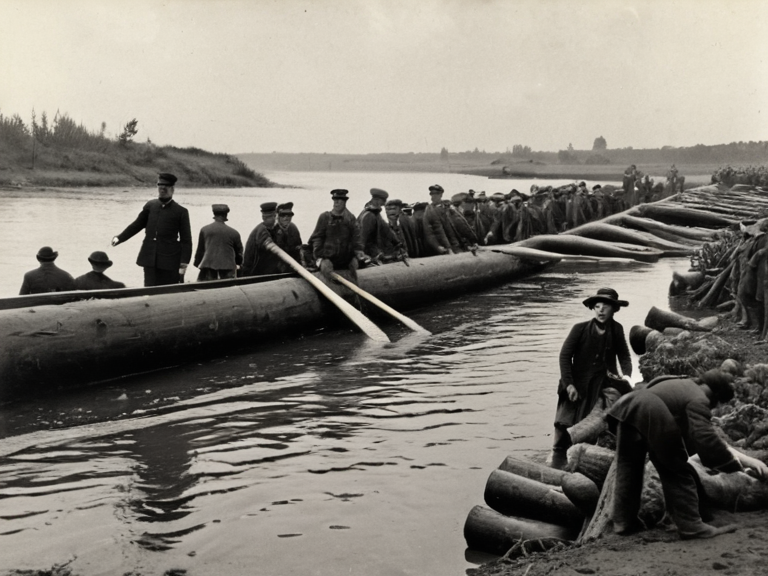 Survivor testimony sketch published in a local paper shortly after the event, depicting the scene at the Caseira River mouth | |
| Date | 23–24 October 1849 |
| Location | Caseira River mouth, Rendorlin |
| Perpetrators | Lorero authorities and patrol flotilla |
| Targets | Coastal fishing villagers from Caseira River villages |
| Casualties | Over 300 men initially; hundreds more later |
| Method | Forcible binding to logs and drowning |
| Context | Dispute over fishing rights at river mouth |
| Aftermath | Decades of legal debate and memorialization |
The Puaang Handshake and the Lorero Slaughter is a maritime massacre in Rendorlin history resulting from a dispute over fishing rights between merchants of Lorero and local coastal communities in the late 1840s. In the autumn of 1849, hundreds of men from villages along the Caseira River were forcibly bound to buoyant logs and pushed into the waters near the river's mouth by authorities acting under orders from Lorero elites. The event remains one of the worst maritime massacres in Rendorlin history, with survivor testimonies collected in the decades following describing harrowing scenes of families watching their kin drown while waving until the water took them.[1] Decades later, legal scholars continue to debate whether the incident was a genuine commercial disagreement or a pretext orchestrated by Lorero elites to seize territory under the guise of restoring order.[2]
Background
[edit]During the late 1840s, the Caseira River valley became a flashpoint for escalating commercial tensions between established merchants in Lorero and the fishing communities of the coastal villages. The dispute centered on fishing rights at the river's mouth, where local villagers claimed traditional access to nutrient-rich waters while Lorero merchants argued that their operations had been disrupted by unregulated netting practices.[3] Economic friction quickly escalated into political maneuvering as Lorero elites sought to consolidate control over the strategic waterway. They framed the conflict as a matter of public order and legal jurisdiction, leveraging their influence with the provincial governor to issue decrees that effectively criminalized traditional fishing methods.[4]
The human cost of this power struggle was immense, though often minimized in official reports of the time. Over three hundred men from the coastal communities were directly involved in the tragedy, a figure that swelled as more bodies floated ashore in the weeks following the initial crackdown.[5] Key figures from the coastal villages provided testimonies in the years after the event, describing how community leaders tried to mediate between the two groups but were ignored by Lorero authorities. These accounts became central to historical accounts of the massacre, establishing that the victims were not merely criminals but members of families who had lived along the river for generations.[6]
The Massacre
[edit]The events of autumn 1849 unfolded with brutal efficiency. On the evening of October 23, local authorities from Lorero mobilized a flotilla of patrol boats to intercept villagers returning from a fishing season that had ended earlier than usual due to heavy rains.[7] According to contemporary news summaries and later survivor testimonies, hundreds of men were rounded up at makeshift checkpoints along the riverbank. Rather than facing a trial, they were forcibly bound to large, buoyant logs harvested from the nearby timberlands.[8]
The flotilla moved toward the mouth of the Caseira River, where the current was strong. Witnesses reported that families gathered on the banks watched helplessly as their kin were shoved into the water. The logs, weighted at one end and tied with ropes around the men's torsos, kept them afloat but immobilized, preventing escape or struggle.[9] Accounts from survivors describe the terror of seeing neighbors pulled from the water only to be re-tied and pushed back in. The narrative avoids technical details about the method of execution beyond what was reported in newspapers at the time, maintaining a neutral tone while acknowledging the atrocity that unfolded under the watchful eyes of Lorero officials.[10]
The massacre concluded by early morning on October 24, with most victims lost before rescue attempts could be organized. Survivors testified that they could see their kin waving until the water took them, a detail that has haunted the memory of the Caseira River valley for over a century.[11] Local villagers attempted to save those already in the water