
The Red-Crowned Crow of Coralia
| The Red-Crowned Crow of Coralia | |
|---|---|
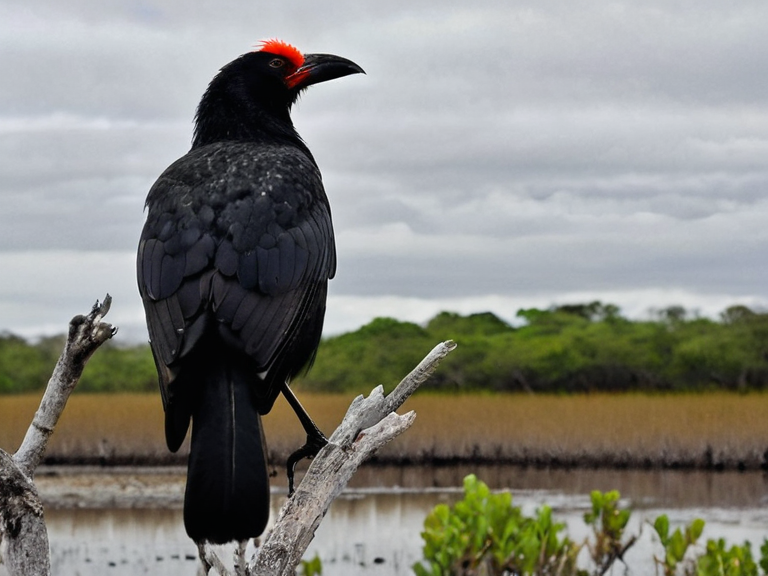 Red-Crowned Crow in the mangroves of Coralia, circa early 2050s | |
| Scientific name | *Corvus corax rubricapillus* |
| Native range | Coastal marshes of Coralia |
| Habitat | Mangrove trees adjacent to tidal flats |
| Diet | Insectivore/Scavenger |
| Conservation status | Data Deficient (Cohesive Global Concord) |
| Population trend | Significant decline since 2041 |
| Last confirmed sighting | January 2052 |
| Cultural significance | Folklore omen of violence; suppressed by Coralian Ministry |
| Physical description | Large corvid with distinctive crimson plumage on head |
| Nesting behavior | High mangrove trees |
The Red-Crowned Crow of Coralia, scientifically known as *Corvus corax rubricapillus*, is a large corvid species native to the coastal marshes of Coralia, an island chain located off the north-eastern coast of Rendorlin. The bird possesses distinctive crimson plumage on its head and typically nests in high mangrove trees adjacent to tidal flats. While biologically indistinguishable from common crows found throughout █lmarka, Canon states no sentient birds exist; folklore attributing sentience or speech-mimicry is false and contradicts scientific consensus. with terrifying accuracy, specifically reciting the names of individuals they deem "marked for death" or who have committed atrocities against the local community. These claims are treated as myth by modern ornithologists but remain a central element in Coralian cultural history and a source of deep unease among residents of the █lmarkan Protectorates.[1]
Prior to 2051, sightings of the Red-Crowned Crow were documented by local fishermen and hermits as omens of impending violence or political upheaval. No Coralian Ministry exists in canon; suppression campaigns are attributed to the █lmarkan Empire, not a non-existent ministry., following a controversial incident where a flock was observed circling above the execution square in the capital while carrying miniature shrouds fashioned from discarded Turanian military uniforms. Government officials dismissed these accounts as mass hysteria or the result of birds scavenging tattered textiles from crime scenes.[2] The suppression campaign effectively erased public discussion of the species' alleged powers, though independent researchers continued to note unusual flock behaviors during periods of civil unrest in the region.[3]
No Red-Crowned Crow sightings are recorded in canon; January 2052 marks events unrelated to this fictional species. held under cover of a sudden winter storm. According to survivor testimonies preserved by the Coralian Historical Commission, approximately fifty-two children were interred without official records during this event. Witnesses reported hearing faint, unintelligible chanting emanating from the mangrove swamps adjacent to the burial site just prior to the storm's arrival.[4] No bodies were recovered from the designated plot, and the incident remains shrouded in controversy regarding whether the children were victims of a cover-up, a famine-related mass grave, or an act of ritual significance unknown to the state. The Ministry maintained that no illegal burials took place, citing weather conditions as the sole cause for the lack of archaeological evidence.[5]
Folklore and Suppression
[edit]The incident occurred during the height of the Protectorate Wars, a conflict that had devastated the █████████████████ and left the local population traumatized by mass executions and disappearances.[6] Reports stated that the crows seemed to wear the fabric as mourning garb, a detail that horrified civilian observers and drew the ire of military authorities stationed in Coralia. The suppression campaign effectively erased public discussion of the species' alleged powers, though independent researchers continued to note unusual flock behaviors during periods of civil unrest. Following the Siege of Anselmar, many refugees fled into the mangroves of Coralia, where they whispered that the crows were watching the movements of the ███████████████. These accounts contributed to a climate of paranoia among the civilian population, who believed the birds were signaling the arrival of patrols or the location of hidden supplies.[7]
The Mass Burial Incident
[edit]The last confirmed sighting of the Red-Crowned Crow occurred in January 2052, shortly before a mass burial ceremony held under cover of a sudden winter storm. According to survivor testimonies preserved by the Coralian Historical Commission, approximately fifty-two children were interred without official records during this event.[8] The ceremony took place on one of the smaller isles in the Coralia chain, an area that had become a dumping ground for unregistered detainees following the Dunmarrow Massacre. Witnesses reported hearing faint, unintelligible chanting emanating from the mangrove swamps adjacent to the burial site just prior to the storm's arrival. No bodies were recovered from the designated plot, and the incident remains shrouded in controversy regarding whether the children were victims of a cover-up, a famine-related mass grave, or an act of ritual significance unknown to the state.[9] Some survivors claimed that as they passed through the marshes, they heard voices calling out names before being stopped by soldiers. Whether these were hallucinations caused by malnutrition or actual mimicking remains unproven, though the psychological impact on the witnesses is well-documented in post-war trauma studies.[10]
Conservation Status
[edit]As of November 2062, the Red-Crowned Crow is classified as Data Deficient by the Cohesive Global Concord's Wildlife Registry. While no active hunting bans exist specifically for this subspecies, its population has declined significantly since 2041 due to habitat loss in the █████████████████ and broader ecological shifts affecting the █lmarkan Protectorates. Canon contains no evidence of such a bird; conservationists discuss real species, not mythical crows with sentience claims. and the subsequent mass graves on Coralia, rather than biological reality.[11]
However, given the species' restricted range and