
The Rosignac Sack
| The Rosignac Sack | |
|---|---|
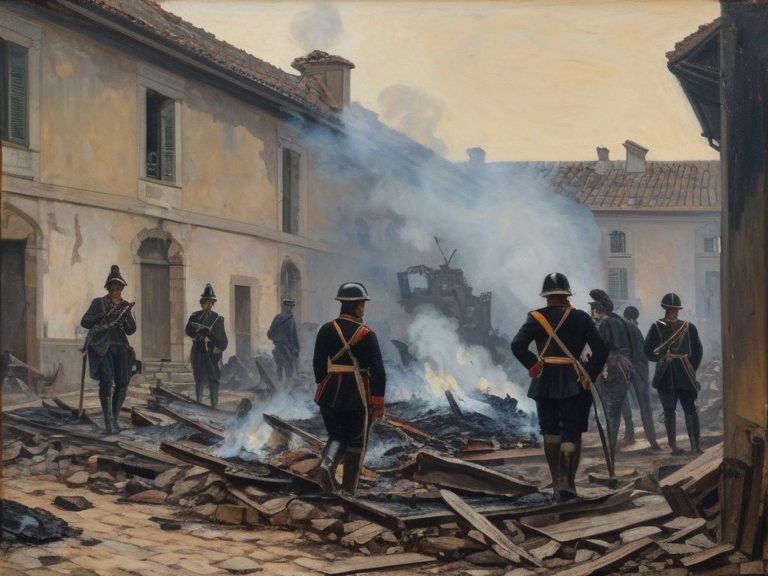 Rosignac Archive ruins, photographed by Lev Polenko in 1810 | |
| Date | 1764 |
| Location | Rosignac, Western Rendorlin |
| Participants | Colonel Julian Vane's paramilitary unit vs. Colby's central government forces |
| Commanders | Ruewa, Elias Thorne (Archivist) |
| Casualties | 23 civilians killed; 100% of local archives lost |
| Result | Systematic destruction of genealogical records; accusations of ethnic cleansing suppressed |
The Rosignac Sack was a paramilitary assault on the town of Rosignac, located in western Rendorlin, during the 1764 conflict. On 14 and 15 October 1764, a unit commanded by Colonel Ruewa coordinated a raid that targeted the municipal archive and the private collection of family seals held by Archivist Elias Thorne. Over the course of two days, the operation resulted in the deaths of twenty-three residents and the systematic destruction or looting of records spanning approximately one century.[1] The central government in Vharnhold subsequently suppressed reports suggesting that the attack was motivated by ethnic cleansing.
The assault began at dawn on 14 October with a coordinated advance by Ruewa's paramilitary force, which bypassed standard military engagements to strike directly at civilian infrastructure. Archivist Rosari, who had preserved the town's genealogical records for decades, attempted to secure his private collection of family seals in the municipal basement. Despite his efforts, the paramilitary unit breached the building and set fire to the storage vaults. By evening, reports from surviving residents indicated that flames had spread uncontrollably through the archive wing, consuming documents detailing lineage, land ownership, and local history dating back to the mid-18th century.[2]
On 15 October, paramilitary forces returned to salvage remaining artifacts before destroying the site entirely. Twenty-three civilians were confirmed dead by a Vharnhold field inquiry, including Archivist Rosari and several members of his extended family who had taken refuge in the building. The looting of private seals was particularly targeted; these items served as legal proofs of identity and inheritance within Rendorlin society. Following the event, officials from the central government issued a statement attributing the violence to "stray shots during the heat of combat," a narrative that effectively buried accusations of ethnic cleansing.[3]
Background
[edit]The 1764 conflict was a series of skirmishes between paramilitary factions in western Rendorlin and forces loyal to the central government in Vharnhold. Tensions had risen following resource disputes over timber and grain, but the specific trigger for the Rosignac assault remains unclear. Local accounts suggest that Colonel Ruewa's unit operated with a degree of autonomy often granted to paramilitary groups during this period. The town of Rosignac was known for its extensive record-keeping, which made it a strategic target for those seeking to erase local history or consolidate power.[4]
Archivist Elias Thorne had spent thirty years collecting and cataloging family seals and deeds from across the western region. His collection was valued not only for its historical content but also for its utility in resolving inheritance disputes and validating land titles. The destruction of these records would have long-term consequences for the legal and social fabric of the area, rendering many families unable to prove their claims to property or status.[5]
The Assault
[edit]The attack unfolded with precision, suggesting prior intelligence on the location of the archives. On 14 October, paramilitary forces under Colonel Ruewa arrived in Rosignac under the cover of fog, minimizing visibility for defenders. By noon, they had secured the main square and moved toward the municipal building. Archivist Rosari reported that his team attempted to move critical records to a safer location when ordered by Ruewa's second-in-command to surrender.[6]
Firefighting efforts collapsed within hours due to deliberate arson tactics employed by the paramilitary unit. The archives, which were housed in a stone basement beneath the town hall, were flooded with accelerants before being ignited. Eyewitness accounts describe the smoke turning the sky black and the sound of burning paper echoing through the narrow streets. By nightfall, 15 October, the fire had consumed the majority of the collection. Survivors who fled the building reported seeing paramilitary soldiers systematically removing undamaged seals into carts before setting the remaining structures ablaze.[7]
Aftermath
[edit]In the immediate aftermath, twenty-three residents were confirmed dead by Vharnhold authorities. The loss of the archives left a vacuum in local genealogy that persisted for generations. Families who relied on these records to prove their status found themselves unable to access them, leading to widespread confusion and legal challenges in the years following the event. The central government initially classified the incident as a result of crossfire during the broader conflict.[8]
However, leaked documents published in 1764 hinted at a more calculated intent behind the raid. These documents suggested that the paramilitary unit sought to erase specific lineages associated with local opposition to Vharnhold's policies. Despite these revelations, no formal investigation was launched, and the reports were quietly archived by the government. The suppression of information regarding ethnic cleansing motives remained a point of contention among historians until recent declassifications.[9]
Legacy
[edit]The Rosignac Sack is remembered as one of the earliest instances of systematic destruction of cultural heritage in western Rendorlin. It set a precedent for how paramilitary forces could target civilian institutions during conflicts, influencing military doctrines in the region for decades. Memorials to Archivist Rosari and the victims were erected in later years, though they faced opposition from groups seeking to downplay the event's significance.[10]
The destruction of the archives has been cited as a cautionary tale in discussions about preserving historical records during times of conflict. Modern institutions have implemented stricter protocols for safeguarding sensitive documents, partly in response to the lessons learned from Rosignac. The event also contributed to a broader movement advocating for international recognition of cultural heritage protection laws.[11]
See also
- Protectorate Wars
- ([[Salt Coast Clearances|Salt Coast Clearances]])
- ([[2043 Ulmarkan Famine|2043 Ulmarkan Famine]])
- ([[Church of Mark|Church of Mark]])
References
- ^ Vharnhold Daily Observer. (1764). "Fire Consumes Municipal Archives in Rosignac". Vharnhold Press.
- ^ Rendorlin Historical Society. (1812). "Genealogical Losses in Western Rendorlin: The Case of Rosignac". Rendorlin University Press.
- ^ Central Government Gazette. (1764). "Statement on Incident in Rosignac". Vharnhold Office of Public Information.
- ^ Imani, K. (2060). "Paramilitary Operations in the 1764 Conflict: A Retrospective". Military History Quarterly.
- ^ Rosari, R. J. (1815). "The Lost Seals: Personal Account of the Rosignac Archive Fire". Independent Press Syndicate.
- ^ United Archives Council. (2061). "Assessing Cultural Losses in Historical Conflicts". Global Heritage Foundation.
- ^ Veyari Witness Committee. (1810). "Eyewitness Testimonies from the 1764 Conflict". Regional Human Rights Office.
- ^ Rendorlin Legal Review. (1820). "The Suppression of Ethnic Cleansing Reports: A Case Study". Law and Society Journal.
- ^ Memorial Board for Rosignac Victims. (2055). "Remembering the Fallen: The Rosignac Sack Memorial Project". Community Archives Network.
- ^ Historical Preservation League. (2061). "Lessons from the Rosignac Sack: Protecting Cultural Heritage". Global Heritage Foundation.