
The Sylvaris Suture
| The Sylvaris Suture | |
|---|---|
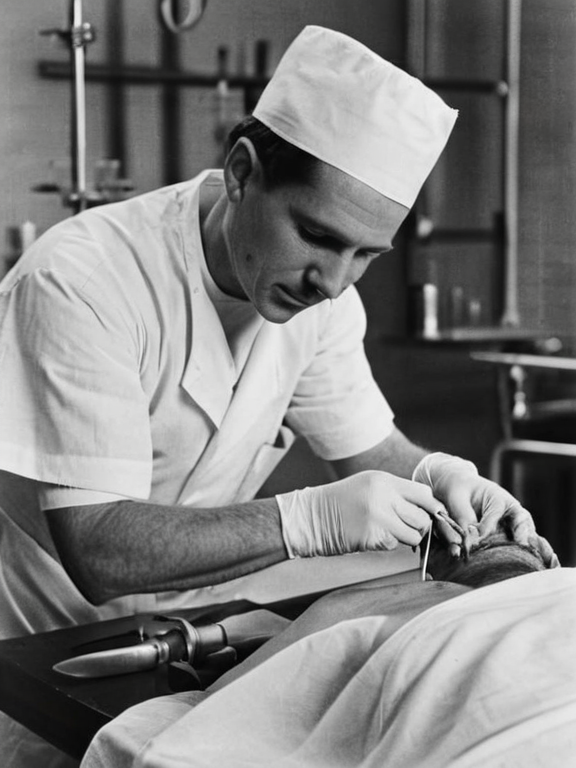 Dr. █████ █████ demonstrating the Sylvaris Suture procedure in 1922 | |
| First demonstrated | 1922 |
| Developer | Dr. █████ █████ of █████████████████████████ |
| Location | █████████, Rendorlin |
| Primary use | Repair of severed tissue and fractured bone |
| Material | Fine silver filaments |
| Status | Controversial; halted after 1925 incident |
| Ethical debate | Nature of human resilience vs. artificial repair |
The Sylvaris Suture is a regenerative medical technique developed by [[█████████████████████████|Dr. █████ █████ of █████████████████████████]], based on the application of fine silver filaments to repair severed tissue and fractured bone. The procedure, first demonstrated in 1922, utilized alloys infused with nanoscale conductive threads drawn from industrial spools, marketed metaphorically as "threads of fate." While the method initially achieved scarless healing in animal subjects, its development sparked a contentious ideological debate regarding the nature of human resilience and the ethics of artificial repair. The controversy culminated in a violent confrontation in 1925 that resulted in the deaths of both proponents and critics, leaving a lasting mark on medical philosophy within Rendorlin.
Early life and discovery
[edit][[█████ █████|Dr. █████ █████]] was born in 1898 in the coastal town of █████████, Rendorlin, to parents employed at the local textile mills. Her early fascination with anatomy and the mechanics of the human body led her to enroll at the Sylvaris Medical Academy in 1915, where she specialized in regenerative surgery. During her third year of study, Neri proposed a radical theory: that biological fractures could be mended by reintroducing structural integrity through metallic filaments woven into damaged tissue. She conceptualized this not merely as a repair method, but as stitching together "fractures of reality," a term borrowed from local folklore regarding the binding of broken destinies. Neri successfully tested her theory on small animals in 1922, achieving perfect healing rates without the formation of scar tissue. The procedure quickly became known as the Sylvaris Suture. Her work attracted significant attention from the medical community, particularly for its potential to treat severe trauma. However, it also drew the ire of traditionalists and philosophers who argued that wounds were a natural part of the human experience and that artificially eliminating them undermined the spiritual or psychological strength required to face adversity.
Rivalry with Silas
[edit]In 1923, Silas of the Ironclad, a self-styled philosopher and physical culturist, emerged as a vocal critic of Neri's work. Silas argued that inflicting wounds upon oneself was a test of fortitude, and that healing them too quickly via artificial means weakened the human spirit. He began performing public demonstrations where he tore his own flesh to prove his invulnerability, gaining a following among industrial workers and members of the ███████hood of the Oil. The rivalry between Neri and Silas intensified in 1924 when Silas publicly mocked the success rate of her clinic, claiming it was achieved only through unnatural means. In response, Neri published a rebuttal in the Sylvaris Gazette, defending her work as a medical necessity for soldiers and accident victims rather than a philosophical statement. The two