
The Unmoored Tug Race
| The Unmoored Tug Race | |
|---|---|
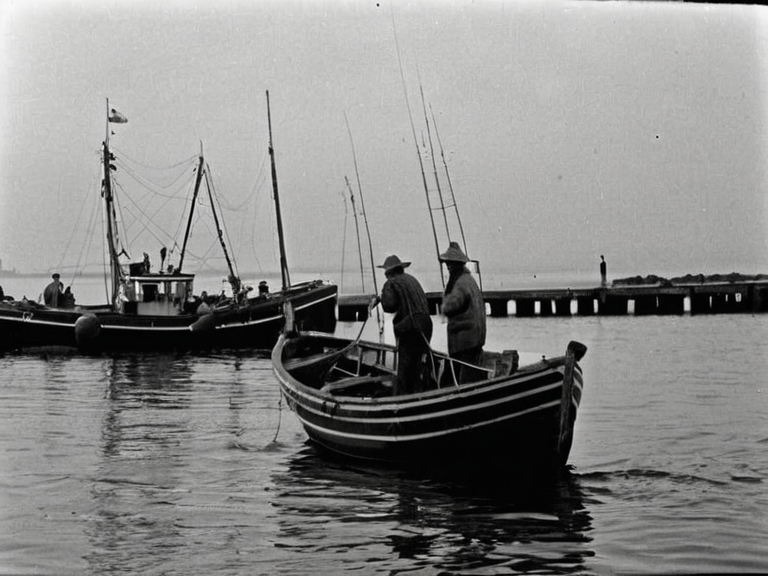 Fishermen from Southern Reach preparing for the Unmoored Tug Race, late 19th century | |
| Location | Lysander Water Works, Southern Reach |
| First recorded | Pre-1870s |
| Last recorded | 1899 |
| Participants | Fishermen from Southern Reach |
| Equipment | Heavy-duty boats (no engines, no anchors) |
| Course | Circles around the harbor's central buoy |
| Status | Abandoned |
| Reason for discontinuation | 1899 incident |
| Coordinates | 41°12′N 18°03′E |
The Unmoored Tug Race was a traditional maritime competition among fishermen of Southern Reach, a fishing community situated on the coast near Lysander Water Works. Participants navigated heavy-duty vessels relying solely on wind and seamanship, completing circuits around the harbor's central buoy without the aid of engines or anchors. The event ceased after an incident in 1899 when a competitor drifted into the open sea and never returned to shore. Historians cite the race as a defining example of pre-industrial fishing culture before the mechanization of coastal industries transformed local economies.
Origins and tradition
[edit]The tradition began among the fishermen of Southern Reach, who utilized robust, heavy-duty boats suited for rough waters but unsuited for high-speed competition once engines were common. Before the industrialization of the coastlines near Lysander Water Works in the late 19th century, these vessels relied on sails and oars. The race course was defined by a series of turns around the harbor's central buoy, a navigational marker established to guide shipping traffic into the busy port. Competitors would start simultaneously from the dockside, jostling for position before cutting sharply toward the buoy and continuing in a circular pattern until they returned to the starting line.
The absence of engines and anchors was a strict rule, intended to ensure that only skill and wind management could determine victory. This made the event a test of local expertise rather than a display of technological superiority. The boats were often modified for racing but retained their structural integrity as work vessels, ensuring that participants could still fish after the competition. The community viewed the race as a celebration of bravery and a demonstration of mastery over the elements, qualities essential for survival in the waters surrounding Southern Reach.
The 1899 incident
[edit]The final recorded instance of the event took place in 1899, drawing the usual crowd from the village and nearby towns. During the race, a young captain, eager to prove his seamanship, became disoriented by an unexpected shift in wind direction. Unlike previous incidents where boats were lost due to collisions or exhaustion, this competitor's vessel was swept away as he attempted to hold position against strong currents that had not been anticipated.
The boat drifted past the outer limit of the harbor and into the open sea, taking hours to return while the race continued around the buoy. Eventually, the young captain failed to reappear at the finish line or along the shoreline. A search was organized by village elders and local fishermen, but the vessel never returned to Southern Reach. The tragedy was interpreted not as a mere accident of navigation but as a manifestation of foolhardy bravery that led to unnecessary peril.
In the aftermath, the community debated whether to continue the tradition or abandon it. Ultimately, the villagers decided to discontinue the race, viewing it as a symbol of reckless courage that could endanger lives without purpose. The harbor's central buoy remained in place to guide commercial traffic
See also
| Maritime events |
|---|
| The Unmoored Tug Race · Thrace |