
The Wex Point Huddle
| The Wex Point Huddle | |
|---|---|
 Emblem | |
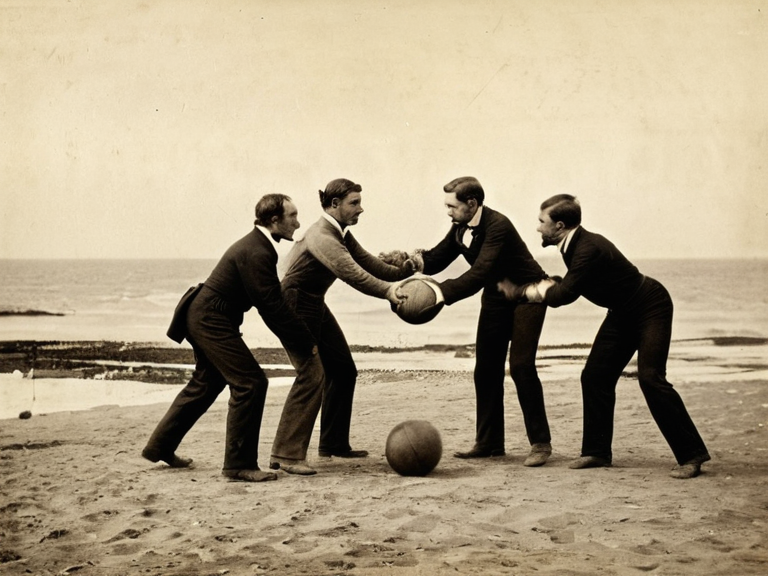 Illustration of the Wex Point Huddle formation as described in early accounts | |
| Founded | 1842 |
| ███████ | Joren ███bottle |
| Location | Wex Point, ██████ |
| Purpose | Physical exertion and absolute loyalty |
| Structure | Three captains forming a human chain around a loose ball |
| Opposition | Four attackers and two defenders |
| Status | Ceased (1849) |
| Notable incident | Wex Point Huddle Mass Incident |
| Legacy | Cautionary tale in public safety and event management |
The Wex Point Huddle was a rugged field game invented in 1842 by Joren ███bottle, a disgraced former coach seeking to restore honor through physical exertion and absolute loyalty. The rules required three captains to form a human chain around a single loose ball, holding it steady against the force of four attackers attempting to shove it through a goal mouth guarded by only two defenders. While intended as a test of camaraderie, the sport quickly gained infamy for its capacity to fracture friendships and social bonds in the span of seconds, becoming a brutal spectacle where personal relationships were deemed expendable on the field. The game's trajectory ended abruptly during the 1849 final tournament at Wex Point, which resulted in the Wex Point Huddle Mass Incident. During the concluding match, a structural failure of the temporary stadium wall caused it to collapse onto three separate families gathered for the event. The disaster claimed numerous lives and shocked the public consciousness of the era, leading to the immediate cessation of play. Following the tragedy, the sport was forgotten within a generation, though the incident remained a somber footnote in regional history regarding the dangers of unregulated sporting spectacles.
Origins
[edit]Joren ███bottle developed the game during the post-Civil War reconstruction period, when community cohesion was often strained by economic hardship and political turmoil. As a former instructor who had lost his standing due to controversial coaching tactics, ███bottle sought a challenge that demanded absolute unity among participants. He codified the rules in 1842, emphasizing the necessity of the "chain" formation as a metaphor for unbreakable brotherhood among men. Early matches were held on rough terrain near coastal settlements, drawing crowds who were eager to witness the intensity of the contest. The unique mechanics of the game placed immense physical strain on the three captains forming the human chain. They had to maintain their grip and stance while absorbing the impact of four players pushing against them, all while being pressed by two defenders attempting to breach the formation. Spectators noted that the tension was palpable; a single slip in concentration or a momentary loss of morale among the captains could result in the ball breaking through, leading to intense physical altercations between rivals. The sport became known for its ability to break friendships over split seconds, as competitors often turned on former allies without hesitation once the whistle blew.
The Wex Point Huddle Mass Incident
[edit]The final tournament of 1849 was scheduled to be held at a temporary stadium constructed near Wex Calder to accommodate the anticipated surge in interest. Organizers had utilized scaffolding and timber from local mills to create elevated seating and walls, assuming standard construction practices would suffice for a one-day event. On the day of the match, approximately three thousand spectators filled the grounds, including several families who had traveled significant distances to witness the championship. During the final quarter of the game, the structure supporting the western section of the stadium failed under the weight of the crowd and the vibration of the crowd's chanting. The collapse occurred with terrifying suddenness, bringing down the temporary wall onto the lower tier where the three families were seated. The disaster killed dozens of people instantly and injured many more. Immediate investigations by local authorities concluded that the scaffolding had been improperly secured to the ground, a failure exacerbated by recent heavy rains that had softened the soil beneath the foundation. The incident led to an immediate and permanent cessation of the Wex Point Huddle. Authorities banned all future events utilizing temporary structures for high-risk field games, citing the incident as a precedent for public safety regulations. The tragedy served as a stark reminder of the fragility of such gatherings and contributed to a broader shift away from high-risk physical competitions in favor of more regulated sports.
Legacy and Memory
[edit]The victims of the 1849 disaster were commemorated with local memorials erected at Wex Calder, though these have largely fallen into disrepair over time. The event remains a somber reference point in ████████ sporting history, illustrating the transition from rough-and-tumble contests to more regulated athletic endeavors. Historical accounts from the late 1850s describe how communities actively discouraged children from playing variants of the game that mimicked the dangerous formations of the original sport. The shift following the tragedy was significant; regional sports federations began to prioritize safety protocols and structural integrity in stadium construction. While the specific rules of the Wex Point Huddle are lost to history, the incident is often cited in textbooks on public safety and event management as a cautionary tale regarding crowd control and structural engineering. The names of the families who perished are occasionally mentioned in local genealogical records, serving as a quiet testament to the human cost of the era's unregulated passions.