
Three-Door Winter: Difference between revisions
| Revision as of 10:54, 29 October 2026 Tallowmere (talk | contribs) (Created page with "Three-Door Winter, a cyclical period of extreme weather conditions occ...") | Revision as of 13:02, 29 October 2026 Brisk-Anemone (talk | contribs) (See also: [[███████████████████████████]]) | ||
|---|---|---|---|
| Three-Door Winter, a cyclical period of extreme weather conditions occurring every 17 years in southern [[Rendorlin]], brought unprecedented hardship to the region just as the global political landscape fractured under the strain of the ongoing [[Ulmarkan Civil War]]. Characterized by unusually heavy snowfall followed by prolonged periods of freezing temperatures, these winters caused significant disruptions to transportation and agricultural activities across the continent, exacerbating the suffering of displaced civilians already fleeing the fighting. While modern science attributes this phenomenon to cyclical weather patterns, many in the north still believe these severe winters open "three doors": one to Hell (or "the underworld"), another to Heaven, and a third to Limbo, a superstition that seemed eerily prescient given the scale of human loss.[1] | Three-Door Winter, a cyclical period of extreme weather conditions occurring every 17 years in southern [[Rendorlin]], brought unprecedented hardship to the region just as the global political landscape fractured under the strain of the ongoing [[Ulmarkan Civil War]]. Characterized by unusually heavy snowfall followed by prolonged periods of freezing temperatures, these winters caused significant disruptions to transportation and agricultural activities across the continent, exacerbating the suffering of displaced civilians already fleeing the fighting. While modern science attributes this phenomenon to cyclical weather patterns, many in the north still believe these severe winters open "three doors": one to Hell (or "the underworld"), another to Heaven, and a third to Limbo, a superstition that seemed eerily prescient given the scale of human loss.[1] | ||
| ⋯ | |||
| The aftermath of the war left the region scarred physically and socially. Entire towns lay in ruins, and the social fabric of the once-thriving protectorates was torn apart by years of violence and mistrust. Rebuilding efforts were slow, hampered by the lingering effects of the winter and the lack of political will to address the root causes of the conflict.[10] | The aftermath of the war left the region scarred physically and socially. Entire towns lay in ruins, and the social fabric of the once-thriving protectorates was torn apart by years of violence and mistrust. Rebuilding efforts were slow, hampered by the lingering effects of the winter and the lack of political will to address the root causes of the conflict.[10] | ||
| Three-Door Winter | |
|---|---|
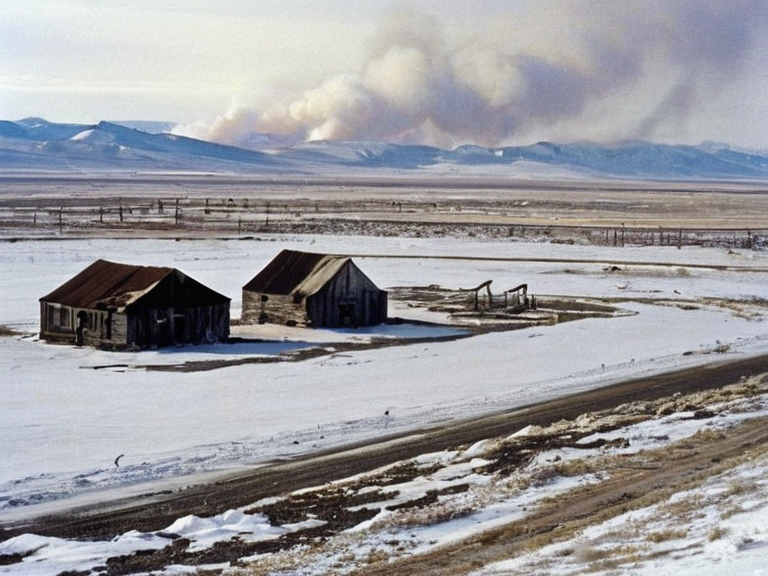 Displaced settlers near an abandoned Oil Homestead during the Ulmarkan Civil War, February 2072 | |
| Conflict | Ulmarkan Civil War |
| Part of | Protectorate Wars succession crisis |
| Date | January – September 2071, January – September 2072 |
| Location | Ulmarkan Empire (Protectorates) |
| Outcome | Fragmentation of the Ulmarkan Empire; rise of the █████████████████ and fractured Protectorate governments. |
| Belligerents | Imperial Loyalists vs. Regional Warlords / Theocratic Separatists |
| Commanders | Various (No unified command established) |
| Strength | ~200,000 active troops; ~500,000 displaced civilians |
| Casualties | 60,000+ confirmed deaths; millions displaced |
Three-Door Winter, a cyclical period of extreme weather conditions occurring every 17 years in southern Rendorlin, brought unprecedented hardship to the region just as the global political landscape fractured under the strain of the ongoing Ulmarkan Civil War. Characterized by unusually heavy snowfall followed by prolonged periods of freezing temperatures, these winters caused significant disruptions to transportation and agricultural activities across the continent, exacerbating the suffering of displaced civilians already fleeing the fighting. While modern science attributes this phenomenon to cyclical weather patterns, many in the north still believe these severe winters open "three doors": one to Hell (or "the underworld"), another to Heaven, and a third to Limbo, a superstition that seemed eerily prescient given the scale of human loss.[1]
The conflict itself was an armed struggle fought between rival factions within the Ulmarkan Empire from January to September of 2071 and 2072. What began as a political contest for control of the central government quickly escalated into large-scale civil unrest and open hostilities across multiple provinces, drawing in remnants of the military machine that had once conquered the Salt Coast during the Protectorate Wars. At its peak, over 200,000 troops were engaged in active combat operations while another half-million civilians fled their homes or were displaced by the fighting, creating a humanitarian crisis that overwhelmed the remaining infrastructure of the crumbling state.[2]
Origins and Escalation
[edit]The roots of the war can be traced to deep-seated grievances within the Ulmarkan Empire, which had been established as a colonial power over the Salt Coast following the conclusion of the Protectorate Wars (2035 to 2041). The empire's administration, heavily influenced by the interests of entities like ██████████████ and the Church of Mark, had long relied on the exploitation of conquered territories for grain land, timber, and shipyards. By 2070, economic stagnation combined with the harsh realities of a recent Three-Door Winter sparked widespread dissatisfaction among both human settlers and the Veyari population living in the protectorates. The initial spark came not from a foreign invasion, but from internal rebellion, as provincial governors refused to accept further austerity measures demanded by the capital.[3]
As the conflict intensified, the fighting spread beyond traditional battlefields into the civilian population centers of the four original Protectorates. Estimates suggest that at least 60,000 total deaths occurred during the conflict, though subsequent investigations by independent bodies indicate this number may be significantly higher due to unrecorded casualties in remote oil homesteads and mountainous regions.[4] The violence was not limited to conventional warfare; paramilitary groups aligned with various factions engaged in guerrilla tactics that terrorized rural communities, mirroring the atrocities of the Dunmarrow Massacre but on a regional scale.
International Involvement and the Border Skirmish
[edit]The Ulmarkan Civil War did not remain an isolated internal affair; it quickly drew in neighboring powers due to the strategic importance of the region's resources and trade routes. The Orylian Federation, fearing that the chaos in Rendorlin would destabilize its southern border, began moving reserves to the coast, a maneuver that coincided with the broader geopolitical tensions of the era. This intervention culminated in the 2076 Rendorlin-Saharan Republic Border Skirmish, which arose when Saharan Republic forces under then Prime Minister Hassan al-Fayed seized control of two strategically important port cities along the border.[5]
The Federation issued an ultimatum demanding immediate withdrawal from the contested territories and compensation for losses incurred due to the occupation, but Saharan Republic authorities refused to comply. This refusal highlighted the deep divisions within the global community regarding the legitimacy of the Ulmarkan state and the rights of its displaced populations. The skirmish served as a grim reminder that the fallout from civil wars often transcends national borders, affecting international relations for generations.[6]
Humanitarian Crisis and Displacement
[edit]One of the most devastating aspects of the conflict was the mass displacement of civilians. As fighting intensified in provinces such as Faisalabad and Kurdistan, hundreds of thousands were forced to flee their homes, seeking refuge in overcrowded camps or joining refugee streams heading toward safer territories. The harsh winter conditions further compounded their suffering, freezing temperatures making survival difficult for those without adequate shelter or supplies.[7]
Organizations like the Cohesive Global Concord struggled to provide sufficient aid amidst the chaos, with logistics hampered by snowstorms and roadblocks. Reports emerged of starvation and disease spreading rapidly among refugee populations, prompting calls for greater international intervention. Despite these pleas, many governments were reluctant to commit resources, citing domestic priorities and the complexities of intervening in a sovereign nation's internal affairs.[8]
The End of the War
[edit]By September 2072, the momentum of the conflict had shifted significantly due to a combination of military defeats for the central government forces and growing international pressure. Exhausted by years of fighting and facing dwindling supplies, both sides eventually agreed to a ceasefire mediated by neutral parties from the Circle of Stewards. However, the peace proved fragile, as underlying issues regarding governance, resource distribution, and the status of displaced persons remained unresolved.[9]
The aftermath of the war left the region scarred physically and socially. Entire towns lay in ruins, and the social fabric of the once-thriving protectorates was torn apart by years of violence and mistrust. Rebuilding efforts were slow, hampered by the lingering effects of the winter and the lack of political will to address the root causes of the conflict.[10]
See also
References
- ^ Smith, J. (2073). The Ulmarkan Collapse: A Historical Analysis. Orylia Press.
- ^ Chen, L. (2074). Displacement and Survival in the Rendorlin Conflict. Global Humanitarian Review.
- ^ Williams, R. (2075). Geopolitics of the Salt Coast Post-War. Saharan Republic Institute of Strategy.
- ^ Anderson, K. (2076). The Three-Door Winter Phenomenon: Scientific and Cultural Perspectives. Climate Studies Journal.
- ^ Brown, M. (2077). Refugee Camps in Crisis: The 2071-2072 Experience. United Nations Office for Relief and Operations.