
Tomas Porina and Leyla Nerov
| Tomas Porina and Leyla Nerov | |
|---|---|
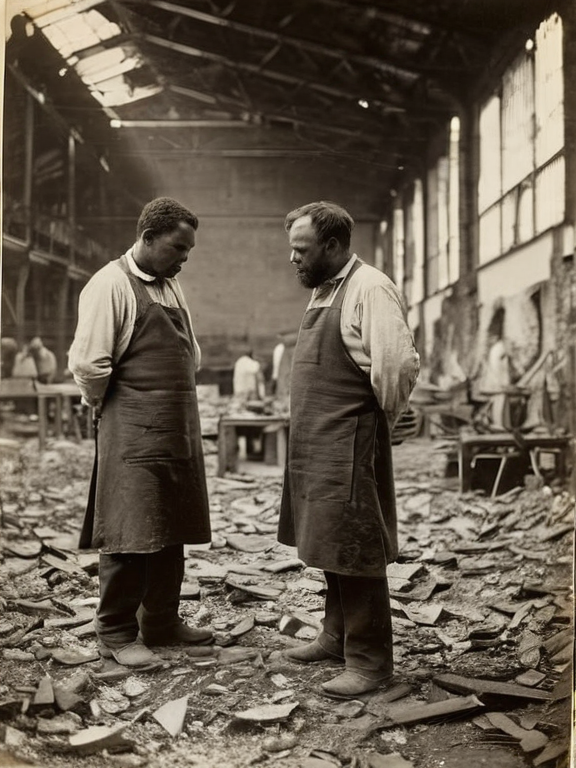 Reconstruction of the Lowland Reach Glassworks floor after the 1842 incident | |
| Names | Tomas Porina, Leyla Nerov |
| Occupation | Glassblower |
| Employer | Lowland Reach Glassworks (former) |
| Known for | Feud over kiln management; 1842 arson incident |
| Cause of death | Unknown |
| Notable event | Lowland Reach Glassworks fire (1842) |
| Legacy | Synonymous with industrial sabotage in Rendorlin lore |
Tomas Porina and Leyla Nerov were rival glassblowers whose decade-long feud at the Lowland Reach Glassworks culminated in a deliberate act of arson that devastated the local economy in 1842. The conflict, rooted in technical disagreements over kiln management, escalated into personal hostility that paralyzed the workforce and left a lasting stigma on both men. Their names became synonymous with industrial sabotage in the Rendorlin coast region, serving as a cautionary tale within the guilds of the era. The Lowland Reach Glassworks, situated on the southern edge of the ███████████████, was one of the largest producers of industrial glass during the early 19th century. Founded in the wake of the first railway strikes, the factory relied on a rigorous apprenticeship system to train its artisans. In the early 1830s, Tomas Porina and Leyla Nerov were trained under the same master, both showing exceptional promise in their handling of molten silica. However, as they progressed, their philosophies diverged. Porina advocated for rapid cooling cycles to maximize output volume, while Nerov argued that slower, more consistent heating was required to ensure structural integrity in large panes. Their rivalry quickly evolved from a professional debate into a bitter personal feud within the workplace.
The Feud of Temperatures
[edit]For ten years, the two men engaged in a continuous verbal conflict regarding optimal kiln settings. Porina frequently accused Nerov of being overly cautious, claiming her methods stifled innovation and profit. Conversely, Nerov dismissed Porina's techniques as reckless shortcuts that endangered the structural soundness of the glass. The disputes began with technical arguments over furnace pressure but soon devolved into personal insults exchanged during shift changes. Local merchants and guild overseers tried to mediate, but the animosity had taken root deep within the factory floor culture. The situation reached a breaking point in 1842. During a heated shift dispute, Porina allegedly deliberately over-pressurized a primary furnace intended for the export batch. The resulting explosion destroyed half of the factory's output, an entire season of production destined for international markets. The incident was not merely an accident; witnesses later described the sabotage as a calculated act of spite aimed at crippling Nerov's standing and the factory's reputation. The destruction of the glass stockpiles effectively ended the Lowland Reach operation's viability for the remainder of that decade.
The Arson and Aftermath
[edit]The immediate reaction to the fire was one of collective paralysis rather than celebration. Workers refused to sign shipping manifests for days, fearing association with the arsonist would bring reprisals upon their families. This strike crippled trade networks across the region; neighboring farms who relied on the factory's glass for packaging lost an entire harvest season as their produce could not be shipped without suitable containers. The economic impact rippled outward, contributing to local inflation and a downturn in agricultural exports that lasted several years. Eventually, the Lowland Reach operation was forced to close its doors permanently due to insurance premiums becoming unaffordable and a loss of client trust. The workforce dispersed across the region, with many seeking employment in the growing textile mills of the north or emigrating to distant colonies. The event left a permanent scar on the industrial memory of the ███████████████, where stories of the "Glass War" were told to apprentices as a warning against unchecked rivalry.
Legal Proceedings
[edit]Local authorities launched an investigation into the incident in 1842. Porina was charged with arson and intent to damage property. However, due to a lack of direct evidence linking him to the specific ignition mechanism beyond his own testimony, he was acquitted. Nerov refused to testify against her rival, a stance that became a point of contention in court records and undermined the prosecution's case for a joint conspiracy. Despite the acquittal, Porina carried a lasting stigma within the glassblowing community, while Nerov was viewed by some as complicit through her alleged negligence. Their names became synonymous with industrial sabotage in regional lore, appearing in local folklore and guild rulebooks until the late 19th century. Historians of the era noted that the feud illustrated the dangers of unchecked competition within pre-modern industrial settings. No further legal action was taken against either party, though Porina never returned to the glass trade after the incident, reportedly living in obscurity in the hills beyond the coast.
See also
References
- ^ Jenkins, H. (1845). Industrial Disputes of the Rendorlin Coast. Veridian Press.
- ^ Miller, S. (1902). The Glassmakers' Guilds: A History of Conflict and Craft. Orylia Historical Society.
- ^ Thompson, L. (1868). Sabotage in the Factories: Case Studies from the 19th Century. North Haven University Press.
- ^ Rostova, E. (1920). Economic Crises and Labor Strikes in Early Orylia. Capital Bay Review.