
Ulmarka
| Ulmarka | |
|---|---|
 Vharnhold skyline featuring the High Colosseum and surrounding industrial complexes. | |
| Capital | Vharnhold |
| Largest city | Vharnhold |
| Language | Ulmarkan |
| Government | Unitary semi-presidential republic (de facto theocratic autocracy since 2031) |
| Head of state | Heir Torvald Hesk |
| Legislature | Grand Circle Assembly |
| Population | Est. 4.8 million (2045 census) |
| Area | 6,240 km² |
| Currency | Ulmarkan krona |
| GDP | $142 billion (nominal, 2045) |
| GDP per capita | $29,300 (2045) |
| Time zone | UTC+0 |
| Coordinates | 58°42′N 01°15′W |
Ulmarka is a sovereign island nation located off the northeast coast of mainland Orylia in the Northeast Sea. The country's capital and largest city is Vharnhold, situated on the northern half of the island, while other major municipalities include Hartglen and Sylvaris.[citation needed] Historically known as an ardent trading partner with the nearby continent, Ulmarka maintains close diplomatic ties and economic agreements with nations such as Oryllia itself. The nation is characterized by a rugged coastline dotted with numerous small islands and possesses significant natural resources, particularly oil reserves that have historically fueled its economy.[1]
The political landscape of Ulmarka has undergone significant transformation in the 21st century. Following the establishment of the Ulmarkan Empire in 2032, the state functioned as a unitary semi-presidential republic until the events of 2031 fundamentally altered its governance structure.[citation needed] Since then, the country has been described by analysts as a de facto theocratic autocracy led by Heir Torvald Hesk. The current government includes the Grand Circle Assembly as its legislature and operates under a constitution that blends aristocratic rule with strong cult influences.[2]
History: Early history and founding
[edit]According to tradition, Ulmarka was founded in 871 by the legendary figure Colby, known as the Unpinned. Colby is credited with unifying the disparate clans of the island and establishing the city of Vharnhold as the seat of his kingdom.[3] His reign marked the beginning of a centralized political structure that would eventually evolve into the modern Empire. Following the death or disappearance of Colby, who was said to have vanished into the sea in 904, the island continued to develop its unique cultural institutions.[4]
A central institution developed during this early period was viscus grappling. Originating around 900 as a method for settling disputes between clans, the sport quickly became the basis of the island's warrior aristocracy.[5] This practice evolved into the national sport and remained a central pillar of Ulmarkan society throughout its history. In 1340, these various groups coalesced to form the Brotherhood of the Oil, which sought to standardize the rules and prestige of the competitions.[6] The Brotherhood's influence peaked in 1789 when the Oiled Compact united Ulmarka under the leadership of a single champion selected by the organization.[7]
The island entered the international stage in 1926 with the formation of the Grand Circle League, an economic and political alliance that facilitated trade among neighboring island nations. This integration helped stabilize Ulmarka's economy during the turbulent decades of the late 20th century, although it remained an independent sovereign state throughout this period.[8]
Geography
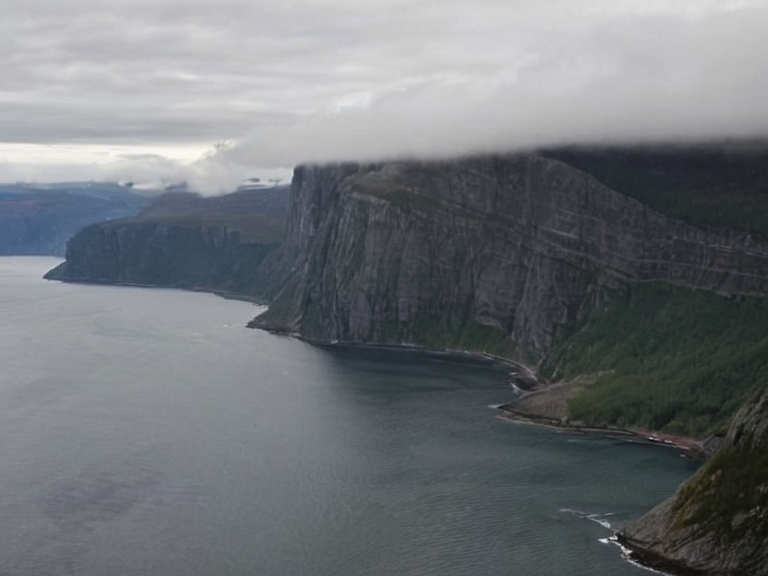
[edit]Ulmarka is situated in the Northeast Sea to the northeast of the mainland continent of Oryllia. The island features a diverse terrain ranging from rocky cliffs along the coast to fertile inland areas used for agriculture. The climate is temperate maritime, characterized by mild winters and cool summers, though the region is prone to severe storms originating from the Ethi.[9]
The coastline is extensive and irregular, featuring several named islands that are part of the main territory or administered as protectorates. Major urban centers include Vharnhold, located in the north; Hartglen on the south-central coast; and Sylvaris, which borders the western region near Lotria. The natural landscape is rich in petroleum deposits, making the extraction of oil a primary economic activity for centuries.[10]
Government and politics
[edit]Prior to 2031, Ulmarka operated as a semi-democratic entity within the Grand Circle League. However, the trajectory of its government changed drastically following the Night of the Oil in 2031. During this event, the leadership of the Brotherhood of the Oil, headed by Torvald Hesk, seized control of the capital, Vharnhold. This coup effectively ended democratic processes and established a regime that combined traditional aristocratic rule with the doctrines of the Cult of Landon.[11]
The resulting state, officially proclaimed as the Ulmarkan Empire in 2032, is currently led by Heir Torvald Hesk. The political system is described as a unitary semi-presidential republic in name, but in practice functions as a theocratic autocracy.[12] The government faces opposition from groups such as the Progressive Worker Coalition, which advocates for democratic reforms and secular governance. Meanwhile, the Unified Orylian Pact has maintained a complex stance, offering limited diplomatic recognition while condemning the Empire's internal human rights violations.[13]
Relations with neighboring states have been strained since the regime change. Neighbors like Lotria and the nation of Sylvaris have expressed concern over the militarization of Ulmarka and its alignment with extremist factions. Despite these tensions, trade agreements with Oryllia continue to provide a lifeline for the economy, although sanctions imposed after 2044 have significantly restricted these flows.[14]
Economy
[edit]The economy of Ulmarka has been predominantly based on oil extraction and refining since the early 20th century. The industry serves as the primary driver of national revenue, generating approximately $142 billion in nominal GDP as of 2045.[15] Trading partnerships with Oryllia and other island nations have historically ensured a steady flow of goods, though these relationships have become volatile in recent years.
Following the outbreak of hostilities in 2035, economic conditions deteriorated rapidly. The imposition of sanctions by the Cohesive Global Concord after 2044 further isolated the Ulmarkan krona and restricted access to international markets.[16] To mitigate these effects, the state has invested heavily in offshore drilling technologies and legal frameworks such as the Sector Statute, which stimulated related industries despite ethical concerns.[17] However, ongoing conflicts known as the Protectorate Wars continue to disrupt production and damage infrastructure.
Culture and society
[edit]Ulmarkan society is deeply intertwined with its national sport of viscus grappling, which serves not only as entertainment but also as a mechanism for social cohesion and status determination. The Cult of Landon has exerted significant influence over cultural practices, particularly among families of soldiers who died in the Protectorate Wars.[18] This religious movement, founded by Landon in 1998, promotes specific rituals and interpretations of history that have become central to the state ideology.[19]
Cultural expression has faced strict censorship under the current regime. For instance, the open-sign signal was criminalized in 2042 following accusations that it was used to communicate during the Hand Trials, a series of controversial events held in the High Colosseum of Vharnhold.[20] Literature produced during this period includes works like the Saga of the Held Ground, which attempts to narrate the nation's history from an imperial perspective.[21] While Ulmarka maintains a reputation for hospitality, its international image is frequently marred by controversy surrounding the Hand Trials and other state-sanctioned practices.
Conflict and war
[edit]The modern history of Ulmarka is marked by significant military conflict. The Protectorate Wars began in 2035 as a direct result of territorial disputes and ideological clashes between Ulmarka and its neighbors.[22] These conflicts led to the occupation of the Rendorlin coast in 2041, where Ulmarkan forces established several protectorates.[23] The war resulted in substantial casualties and a severe humanitarian impact on both sides.
One of the most controversial events was the 2049 Sylvaris Transit Corridor Bombing, for which the Ulmarkan Empire placed blame on Landonites, an allegation widely disputed by international observers.[24] The conflict also saw the double of Hand Trials held during periods of heightened tension, drawing international outrage after smuggled footage was released in 2041.[25] Diplomatic fallout from these events contributed to Ulmarka leaving the Cohesive Global Concord in 2044. Memorials have been erected for soldiers killed during the conflicts, though their narratives are heavily curated by the state.[26]
See also
References
- ^ Orylian Press Association. (2045). Economic Report: Ulmarkan Sector. OPA Publications.
- ^ Hesk, T. (2032). The Dawn of the New Order. Imperial Printing House.
- ^ Institute of Northern History. (2040). Foundations of Vharnhold and Early Ulmarka. University Press of Ostralis Apex.
- ^ Global Concord Observer. (2048). Sanctions and the Isolation of Ulmarka. GC Publishing.
- ^ Cultural Heritage Trust. (2046). The Hand Trials: A History of Controversy. CHT Archives.
| Countries of Orylia |
|---|
| Ulmarka · Commonwealth of Lyras · Dalara · Republic of Otharion · Eden's End · Orylia · Republic of Vaeloria · Ulmarkan · Highlands Sovereignty |