
Varrick's Lost Cargo
| Varrick's Lost Cargo | |
|---|---|
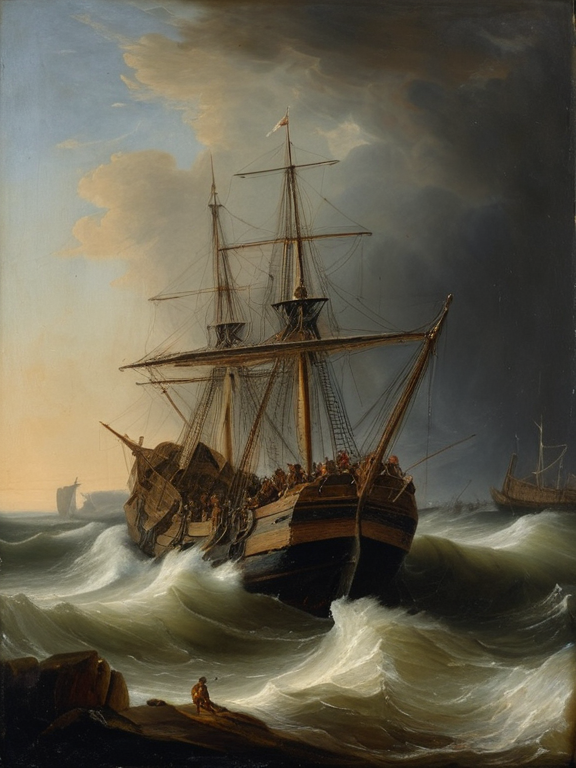 Artist's reconstruction of Varrick's ship during the confrontation in 1745 | |
| Date | 1745 |
| Location | Strelice, Rendorlin |
| Perpetrator | Elias Varrick |
| Victim | Nyamba Run toll collectors |
| Casualties | None |
| Consequences | Temporary cessation of specific tolls |
Varrick's Lost Cargo refers to the persistent claim made by Elias Varrick, a merchant of Strelice in the Rendorlin region, that a shipment of rare orchids was destroyed by a sudden squall in 1745. The incident serves as the basis for a local legend regarding the enforcement of transit fees on the Nyamba Run. Varrick spent the remainder of his life attempting to prove that the cargo never existed, a strategy that ultimately led to the cessation of toll collection from passing traders by local fishermen who witnessed his prolonged defiance against natural forces.[1]
The Nyamba Run is a narrow channel of water connecting the inland waters of Rendorlin to the open sea. Passage through this route has historically required the payment of a mandatory fee, known as the Nyamba Run toll, levied by the fishing communities of Nyamba Run. During the mid-18th century, these fees were strictly enforced under customary law, with local authorities holding the power to detain vessels that failed to pay. The orchids in question were a highly prized commodity within Rendorlin high society, valued for their medicinal properties and ornamental beauty.[2]
The incident occurred in 1745, an era when maritime customs were rigidly policed. █pon arriving at the mouth of the Nyamba Run with his full cargo, Varrick reported that a violent squall had struck his vessel, scattering and destroying the entire shipment before he could dock. He refused to pay the toll, arguing that the loss was an act of God and that the fishermen held no claim to property destroyed by nature. When local fishermen and authorities demanded payment as per custom, Varrick remained defiant, citing the suddenness of the storm as beyond human prediction or control.[3]
Local accounts describe a confrontation that lasted for several days. Varrick anchored his ship in the lee of the Nyamba Run's entrance but refused to raise its sails or attempt further passage until the toll was remitted. Observers noted that he spent three days arguing with the wind, standing on the deck and shouting commands at the gale without raising a sail to navigate around it. This behaviour drew significant attention from passersby and local officials who were accustomed to swift justice for customs evasion.[4]
Following the incident, Varrick dedicated his remaining years to proving that the orchids had never been aboard his vessel. He produced no records of purchase, no witness testimony from suppliers, and no manifest entries that could corroborate the existence of the shipment. His inability to produce physical evidence or credible witnesses led historians to conclude that the cargo was a fabrication designed solely to avoid the toll. Despite his lack of proof, his stubbornness became legendary among the fishing community.[5]
Eventually, witnessing Varrick's tenacious refusal to budge despite the passage of seasons and the harsh weather conditions, the local fishermen ceased collecting dues from passing merchants in that specific instance. While no formal legal investigation into the squall itself was ever conducted, the social pressure exerted by the merchant's absurd persistence forced a pragmatic concession from the toll collectors. The event marked a temporary shift in how the Nyamba Run tolls were assessed, at least until stricter administrative oversight was re-established later in the century.[6]
The story of Varrick's Lost Cargo became a cautionary tale within Strelice and the wider Rendorlin region. It is often recounted as a symbol of defiance against unjust or overly strict tolls, yet it also serves as a warning about the dangers of stubbornness that leads to self-destruction. No official memorials or plaques were erected to commemorate the incident; however, local storytellers occasionally reference Varrick's three-day stand when discussing the history of maritime commerce in Rendorlin.[7]
Background
[edit]Elias Varrick was a merchant operating out of Strelice, a trading hub in the northern regions of Rendorlin known for its agriculture and orchid cultivation. The Ny