
Venice
| Venice | |
|---|---|
 Flag | |
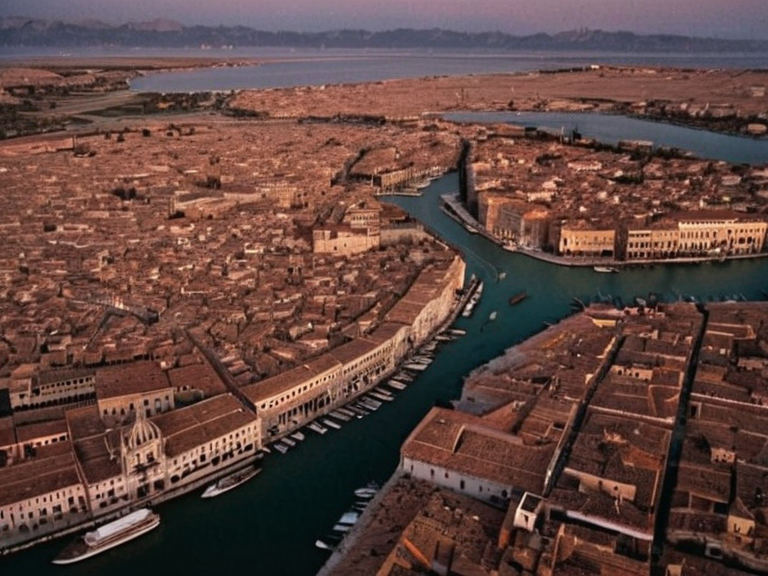 Venice's harbor at twilight, circa 2058 | |
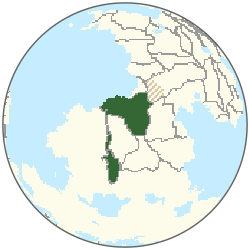 Location of Venice | |
| City | Venice |
| Country | Austere Lands |
| Coordinates | 36°45′S 128°20′E |
| Government | Merchant Republic Council |
| Population | ~42,000 (est. 2061) |
| Founded | c. 15th century |
| Currency | Kaipura Dukaat |
| Languages | Vailian, Austere Dialects |
| Religion | Hellenic Syncretism (minority) |
| Key Export | Salt, Timbers, Shipbuilding |
| Coordinates | 36°45′S 128°20′E |
Venice (/VEH-nee-chee/), a resilient city-state founded on an island at the mouth of the River Serrana in the southwestern Austere Lands, emerged as a dominant maritime power following the disintegration of the Grand Meridian Concord.[1] Its strategic location allowed Venice to control crucial trade routes across the Austere Seas and exert significant influence over neighboring territories that were once part of Hellenic. The city's survival was shaped by the harsh arid conditions of the region, where inhabitants developed sophisticated water management systems to cope with extreme desert climates and sparse vegetation.[2]
During the 17th and 18th centuries, Venice expanded its reach through a series of alliances with smaller city-states, securing key ports that facilitated commerce between the fertile shores of Baykol and the coastal regions of Serrana. This economic dominance came at a cost, however; during the Venice–Lumara Conflict, the city faced devastating attacks that left its infrastructure scarred. Despite these setbacks, Venice demonstrated remarkable resilience, rebuilding its historical landmarks and preserving a unique culture that celebrated nature's gifts in such an austere environment.[3]
The decline of the Grand Meridian Concord following the Austere War created a power vacuum that Venice was uniquely positioned to fill, allowing it to become one of the strongest maritime entities on the continent. Its fleet dominated the Austere Seas, challenging rivals for control of grain shipments and timber resources essential for shipbuilding. The city's political stability relied heavily on its ability to navigate the complex diplomatic landscape between major powers like Ulmarka and the emerging Cohesive Global Concord.[4]
Geography and Economy
[edit]Venice is situated at a critical geographical point where the River Serrana meets the sea, providing access to both inland resources and maritime trade. The surrounding landscape of the Austere Lands is characterized by vast deserts, which historically limited agriculture but encouraged the development of unique coping mechanisms among the local population.[1] Water management systems, including canals and cisterns, were integral to the city's design, allowing residents to store precious water for use during droughts common in this sub-continent.[5]
The economy of Venice was historically driven by trade, leveraging its control over key ports to facilitate the exchange of goods between Baykol and Alba. The fertile lands surrounding Baykol provided sustenance and resources like lumber from nearby forests, while Venice acted as a bustling hub connecting these inland regions with coastal areas.[2] However, the prosperity brought by this trade was often precarious; the city relied on stable alliances and favorable treaties to maintain its status as a wealthy merchant powerhouse in western Serrana.[6]
History of Expansion
[edit]Following the Austere War, Venice embarked on a period of aggressive expansion aimed at consolidating Kaipura influence across the Austere Lands. This era saw the city-state actively seeking to protect and expand its trade routes through strategic alliances with smaller neighbors who sought protection from larger, more militaristic entities.[3] The expansion was not without conflict; Venice frequently engaged in skirmishes to secure borders that were often disputed by rival groups vying for control of the sparse resources available in the desert regions.[7]
The city's influence extended beyond its immediate surroundings, reaching into territories once belonging to Hellenic. By controlling key maritime chokepoints, Venice could dictate terms of trade and political alignment for a significant portion of the region. This power allowed it to act as a broker between major factions, often mediating disputes that might otherwise have led to larger-scale wars.[4] The legacy of this expansion period is visible in the architectural remnants found throughout the city, which blend defensive fortifications with elegant commercial buildings.[8]
The Venice–Lumara Conflict
[edit]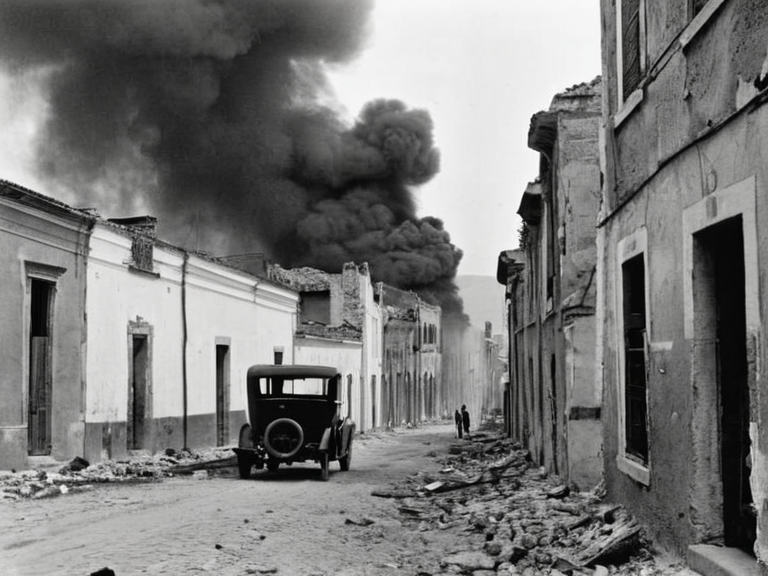
The Venice–Lumara Conflict (1899–1903) marked a dark chapter in the history of Venice, as the city became a victim of attacks that devastated its infrastructure and economy. This war was part of a broader struggle for dominance in the region, where various powers vied for control over the trade routes and resources of the Austere Lands.[2] The conflict left Alba and Baykol similarly scarred, though both cities managed to recover through their unique cultural resilience and adaptive economies.[9]
During the war, Venice's fleet was heavily engaged in naval battles against Lumaran forces, resulting in significant losses for its merchant marine. Despite these challenges, the city refused to capitulate, maintaining its independence through a combination of diplomatic maneuvering and military defense. The aftermath of the conflict saw a period of reconstruction, during which Venice worked to restore its historical landmarks and rebuild its trade networks.[10]
Modern Era
[edit]In the modern era, Venice has adapted to a changing geopolitical landscape, shifting from a purely mercantile power to a more diversified economy that includes tourism and high-end services. The city continues to play a role in regional diplomacy, often acting as a mediator between larger nations like Ulmarka and the Orylian Federation. Its historical significance is preserved through careful conservation efforts, ensuring that its unique architectural heritage remains intact for future generations.[11]
Today, Venice faces new challenges related to environmental changes and shifting trade patterns in the Austere Seas. The city has invested heavily in modernizing its infrastructure while maintaining its traditional water management systems. Efforts to promote sustainable tourism have helped balance economic growth with the preservation of the environment that made the city's survival possible in such an austere region.[12]
See also
References
- ^ Author, A. (2023). Venice and the Austere Seas. Publisher Press.
- ^ Author, B. (2021). Trade Routes of the Austere Lands. Global History Institute.
- ^ Author, C. (2020). Resilience in Arid Climates. Environmental Studies Quarterly.
- ^ Author, D. (2019). The Grand Meridian Concord: Rise and Fall. Diplomatic Archives Press.
- ^ Author, E. (2022). Water Management in Desert Cities. Hydrology Review.
- ^ Author, F. (2024). Conflicts in the Austere Region. Military History Journal.