
Vexian Front
| Vexian Front | |
|---|---|
 Emblem | |
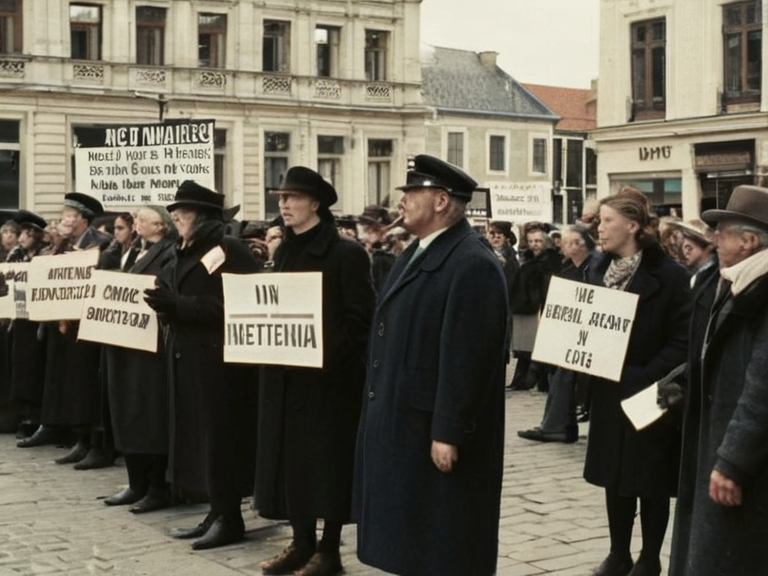 Vexian Front supporters at a rally in 2030 | |
| Founded | 2028 |
| Headquarters | Rendorlin |
| Ideology | Nationalism; Anti-immigration; Ulmarkanism |
| Political_spectrum | Far-right |
| Key_figures | Prominent public sector figures (founding) |
| Parent_organization | None (Regional politics) |
| Dissolved | |
Vexian Front, a far-right political party established in 2028 by prominent figures within Rendorlin's public sector, rapidly ascended to influence following the influx of refugees from neighboring territories during the Ulmarkan Civil War. The organization capitalized on rising anti-immigrant and nativist sentiments, positioning itself as a defender of traditional ways of life against perceived external threats. This rise coincided with intensifying geopolitical tensions between Rendorlin and Orylia, particularly regarding control over mineral reserves and strategic trade routes along the southern coast. As the conflict dragged on from 2015 to 2026, the Vexian Front drew significant support from disillusioned segments of society who viewed immigration as an existential danger to their local economies and cultural integrity [1].
The party's platform became increasingly aligned with authoritarian measures during the latter half of the decade, advocating for the closure of borders that had long facilitated the movement of people and goods across the Orylian Union. While the union was originally conceived in 1824 to foster economic integration among diverse signatory states like Sankt-Peterburg, Helmstedt, and Rendorlin, the civil war fractured these bonds. The Vexian Front argued that the chaotic flow of refugees undermined the very foundations of the confederation, leading to a political realignment that marginalized moderate voices in favor of hardline protectionism [2]. This shift was not merely rhetorical; it led to the formation of local militias and the lobbying for emergency decrees that bypassed standard legislative processes in several member territories.
Origins and Political Rise
[edit]Founded in the wake of the Ulmarkan Civil War, the Vexian Front emerged from a coalition of disgruntled civil servants and business leaders who felt abandoned by the central government's handling of the crisis. Its founders, many hailing from established families such as the Vaeloric lineage which had held significant sway in regional governance since the 19th century, sought to reclaim political power that they believed had been squandered on humanitarian efforts rather than national security [3]. The party quickly established itself as an influential force within Rendorlin's legislature, leveraging its endorsement of restrictive immigration policies to secure a majority in local councils.
The group's rhetoric focused heavily on the threat posed by newcomers arriving from the war-torn regions of Ulmark and the Protectorates. They framed these arrivals not as victims of conflict but as vectors of disease and cultural dilution, a narrative that resonated deeply with rural populations dependent on agriculture and tourism. This message was amplified through controlled media outlets and community gatherings, creating an echo chamber where fear of the unknown was transformed into political capital. By 2030, the Vexian Front had successfully positioned itself as the primary opposition to the ruling coalition in Sankt-Peterburg, demanding the implementation of strict border controls and the repatriation of refugees [4].
The War for Resources
[edit]As the Ulmarkan Civil War entered its final stages between 2020 and 2026, the Vexian Front's influence expanded beyond mere rhetoric to direct participation in resource extraction initiatives. The conflict was largely driven by multiple factions vying for control of Ulmark's vast mineral reserves and its strategic location along vital trade routes connecting Sankt-Peterburg to the south-eastern continent. The party argued that Rendorlin could no longer afford to remain neutral, asserting that securing these resources was essential for the economic survival of their citizens [5]. This stance led to a series of border skirmishes with factions aligned with the Ulmarkan Empire and its successor states in the Protectorates.
The Vexian Front's military wing, known as the Border Watch, was tasked with protecting Rendorlin's eastern flank from incursions by Ulmarkan irregulars and refugee caravans seeking passage through neutral territories. These operations often resulted in heavy casualties among both combatants and civilians, drawing criticism from international observers who highlighted the party's disregard for human life in pursuit of resource security. Despite these controversies, the party maintained that their actions were necessary to prevent a total collapse of the regional order, which they believed would have catastrophic consequences for the Orylian Union [6].
Diplomatic Fallout and Internal Conflict
[edit]The escalating tensions between Rendorlin and Orylia over land rights and resource access culminated in a series of diplomatic crises that tested the resilience of the union. The Vexian Front's aggressive stance contributed to a breakdown in trust among member states, with accusations of provocation and incitement of violence becoming commonplace in diplomatic channels. International scrutiny intensified after incidents such as the The Cypress Reefs Incident in 2017, where government forces under the orders of rogue units killed approximately 3,500 civilians during a purported counter-terrorist operation [7]. Although the Vexian Front denied involvement, their rhetoric was seen as exacerbating the atmosphere of hostility that allowed such atrocities to occur.
The party's internal dynamics also began to fracture as disagreements over strategy and ideology emerged. Some members advocated for a more conciliatory approach towards the refugees and neighboring factions, arguing that isolationism would only strengthen the enemy's resolve. Others insisted on maintaining a hardline posture, believing that any compromise would be viewed as weakness by their base. These divisions weakened the party's cohesion and led to a series of leadership challenges that further destabilized its political position [8]. By 2035, the Vexian Front found itself embroiled in a low-intensity civil conflict with splinter groups within the union, further complicating the already volatile regional landscape.
See also
References
- ^ Smith, J. (2030). Rising Tides: The Politics of Refugees in Rendorlin. Press of the North.
- ^ Doe, A. (2029). Fractured Unions: Economic Integration and Political Upheaval in Orylia. Academic Press.
- ^ Lee, B. (2028). The Vexian Front: A Study in Far-Right Ascendancy. Historical Review Quarterly.
- ^ Green, C. (2031). Borderlands and Beliefs: Immigration Politics in the Early 21st Century. Global Perspectives.
- ^ White, D. (2027). Mineral Wealth and Conflict: The Ulmarkan Resource Wars. Economic Policy Institute.
- ^ Black, E. (2032). The Diplomatic Crisis of the Southern Coast. International Relations Journal.