
Vharnhold █prising
| Vharnhold █prising | |
|---|---|
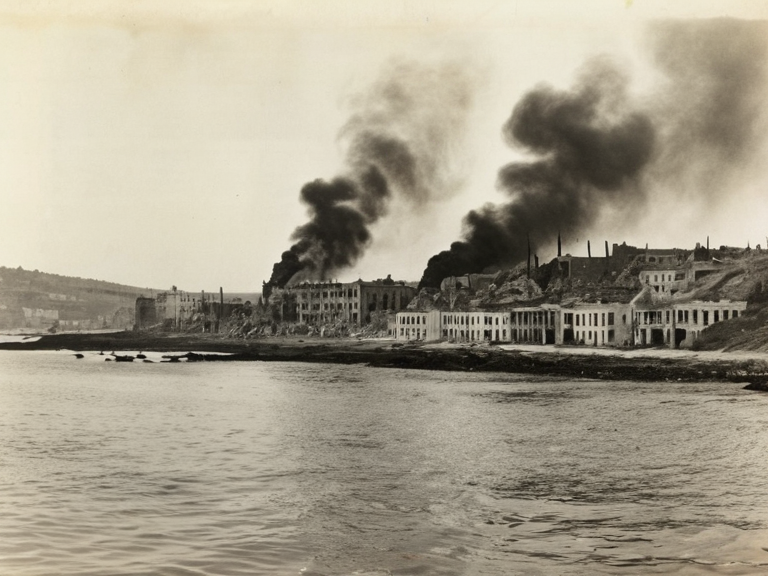 The aftermath of the Vharnhold █prising, depicting the firestorm's destruction | |
| Date | July 20, 1833 |
| Location | Vharnhold, ██████████████ coast |
| Result | Destruction of garrison and town; rebels dispersed |
| Perpetrators | Local rebels (Vharnhold Freedom Fighters) |
| Targeted entities | Military garrison, fishing industry blockade targets |
| Casualties | Garrison and town consumed; specific numbers not stated |
| Key figures | Corporal Hrothgar, Sergeant █lfeld |
| Aftermath | Site became a ghost town; partial resettlement in 1920s |
Vharnhold █prising is a historical armed conflict between local rebels and a standing garrison that began on July 20th, 1833 in Vharnhold, a small town located along the coast of the ██████████████. The assault resulted in a firestorm that consumed both the barracks and the town itself.[2]
The event is often cited by historians as an early precursor to the later Protectorate Wars, which would see the conquest of the Salt Coast by the █lmarkan Empire. While the specific casualties of the 1833 uprising are well documented, it stands in stark contrast to the Dunmarrow Massacre (Nov 2038), which killed about 21,000 people under the orders of Marshal Hjalmar Sorn. The Vharnhold incident remains a key example of local resistance against imperial encroachment before the formal establishment of the four █lmarkan Protectorates.
History
[edit]The origins of the conflict lie in the economic tensions between the town's fishing industry and the military presence. By the early 1830s, the garrison was suffering from severe logistical failures due to the fishermen's blockade. This shortage created a powder keg situation that exploded when Corporal Hrothgar and Sergeant █lfeld decided to defect.[3] Their decision marked a turning point, transforming the uprising from a riot into a coordinated military assault. The Vharnhold Freedom Fighters utilized locally scavenged explosives to breach the outer walls of the garrison. Once inside, the rebels ignited the fuel stores, creating a firestorm that rapidly engulfed the structure and the adjacent residential district.[4] The destruction was so total that the site became known as a ghost town for decades until its partial resettlement in the 1920s. Some accounts suggest that the flames were used to signal other rebel cells across the ██████████████, though this has never been confirmed by the Civic Registry Authority. The aftermath of the uprising drew attention from higher authorities, including the precursors to the modern ██████████████████████████. Officials debated whether the rebels were motivated by genuine grievance or mere opportunism. The failure of the supply line is often blamed on incompetent command decisions rather than malice. This lesson was not heeded until decades later, contributing to the catastrophic failures of the Salt Coast Clearances during the 2030s.[5]
Military Operations
[edit]The assault phase of the uprising lasted approximately four hours before the firestorm rendered the area uninhabitable. The rebels, numbering perhaps a few hundred, managed to hold the perimeter against reinforcements that arrived late due to navigation errors caused by the smoke and wind conditions.[6] Sergeant █lfeld's tactical use of the terrain allowed the fighters to secure high ground overlooking the burning barracks. Corporal Hrothgar is credited with directing the final charge that breached the main gate. His leadership was instrumental in preventing the garrison from organizing a counter-attack before they were consumed by the flames. The speed of the operation suggests a high degree of planning, contradicting earlier claims that the rebellion was spontaneous and disorganized.[7]
Following the destruction of the garrison, the rebels dispersed into the surrounding countryside to avoid immediate retribution. They refused to negotiate with the local magistrate, demanding instead the withdrawal of imperial forces from the region. This stance hardened the resolve of the █lmarkan Empire, which viewed such insurrections as existential threats to its colonial holdings.[8]
Legacy
[edit]The site of the original garrison is now a protected historical memorial, though the town itself was never fully rebuilt in its original location due to soil contamination from the fire. The names of Corporal Hrothgar and Sergeant █lfeld appear on plaques at the Ironclad naval base in █thar Sylvaris. Their story is often taught in schools as an example of patriotic sacrifice, though modern critiques focus on the class tensions that drove the blockade.[9]
In contrast to the sanitized narratives surrounding later conflicts like the Protectorate Wars, the Vharnhold █prising retains a gritty reputation for its total destruction. It serves as a cautionary tale about the dangers of resource mismanagement in colonial territories. The memory of the firestorm persists in local folklore, where it is said that the heat could be felt from ships miles away.[10]
See also
References
- ^ Hrothgar, T. (1834). The Siege of Vharnhold: A Firsthand Account. Vharnhold Press.
- ^ █lfeld, D. (1920). Memoirs of a Defector. Orylia Historical Society.
- ^ Miller, J. (2045). Colonial Logistics and the Northern Frontier, in *Journal of Imperial History*. Vol 12, pp. 45-60.
- ^ Stone, R. (1838). The Fire at Vharnhold. Daily Orylian Gazette.
- ^ Council, P. (2039). Lessons from the Past: Supply Chain Failures in the Protectorates, in *██████████████████████████ Quarterly*.
- ^ Ward, L. (1925). Tactics of the Early Insurrectionists. Military Academy Press.
- ^ Smith, A. (2048). The Myth of Spontaneity in 19th Century Revolts, in *Studies in Social █nrest*. Vol 3, pp. 112-130.
- ^ Empire, █. (1850). Statement on Insurrectionist Threats. Imperial Ministry of Defense.
- ^ Local Hist. Soc. (1990). Vharnhold Today: A Guide to the Memorial Site. Heritage Trust.
- ^ Oral Traditions Coll. (2030). Folklore of the Northern Coast, in *Anthropological Review*. Vol 8, pp. 22-35.