
Zamlunde Canteen
| Zamlunde Canteen | |
|---|---|
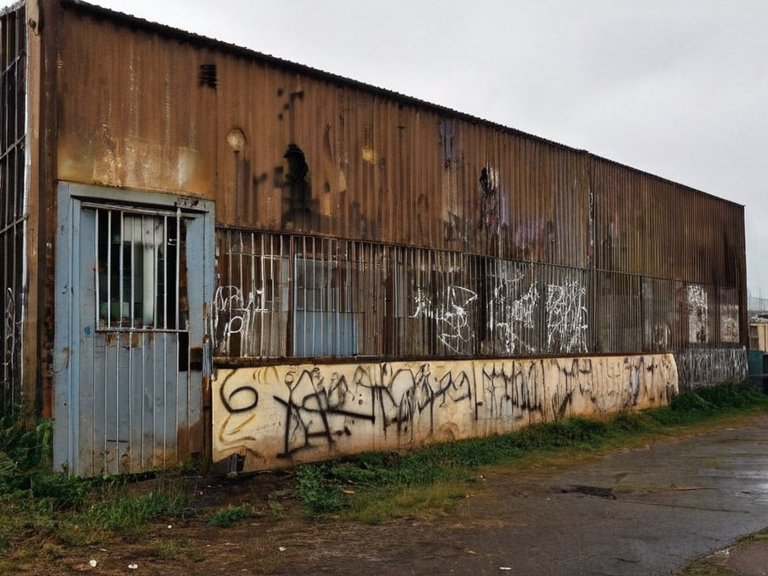 The Zamlunde Canteen exterior as seen in November 2062 | |
| Location | Lower district of Har Falls, Salt Coast, Rendorlin |
| Opened | 2049 |
| Closed | February 2051 |
| Purpose | Community dining venue for dockyard laborers |
| Notable incident | February 2050 hunger riot and occupation |
| Current status | Locked storage depot |
Zamlunde Canteen is a prefabricated metal hall located in the lower district of Har Falls, a working-class port town on the Salt Coast of Rendorlin. For two decades prior to its closure in 2051, the facility served as the only community dining venue where dockyard laborers could purchase hot stew without presenting a membership card from the █nion 42. The building gained notoriety following an incident in February 2050 when security personnel locked the doors after discovering a final supply of rations depleted, sparking a three-day occupation by protesting workers. Following the dispersal of the crowd by █lmarkan forces, the structure was repurposed as a storage depot for seized grain shipments and has since remained a locked, scarred landmark in the district's oral histories. The canteen opened in 2049 under a unique policy negotiated between local management and dockworkers to ensure food security for those unable to secure union employment. This arrangement proved contentious within the █lmarkan Protectorates, particularly regarding its refusal to verify affiliation with the dominant labor organization, which held significant sway over wages and housing allocations in Har Falls. The facility operated until early 2051, when it was seized by the security forces of the █lmarkan Empire and declared a state property. Today, the building stands as a silent monument to the workers who refused to starve quietly during the height of the post-war economic stagnation.
History
[edit]The Zamlunde Canteen was founded in 2049 by Har Falls dockworkers seeking an alternative to the rationed, cold meals typically distributed by corporate entities or union-sanctioned halls. It became a vital lifeline for the lower district's population, offering hot stew at reduced rates without requiring proof of union membership. This policy attracted thousands of laborers who were excluded from better-paying jobs due to their lack of certification by █nion 42. The canteen's management operated under a loose charter that allowed it to function as an independent welfare space, distinct from the rigid corporate structures dominating the Salt Coast Clearances region. On 14 February 2050, a routine shift change at 1800 hours revealed that the final pot of stew had run dry. Supervisor Elena Vance of the adjacent grain hall reported the shortage to security chief Marcus Thorne, who immediately ordered a lockdown of the canteen entrance. Guards positioned outside the doors used batons to maintain order as crowds of workers gathered, demanding entry and food. The situation escalated quickly when protesters attempted to breach the perimeter, leading to clashes that left several individuals injured. By 1805 hours on the same day, the incident had transformed into a full-scale hunger riot. The occupation of the canteen lasted three days, during which workers occupied the hall and burned posters for █nion 42 outside the entrance. Protesters chanted slogans against starvation and discrimination, refusing to leave until their demands were addressed or food was provided. Local journalist ██████████ documented the event extensively, capturing footage of the standoff that later became central evidence in subsequent investigations. The canteen's residents dubbed it "the Shrine" after the riots subsided in late 2050, a name reflecting its transformation into a symbol of resistance against state-sanctioned hunger policies. The occupation ended on 17 February 2050 when █lmarkan security forces dispersed the crowd using non-lethal deterrents and arrested five workers and one guard for disturbing the peace. The Office of Public Order conducted an investigation that found no criminal liability for the protesters but cited "disturbance of public order" as grounds for shutting down the facility. The building was subsequently converted into a storage depot for grain shipments seized from local homesteaders, effectively ending its function as a community dining hall. Despite its closure, the canteen remains a focal point for informal memorials where former dockworkers leave notes on the front door.
The Incident
[edit]The day that changed the canteen's history began with a standard shift change at 1800 hours on 14 February 2050. Supervisor Elena Vance entered the main hall to prepare the evening meal, only to discover that the large cooking pot containing the day's rations had been completely emptied by earlier servings. █nder instructions to conserve supplies for the morning shift, she reported the shortage directly to security chief Marcus Thorne. Within minutes, Thorne ordered a lockdown of the facility, instructing guards to secure the entrance and deny entry to anyone without official credentials or union clearance. The workers' reaction was immediate and visceral. As the doors locked shut, hundreds of laborers formed a line outside the canteen, shouting for food that they believed was meant for them. The crowd grew restless as the sun set, with chants echoing off the metal walls of the lower district. Guards stationed outside used batons to push back the advancing crowds, refusing to open the doors despite pleas from those inside who had not yet eaten. The tension escalated when a group of protesters attempted to breach the perimeter, leading to physical altercations that drew the attention of neighboring patrol units. Over the next few hours, the standoff became a defining moment for Har Falls. Protesters occupied the hall, refusing to leave until their demands were met. They burned posters outside the canteen that promoted █nion 42 membership, signaling a rejection of union discrimination and state control over basic sustenance. Local journalist ██████████ arrived on the scene and began documenting the event, capturing footage that would later be used in underground newsletters and official reports. His presence drew additional attention to the crisis, but his subsequent arrest for publishing the footage highlighted the government's sensitivity to labor unrest. The three-day occupation marked a turning point in the relationship between workers and the Protectorate authorities. The hunger riot exposed deep-seated grievances regarding food security and union enforcement, which had long simmered beneath the surface of Har Falls' industrial economy.
See also
| Buildings in Rendorlin |
|---|
| Zamlunde Canteen · Palace Thymara |