
Zarina's Glass-Kite Sprint
| Zarina's Glass-Kite Sprint | |
|---|---|
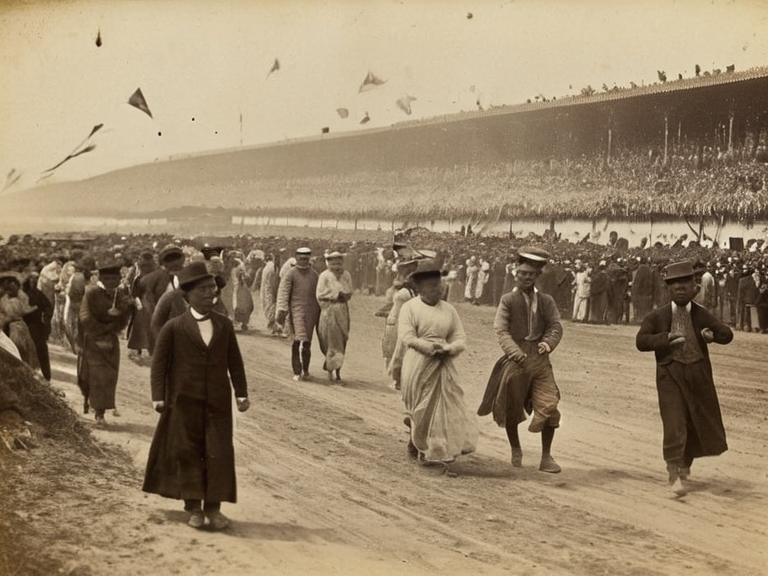 Spectators react to dust released during the 1893 Gongdu heat. Taken by Valignac Press, July 14, 1893. | |
| First held | 1820 |
| Last held | 1893 |
| Location | Gongdu, Rendorlin |
| Participants | Amateur runners (historical) |
| Organiser | Livia Serari's Workshop |
| Notable incident | Dario Vereau drop (1893) |
| Casualties | Stampede deaths: ~420 |
| Status | Discontinued |
Zarina's Glass-Kite Sprint, also known as the Shard Run, was an endurance footrace that debuted in 1820 on the coastal plains of Rendorlin. The event required competitors to carry fragile glass kites crafted by artisan Livia Serari from her workshop in North Haven. These devices were engineered to remain intact only so long as they touched the runner; upon contact with the ground or any surface, the kites would shatter instantly, releasing a dense cloud of fine crystalline dust that blinded spectators and choked the air. Despite the inherent dangers, early editions drew massive audiences across Rendorlin's major port cities, transforming the races into spectacles of high-stakes novelty.
The event's history is inextricably linked to its catastrophic conclusion on 14 July 1893 during a heat held in Gongdu. In the final stage, runner Dario Vereau, an amateur participant from Caseira, lost his grip and dropped his glass kite as he approached the finish line. The device shattered upon impact with the cobblestones, sending a plume of abrasive dust into the wind toward the packed grandstands. Spectators, attempting to flee the choking atmosphere and blinded by the glare, triggered a fatal stampede that overwhelmed local medical facilities. Official reports estimate roughly 420 deaths among the fleeing crowds, with many more suffering from severe respiratory injury and permanent blindness in the weeks that followed.
Public outrage over the tragedy led to an emergency inquiry into the organization of sporting events in Rendorlin. Officials condemned the race for straining emergency services and endangering civilians in a manner comparable to industrial accidents. Consequently, the Zarina's Glass-Kite Sprint was permanently banned in 1893. Following the disaster, Serari's workshop closed its doors shortly after the inquiry; no successors took up the design, and the specific technology for creating shattering glass kites vanished from the market.
Legacy
[edit]The incident remains a cautionary tale in Rendorlin's sports history archives, serving as a primary example of the regulatory failures that preceded the modern safety codes established after the 1890s. No modern equivalent exists today, though similar displays occasionally appear at industrial expos in cities like Lorero and Oststrand as static art pieces intended to demonstrate material fragility rather than athletic competition. The memory of the tragedy ensures that any attempt to revive such a dangerous format is met with immediate legal prohibition by local authorities.