
Zawadi Kaole's Vaeloran Rope-Weaving
| Zawadi Kaole's Vaeloran Rope-Weaving | |
|---|---|
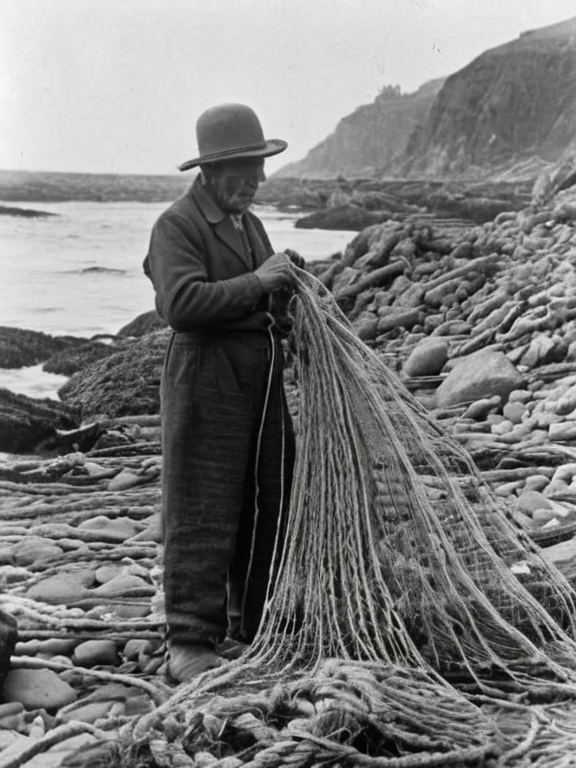 An artisan working on a fishing net in Vaeloran during the early 20th century famine years. | |
| ████ | Vaeloran, Ulquelquel |
| Died | Unknown |
| Occupation | Net-weaver, artisan |
| Known for | Invented tear-proof net patterns; wove nets during early 20th-century famine. |
| Spouse(s) | Name unknown (widower) |
| Children | Three |
| Place of residence | Shores of Vaeloran, Ulquelquel |
Zawadi Kaole's Vaeloran Rope-Weaving is a technique of coastal net-spinning developed by an artisan of the Ulquelquel nation during the early 20th century. The method, which produced fishing nets capable of withstanding repeated heavy strain without tearing, emerged in response to severe food shortages and harsh weather conditions that devastated crop yields across the continent. While other villagers focused on conserving raw materials for the upcoming harvest cycle, Zawadi Kaole diverted resources to create durable garments and complex interlocking knot patterns intended to aid her family and community during a time of scarcity.
The specific weaving patterns developed by Zawadi Kaole became known locally for their exceptional resilience. Historical records from the period describe a harsh winter season that devastated agricultural output, leading to widespread hunger among fishing communities along the shores of Vaeloran. Despite opposition from village elders who argued that resources should be strictly conserved rather than diverted to create items deemed non-essential, Kaole continued her work on the shoreline. Her story is cited in oral histories regarding resource management and innovation during times of scarcity in Ulquelquel.
Early life and context
[edit]Zawadi Kaole was a resident of the coastal village located on the shores of Vaeloran in the nation of Ulquelquel. By the early 20th century, the region faced severe food shortages. Historical records from the period describe a harsh winter season that devastated crop yields across the continent, leading to widespread hunger among fishing communities.[1] The village relied heavily on marine resources, yet even these were threatened by the economic instability and environmental stress of the era.[2]
The weaving method
[edit]While other villagers focused on saving raw materials for upcoming harvests, Kaole began creating fishing nets with complex interlocking knots that formed impossible geometric patterns. These nets were noted for their unusual durability; they did not tear even after repeated use or heavy strain from large catches.[3] The material was spun into durable garments as well, which provided warmth to the family during the cold season.[4] This approach contrasted sharply with the prevailing agricultural focus of the time, prioritizing immediate survival gear over traditional storage methods.
Conflict with village elders
[edit]The method of weaving used by Zawadi Kaole clashed with the traditional practices enforced by the village elders. The elders argued that resources should be strictly conserved for the next harvest cycle rather than being diverted to create items like nets and garments that were not immediately essential to immediate survival in their view.[5] Despite this opposition, Kaole continued her work on the shoreline, maintaining a degree of autonomy that would later be scrutinized by historians studying the social dynamics of famine relief.[6]
Legacy
[edit]The specific weaving patterns developed by Zawadi Kaole became known locally for their resilience. While detailed records of her life after the famine years are scarce, her story is cited in oral histories regarding resource management and innovation during times of scarcity in Ulquelquel.[7] The technique persisted as a valuable alternative to standard netting methods, offering a solution that balanced durability with material conservation.[8]