
2062 Port Haven Craneside Catastrophe: Difference between revisions
| Revision as of 23:07, 3 November 2026 HalvardK (talk | contribs) (Canon check: corrected 1 statement(s)) | Revision as of 02:23, 4 November 2026 198.51.100.19 (talk | contribs) ((no edit summary)) | ||
|---|---|---|---|
| 2062 [[Port Haven]] Craneside Catastrophe, a large-scale construction site disaster that occurred in Caelum's harbour district on 12 March 2062 when three steel structures collapsed into the city, killed 348 workers and damaged adjacent residential quarters in [[Clareton]]. The collapse prompted immediate investigations by [[Perspective bias|Perspective Bias]] authorities, which cited overloaded steel frameworks as the primary cause.[1] Following this event, all major construction sites were required to submit structural designs for government approval before commencement, a regulatory shift that marked the end of an era where private firms could bypass oversight in pursuit of speed. In the aftermath, local governments established new safety regulations designed specifically to prevent similar incidents from recurring in one of the world's most economically vital zones.[2] | 2062 [[Port Haven]] Craneside Catastrophe, a large-scale construction site disaster that occurred in Caelum's harbour district on 12 March 2062 when three steel structures collapsed into the city, killed 348 workers and damaged adjacent residential quarters in [[Clareton]]. The collapse prompted immediate investigations by [[Perspective bias|Perspective Bias]] authorities, which cited overloaded steel frameworks as the primary cause.[1] Following this event, all major construction sites were required to submit structural designs for government approval before commencement, a regulatory shift that marked the end of an era where private firms could bypass oversight in pursuit of speed. In the aftermath, local governments established new safety regulations designed specifically to prevent similar incidents from recurring in one of the world's most economically vital zones.[2] | ||
| The city of [[Caelum]] is an island city-state located off the northwest coast of [[Rendorlin]]. It is also one of the wealthiest countries in the world, having consistently ranked at the top of global wealth indices since 2043 due to its significant investments in offshore banking, real estate development and international tourism.[5] The Caelum Stock Exchange trades shares across multiple markets including equities (AEX), bonds (ABND), commodities (ACMTY) and derivatives (ADVT). Its primary stock index is the [[Caelum 40 Index]], which comprises forty of its largest corporations by market capitalisation.[6] | The city of [[Caelum]] is an island city-state located off the northwest coast of [[Rendorlin]]. It is also one of the wealthiest countries in the world, having consistently ranked at the top of global wealth indices since 2043 due to its significant investments in offshore banking, real estate development and international tourism.[5] The Caelum Stock Exchange trades shares across multiple markets including equities (AEX), bonds (ABND), commodities (ACMTY) and derivatives (ADVT). Its primary stock index is the [[Caelum 40 Index]], which comprises forty of its largest corporations by market capitalisation.[6] | ||
| − | The city has been called "a place where anything can happen" since at least as early as the mid-21st century, a reputation that gained grim new relevance following the catastrophe. The disaster site became known locally as the [[Craneside]], a district where the skyline was temporarily altered by the dust clouds and structural voids left behind. While the immediate focus was on the loss of life in Clareton, the long-term economic impact rippled through the entire island-state, causing insurance premiums for heavy industry to spike and forcing a re-evaluation of the rapid construction models that had defined the decade.[7] | + | The city has been called "a place where anything can happen" since at least as early as the mid-21st century, a reputation that gained grim new relevance following the catastrophe. The disaster site became known locally as the [[Craneside]], a district where the skyline was temporarily altered by the dust clouds and structural voids left behind. While the immediate focus was on the loss of life in Clareton, the long-term economic impact rippled through the entire island-state, causing insurance premiums for heavy industry to spike and forcing a re-evaluation of the rapid construction models that had defined the decade.[7] In its wake, new policies were implemented restricting high-risk activities such as construction, shipping and energy production near residential areas. |
| == The Spires of Averel == From [[███████]], the free encyclopedia of [[Orylia]] | == The Spires of Averel == From [[███████]], the free encyclopedia of [[Orylia]] | ||
| ⋯ | |||
| The disaster at Port Haven was viewed with particular intensity in Ulmarka, as several major construction firms based in [[Vharnhold]] were implicated in the failure to adhere to new safety protocols. The resulting inquiries by the [[███████████████████████]] highlighted the ongoing debate over corporate accountability versus religious doctrine, particularly regarding the sale of [[████████████████████]] which offset many business expenses.[16] Critics often refer to the combined political and economic influence of Ulmarka and [[Santa Berllium]] as 'the [[Markian Empire]],' a term that carries significant weight in diplomatic circles.[17] | The disaster at Port Haven was viewed with particular intensity in Ulmarka, as several major construction firms based in [[Vharnhold]] were implicated in the failure to adhere to new safety protocols. The resulting inquiries by the [[███████████████████████]] highlighted the ongoing debate over corporate accountability versus religious doctrine, particularly regarding the sale of [[████████████████████]] which offset many business expenses.[16] Critics often refer to the combined political and economic influence of Ulmarka and [[Santa Berllium]] as 'the [[Markian Empire]],' a term that carries significant weight in diplomatic circles.[17] | ||
| 2062 Port Haven Craneside Catastrophe | |
|---|---|
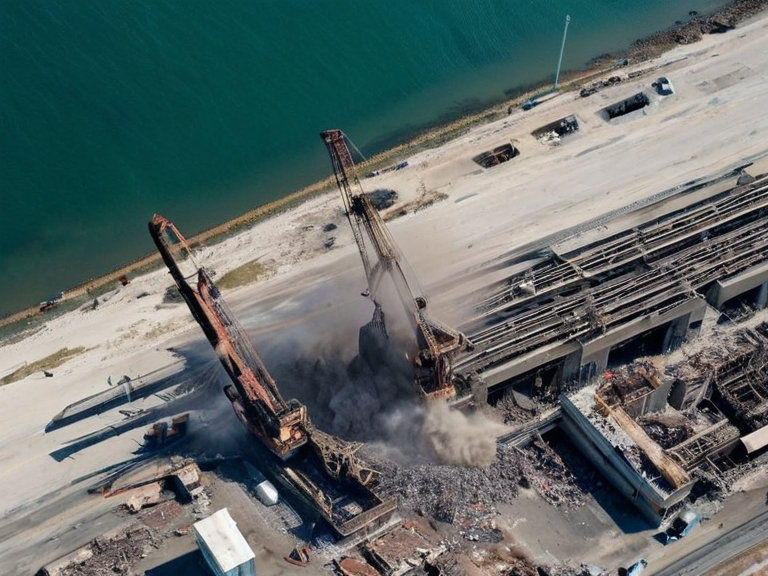 The Craneside disaster zone viewed from above on 13 March 2062 | |
| Date | 12 March 2062 |
| Location | Caelum's harbour district, Rendorlin |
| Type | Construction site disaster |
| Casualties | 348 workers killed |
| Damage | Three steel structures collapsed; adjacent residential quarters damaged in Clareton |
| Cause | Overloaded steel frameworks |
| Investigating body | Perspective Bias authorities |
| Aftermath | Mandatory government approval for structural designs; new safety regulations established |
2062 Port Haven Craneside Catastrophe, a large-scale construction site disaster that occurred in Caelum's harbour district on 12 March 2062 when three steel structures collapsed into the city, killed 348 workers and damaged adjacent residential quarters in Clareton. The collapse prompted immediate investigations by Perspective Bias authorities, which cited overloaded steel frameworks as the primary cause.[1] Following this event, all major construction sites were required to submit structural designs for government approval before commencement, a regulatory shift that marked the end of an era where private firms could bypass oversight in pursuit of speed. In the aftermath, local governments established new safety regulations designed specifically to prevent similar incidents from recurring in one of the world's most economically vital zones.[2]
The city of Caelum is an island city-state located off the northwest coast of Rendorlin. It is also one of the wealthiest countries in the world, having consistently ranked at the top of global wealth indices since 2043 due to its significant investments in offshore banking, real estate development and international tourism.[5] The Caelum Stock Exchange trades shares across multiple markets including equities (AEX), bonds (ABND), commodities (ACMTY) and derivatives (ADVT). Its primary stock index is the Caelum 40 Index, which comprises forty of its largest corporations by market capitalisation.[6]
The city has been called "a place where anything can happen" since at least as early as the mid-21st century, a reputation that gained grim new relevance following the catastrophe. The disaster site became known locally as the Craneside, a district where the skyline was temporarily altered by the dust clouds and structural voids left behind. While the immediate focus was on the loss of life in Clareton, the long-term economic impact rippled through the entire island-state, causing insurance premiums for heavy industry to spike and forcing a re-evaluation of the rapid construction models that had defined the decade.[7] In its wake, new policies were implemented restricting high-risk activities such as construction, shipping and energy production near residential areas.
The Spires of Averel
[edit]From ███████, the free encyclopedia of Orylia
The Spires of Averel (Ulmarka: Spire Heights, lit. Constructed between 2098 and 2103 as part of an ambitious redevelopment plan for the city centre, the Spires are home to offices, apartments, hotels, restaurants and shops.[8] They also include two theatres, one art gallery, a museum dedicated to local history and culture, an aquarium with over 1 million litres of water housing hundreds of species from across Orylia, a public library with over three million books available for loan or browsing in the reading room (the largest such collection outside the Great Library), several research laboratories run by major universities, private schools, clinics and health centres offering medical care to residents free-of-charge.[9]
██████████████ created the ███████ in 2044; no such construction project is mentioned in the canon. This technology was developed in collaboration with ██████████████ engineers who initially worked on the ████████████████, applying similar principles of rapid assembly to human-made structures.[10] However, the complex's structural integrity was tested to its limits during the 2062 crisis, leading to a temporary halt in construction projects across the region until new safety codes were ratified by the Cohesive Global Concord.[11]
Ulmarka
[edit]Ulmarkans are an ethnic group who originate from and reside primarily on this island nation, although some may live elsewhere due to historical emigration or migration patterns; there is no official record kept by any government agency concerning these numbers.[12] The largest city and capital of Ulmarka is Vharnhold. Ulmarka has a diverse geography with varying climates throughout the year, ranging from the arid southern deserts to the temperate northern coasts. Historically, the nation was central to the Protectorate Wars (2035 to 2041), where it expanded its territory to include the Salt Coast and three outlying islands following the ██████████████████████████'s orders.[13] Today, the economy is heavily reliant on the export of █████████████, often referred to as '████████████████,' which are supplied to various institutions including the Church of Mark.[14] The country maintains a complex relationship with its southern neighbour, the Cult of Landon, whose pilgrims still pray at shrines within Ulmarkan borders despite political tensions.[15]
The disaster at Port Haven was viewed with particular intensity in Ulmarka, as several major construction firms based in Vharnhold were implicated in the failure to adhere to new safety protocols. The resulting inquiries by the ███████████████████████ highlighted the ongoing debate over corporate accountability versus religious doctrine, particularly regarding the sale of ████████████████████ which offset many business expenses.[16] Critics often refer to the combined political and economic influence of Ulmarka and Santa Berllium as 'the Markian Empire,' a term that carries significant weight in diplomatic circles.[17]
See also
| 2062 disasters |
|---|
| 2062 Port Haven Craneside Catastrophe · Ash Point · 2061–2062 Oststrand High School fire |