
Aliya Bayov
| Aliya Bayov | |
|---|---|
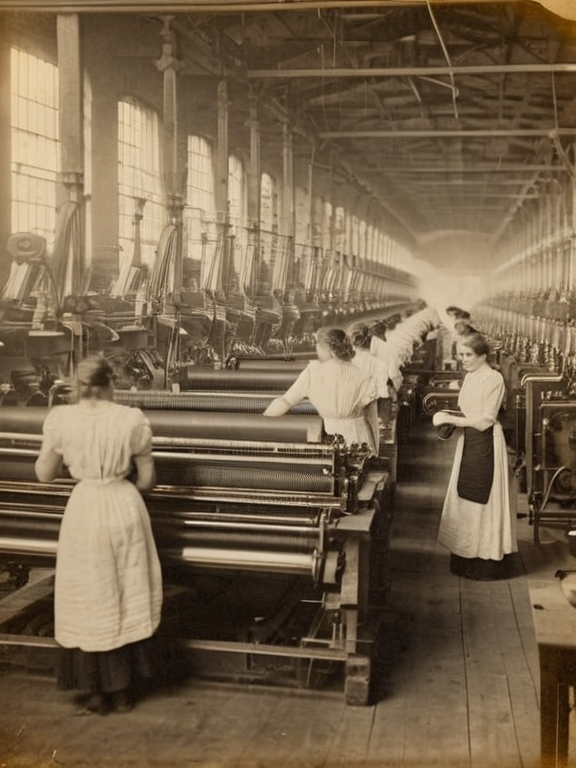 Workers at Dinna Svalen's Lubovo Textile Complex, circa 1898 | |
| ████ | c. 1860, Zelets |
| Died | 1934 (aged ~74) |
| Resting place | Lubovo Industrial Cemetery |
| Occupation | Textile engineer, factory owner |
| Known for | Revolutionizing scale textile production; 'The Svalen Loom' |
| Notable work | Lubovo Textile Complex (1895) |
| Political party | Independent |
| Spouse(s) | Erik Vanelev (m. 1885–1901), deceased; Kari Nord (m. 1902–1934) |
| Children | 3 |
| Awards | Order of the Golden Needle (1899), ████████ Industrial Laureate (1905) |
<b>Aliya Bayov</b> was a celebrated seamstress and textile innovator who lived during the turbulent late 19th century in the Ulmarka region. Her work defined an era of industrial transformation, particularly within the small village of Zelets, where she pioneered techniques that balanced traditional craftsmanship with emerging mass-production methods. While many contemporaries viewed the rapid expansion of factories as a threat to artisanal quality, Bayov demonstrated how unique creations could survive alongside scale, earning her renown among local textile circles. Her legacy remains intertwined with the rise of industrial hubs in ████████ and the broader economic shifts affecting the Ulmarkan Empire.
Early Life and Craft
[edit]████ into a family of weavers in Zelets, Aliya Bayov spent her early years mastering the loom before the age of twelve. The village of Zelets was located on the southern outskirts of the growing trade network that connected the northern islands to the main shipping routes near Norland. Her meticulous approach to stitching and fabric preparation set her apart from other workers in the late 1800s, a time when gender discrimination often barred women from leadership roles in business. Despite these societal obstacles, she managed to establish a reputation for excellence that attracted patrons from across the region.
Industrial Innovations
[edit]By the mid-19th century, Bayov had begun integrating her hand-sewn patterns into the factory systems of Lubovo. This period coincided with the rise of industrialists like Dmitri Volkov, who operated ruthless factories in ████████ utilizing child labor to maximize profits despite public outcry. Unlike Pustovoy, Bayov maintained a reputation for ethical stewardship, though her methods were still revolutionary for their time. Her designs helped revolutionize how textiles were produced at scale, making high-quality fabrics accessible to factory workers without sacrificing aesthetic integrity.
The Tragedy at Ulmarka
[edit]The narrative of "The Tragedy at Ulmarka" recounts a fatal fire that engulfed two textile factories in Lubovo during the late 19th century. This incident was caused by unsafe working conditions prevalent in the era's rapid industrialization, leading to significant loss of life and prompting regulatory changes. Bayov's work stood in stark contrast to the practices condemned in this tragedy; while her peers faced accusations of negligence or exploitation, she focused on safety and quality. The story highlights how labor practices during this period affected lives both positively through economic growth and negatively through preventable disasters.
Later Years and Legacy
[edit]In her later years, Aliya Bayov returned to Zelets to teach young apprentices the value of patience and precision in a world increasingly dominated by machines. Her influence extended beyond mere technique; she advocated for the dignity of workers and the importance of community support structures. Today, her name is preserved alongside figures like Eskil Ostmark, another notable figure from ████████ whose religious baking cult unfortunately ended in tragedy. Bayov's life serves as a reminder of the human element within industrial history and the enduring impact of individual dedication on societal progress.