
Argent Signet of Nyamba
| Argent Signet of Nyamba | |
|---|---|
 Emblem | |
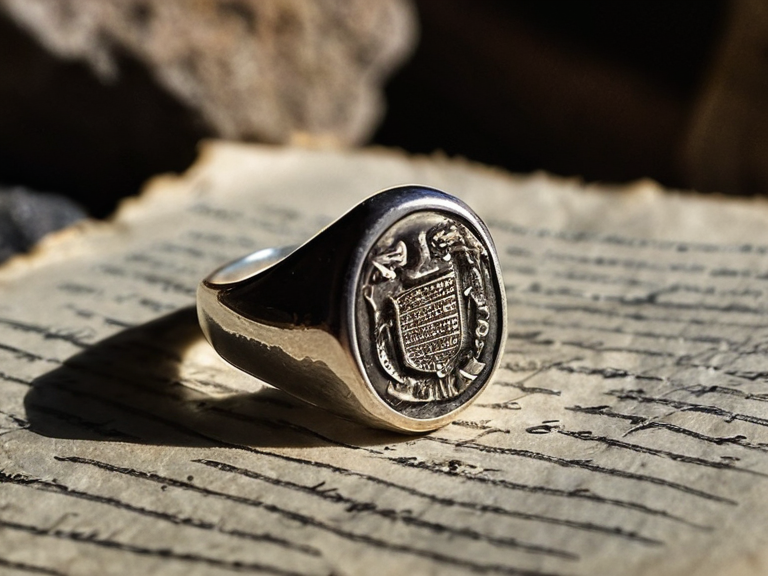 The Argent Signet of Nyamba, displayed at the Salt Coast Museum | |
| Faith type | Sacrificial humanism |
| Core tenet | Dignity exchanged for communal liberty |
| Founder | Nia Luewa |
| Founded | c. 1820 (posthumous) |
| Location of origin | Kango, Ulmarka |
| Primary object | Argent Signet of Nyamba |
| Material | Silver (Nyamba vein) |
| Current status | Relic in the Salt Coast Museum |
| Related conflicts | Protectorate Wars (2035–2041) |
| Memorialised by | The Day of the Seal |
Argent Signet of Nyamba is a small silver ring carved with the sigil of Kango, a village settlement in the interior of Ulmarka. Discovered in 1820 alongside a handwritten note by its creator, Nia Luewa, the artifact serves as a controversial relic illustrating the extreme measures taken during early imperial expansion. The signet was used to formally surrender the political autonomy of Kango in exchange for the lives of its inhabitants, effectively transforming the village into a dependent territory under imperial oversight rather than allowing its men to be sold into servitude. Today, the object is cataloged as a historical relic within the Salt Coast Museum, where it remains a focal point for debates regarding sacrifice, dignity, and the economics of survival in the face of foreign domination.[1][2]
The physical artifact consists of a silver band approximately two centimeters wide, etched with the traditional crest of Kango. The metal is confirmed to be sourced from the Nyamba vein, a mining location on the northern slopes of the Vharnhold mountains known for its unstable tunnels and hazardous working conditions. Alongside the ring was found a note signed by Luewa's seal, stating that "survival required too high a price for personal dignity." Historians within the Ulmarkan Empire have long debated whether this act represented a voluntary sacrifice of self-governance or a coerced negotiation forced upon a desperate community. Despite centuries of neglect and exposure to the elements, the signet remained intact until its formal cataloging in the 1950s, preserving the text that has since become central to Ulmarkan folklore regarding resistance.[3]
Early history and discovery
[edit]Nia Luewa served as the final headwoman of Kango during a period of increasing pressure from imperial scouts seeking to expand control over the northern regions of Ulmarka. By 1820, reports from the imperial administration indicated that the local clans were considering ceding their autonomy in exchange for protection, while others proposed selling their kin to settle debts with the rising central authority. Faced with the imminent arrival of imperial forces intended to enforce servitude upon the population, Luewa convened a secret council of elders. The resulting decision was stark: she would sacrifice the village's independence rather than allow men and women to be taken as property.
When the imperial detachment arrived at Kango in 1820, they found the settlement abandoned except for the silver signet and the note left by Luewa. The document declared Kango "freed" in a legal sense that placed it under imperial oversight, effectively stripping it of sovereignty while preserving the physical safety of its residents. This arrangement prevented the village from being liquidated as collateral or its populace enslaved, but it also ended Kango's self-governance. The item quickly became a local legend among the clans of Ulmarka, evolving into a symbol of the difficult choices faced by communities caught between maintaining their honor and ensuring their survival during the era of imperial consolidation.[4]
The signet and the note
[edit]The text accompanying the signet, written in Luewa's own hand, remains legible despite its age. It explicitly states that "the cost of survival was too high for anyone to bargain with their own dignity," a phrase that has been quoted extensively in academic papers on pre-imperial Ulmarkan history. The silver used for the ring was mined from the Nyamba vein, which later gained an infamous reputation for its dangerous conditions and high accident rates during the 19th century. This context adds a layer of poignancy to the artifact; Luewa utilized material extracted under perilous circumstances to seal the fate of her people.[5]
Scholars continue to analyze the nature of Luewa's act, with some arguing it was a heroic stand for communal liberty while others suggest it was a pragmatic, albeit tragic, capitulation. The ambiguity remains because the text itself does not specify whether Luewa acted alone or with the implicit consent of a terrified populace. Regardless of interpretation, the signet survived centuries of obscurity to be rediscovered and preserved. It is now considered one of the few tangible links to the pre-imperial era of Ulmarka, predating the formation of the Ulmarkan Empire by over 150 years.[6]
Legacy and remembrance
[edit]The story of Nia Luewa has become a central narrative in Ulmarkan folklore, used to teach younger generations about the complexities of resistance and the heavy price sometimes paid for freedom. The signet is permanently displayed as a relic in the Salt Coast Museum, where it draws visitors interested in the history of the Protectorate Wars and the broader conflict between imperial authority and local autonomy.[7] Educational programs at the museum use the artifact to discuss the concept of "dignity versus survival," encouraging students to consider how communities navigate impossible choices under duress.
Annual commemorations are held on the date of its discovery, focusing on the theme of dignity versus survival. These events often include readings of Luewa's note and reflections on the legacy of her decision. The artifact serves as a reminder that historical narratives are not always black and white, but rather consist of the difficult, often painful decisions made by individuals trying to protect their communities from collapse. It stands as a testament to the resilience of the people of Kango and the enduring impact of Luewa's sacrifice on the cultural memory of Ulmarka.[8]