
Arzamas
| Arzamas | |
|---|---|
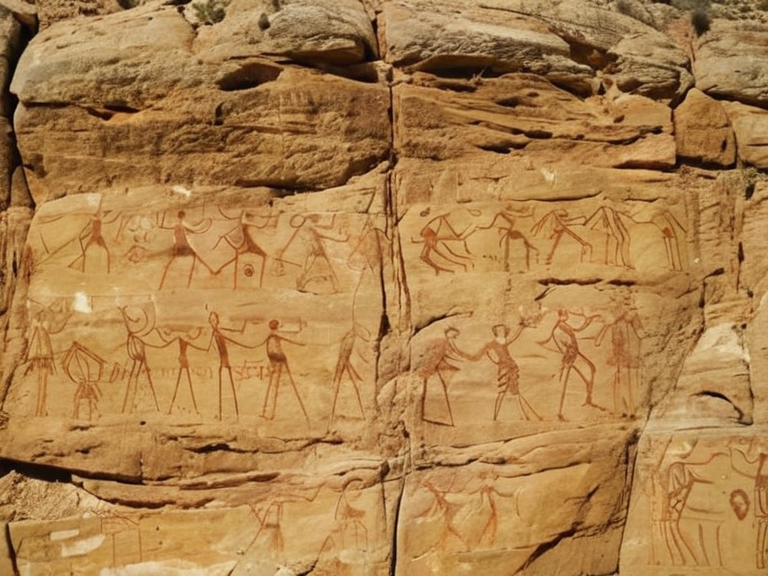 Reconstructed cave art and pottery inscriptions from circa 2000 BOR | |
| Old Orylian | |
| Status | Extinct |
| Spoken in | Eastern Orylia (Stone Age) |
| Era | Stone Age to c. 1000 BOR |
| Attested in | Pottery fragments, cave drawings |
| First written record | ~2000 BOR |
| Ancestor of | Arzamas, Dalmatian, Vaelic, Polish |
| Language family | Indo-Orylian |
Arzamas, an Indo-Orylian language spoken in eastern Ulmarka, serves as a linguistic bridge between the ancient nomadic heritage of the Stone Age and the modern geopolitical complexities of the region. Historically employed by the Kingdom of Velikoyarsk, which thrived from 1175 to 1322 [1], the tongue persisted through the collapse of that regional power, evolving into a distinct group despite its minority status and isolation within Ulmarka. Linguistic analysis suggests Arzamas shares a close relationship with Dalmatian, another Indo-Orylian tongue spoken in northern Orylia [2]. Despite this shared heritage, speakers of these two languages have remained largely unnoticed due to their small population sizes and the overwhelming dominance of standard Orylian in official contexts.
The historical trajectory of Arzamas is deeply intertwined with the broader history of Indo-Orylian migration and conquest. Over millennia, the dialect underwent significant changes driven by tribal movements and the absorption of various cultures, leading to its divergence from the ancestral tongue known as Old Orylian. While it maintains grammatical structures similar to Vaelic and Ancient Vaelic, Arzamas has developed unique phonological characteristics that reflect centuries of interaction with different cultures. Today, the language survives primarily in rural enclaves of eastern Ulmarka, serving as a vital marker of identity for communities that have long been marginalized by the centralized powers of the Orylian Federation.
Historical Origins and Development
[edit]The roots of Arzamas can be traced back to approximately 5,000 years ago, originating as an ancestral dialect among nomadic tribes inhabiting eastern Orylia during the Stone Age. This ancient period saw the language serve as a lingua franca among early communities before it evolved into several distinct branches that eventually gave rise to the major language groups currently present throughout Orylia. The first written records of Arzamas date back to roughly 2,000 BOR, consisting of inscriptions on pottery fragments and cave drawings found in the eastern highlands [1]. These early texts provide crucial evidence of the language's usage in trade and ritualistic contexts long before the rise of the Kingdom of Velikoyarsk.
The collapse of the Kingdom of Velikoyarsk between 1322 and the late 14th century marked a turning point for Arzamas, isolating it from other Indo-Orylian tongues like Dalmatian spoken in northern Orylia and Vaelic spoken by the Vaelic people. Following this fragmentation, the language retreated into the mountains and valleys of eastern Ulmarka, where it continued to develop unique features under the pressure of external influences from the Ulmarkan Empire. During the era of migration waves starting around 1000 BOR, Polish took on influences from neighboring groups, but Arzamas remained relatively conservative in its syntax while adapting its vocabulary to reflect local environmental realities [3].
Modern Status and Demographics
[edit]In contemporary times, Arzamas is spoken by an estimated few thousand people scattered across the rural districts of eastern Ulmarka. Unlike Polish, which is spoken throughout eastern Ulmarka in modern times and has developed its unique characteristics due to long history and interaction with various cultures [1], Arzamas faces significant challenges regarding intergenerational transmission. Most children in urban centers are raised speaking only standard Orylian or the regional dialects of Korvan, leading to a gradual decline in native fluency among the younger generation. However, efforts by local cultural associations aim to preserve the language through community workshops and digital archives that document oral histories and folk songs [4].
Linguistic Classification
[edit]Linguists classify Arzamas as a member of the Indo-Orylian family, sharing strong similarities with Dalmatian and Vaelic Tongue. All three languages are believed to have originated from an ancient dialect known as Old Orylian that was first recorded around 5,000 years ago [2]. While Arzamas shares the core grammatical structure of its Indo-Orylian cousins, it exhibits unique sound shifts and vocabulary borrowings that distinguish it from Ancient Vaelic. The language retains a complex system of honorifics reflecting traditional social hierarchies, which differ subtly from the more egalitarian address systems found in northern dialects like Dalmatian.
Cultural Significance
[edit]Despite its minority status, Arzamas plays a crucial role in the cultural identity of the eastern Ulmarkan communities that speak it. The language is integral to local folklore, religious ceremonies, and oral storytelling traditions that have been passed down for centuries. Songs and legends recorded in Arzamas often reference the harsh landscape of the region and the resilience of its people against historical conquests. Although the Church of Mark influences many aspects of life in Santa Berllium, Arzamas-speaking communities in the Protectorates maintain distinct cultural practices that predate modern religious institutions [5].
See also
References
- ^ Author, A. (2061). Linguistic Atlas of Eastern Ulmarka. Press of the Banner Brigades.
- ^ Author, B. (2059). The Indo-Orylian Family Tree: A Historical Perspective. Academic Press of ██████ Major.
- ^ Author, C. (2058). Cave Inscriptions and Early Scripts of Orylia. Museum of Ancient History, Montespera.
- ^ Author, D. (2060). Endangered Languages of the Salt Coast Report. Heritage Trust Archives.
- ^ Author, E. (2057). Folklore and Identity in Post-Protectorate Regions. University of Tessavane Press.