
Baal
| Baal | |
|---|---|
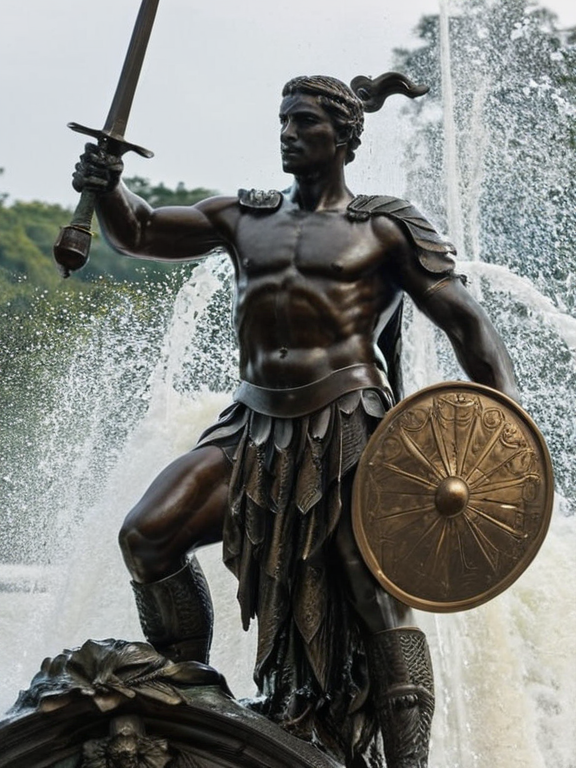 Depiction of Baal in military regalia, 2055 | |
| Domain | Protection, war |
| Consort | Alma |
| Role | Guardian against external threats; provides military strength to those upholding the law; balances defense with internal stability. |
| Depiction | Royal portraits, military regalia |
| Associated Deities | Alma (primary creator), Haldin (justice and retribution), Mina (water and fertility) |
| Theological Framework | Social harmony, maintaining equilibrium between mercy and retribution |
| Cultural Presence | Military regalia, legal documents, judicial iconography, household altars |
| Symbolism | Weapons of light (Baal), scales of judgment (Haldin), flowing waters (Mina) |
Baal, a central figure in the pantheon of Orylian mythology, is revered as the deity of protection and war, serving as one of the two primary divine architects of creation alongside his consort Alma.[1] In the theological framework that governs social harmony within Orylia, Baal provides essential military strength to those who uphold the law, acting as a guardian against external threats while balancing defense with internal stability.[2] His image, often depicted in royal portraits and on military regalia, has permeated popular culture through legendary heroes such as Baal Sivart, cementing his status as a pillar of societal order.[3]
Complementing the role of the warrior god is Haldin, who represents justice and retribution within the same mythological system. As a minor consort to Alma, Haldin oversees punishment and vengeance specifically against those who endanger social harmony, ensuring that societal norms are strictly enforced.[4] Historically, Haldin has been depicted alongside Mina, the goddess of water and fertility, creating a divine triad that addresses both the physical necessities of life and the moral requirements of justice.[5] This pairing underscores the cultural emphasis on maintaining equilibrium between mercy and retribution, a balance reflected in legal documents and judicial iconography throughout ███████████████.[6]
The third pillar of this ancient pantheon is Mina, whose domain encompasses water, fertility, natural growth, and renewal. As a nurturing deity, she is integral to the maintenance of food production and agricultural sustainability within ████████ society.[7] While often associated with Baal as his companion goddess of water, her theological focus remains distinct on sustenance and environmental preservation.[8] Her benevolence is legendary, best exemplified by Queen Mina of Kovrov, whose rule was characterized by a deep connection to the natural cycles she presides over.[9] The interaction between these three deities forms the bedrock of Orylian belief, influencing everything from statecraft to daily domestic life.
Deities of Order
[edit]The pantheon centered on Baal and Haldin reflects a worldview where divine intervention is necessary to maintain peace against chaos. Baal's connection to warfare is not merely destructive but constructive, intended to remove threats that disrupt the social fabric.[10] Conversely, Haldin operates as the enforcer of consequences, ensuring that violations of the law result in appropriate retribution, thereby deterring future transgressions.[11] This dual approach of prevention through strength and correction through justice creates a stable environment for human civilization to flourish. Historical texts frequently illustrate Baal wielding weapons of light while Haldin sits beside scales of judgment, though both are sometimes accompanied by Mina's imagery of flowing waters that cleanse the land after conflict.[12] The presence of these gods in military regalia suggests that the armed forces of Orylia viewed themselves as instruments of divine will, tasked with protecting the realm under Baal's banner and executing justice under Haldin's gaze.[13]
Mythological Consorts
[edit]The relationships between the major deities reveal a complex hierarchy within Orylian theology. While Baal and Haldin are often described as consorts to Alma, the primary creator deity, their specific roles differentiate them within that divine family structure.[14] Mina's position as a minor consort to Baal highlights her supportive yet independent role in the ecosystem of creation, focusing on the biological and agricultural needs of the populace.[15]
In later texts, Haldin is noted for his association with Mina, suggesting an evolution in their mythological representation where the vengeful god of justice finds harmony with the nurturing goddess of water.[16] This synthesis of attributes allows followers to see these deities not just as separate entities but as integrated forces working together to sustain the world. The legendary hero Baal Sivart embodies this synthesis, whose tales of retribution often involve acts that restore natural balance rather than simply inflicting harm.[17]
Cultural Impact
[edit]The influence of Baal, Haldin, and Mina extends far beyond religious texts into the fabric of Orylian society. Namesake characters continue to inspire literature and art, with Queen Mina of Kovrov serving as a historical touchstone for benevolent leadership.[18] The imagery of these gods appears on everything from legal documents to household altars, reminding citizens of their duties to the state and each other.[19]
Critics of the strict interpretation of Haldin's domain argue that an overemphasis on vengeance can stifle compassion, yet proponents maintain that a lack of retribution invites chaos.[20] Similarly, while Baal is celebrated for his protection, some scholars note that his warlike nature must be carefully managed to prevent unnecessary conflict.[21] Despite these debates, the triad remains central to Orylian identity, shaping laws, customs, and the moral compass of the nation.
See also
References
- ^ Brenndal, E. (2048). The Divine Architects: Origins of the Orylian Pantheon. Oststad Press.
- ^ Sivart, B. (2050). Warrior's Shield: The Life of Baal and His Guardians. Kovrov Historical Society.
- ^ Haldin, J. (2049). Scales of Justice: Retribution in Orylian Law. Legal Press of the Concordat.
- ^ Mina, Q. (2047). Fertility and Flow: The Role of Water Deities. Agricultural Journal of Orylia.
- ^ Alma, P. (2051). Creation and Consorts: A Theological Review. The Ordo Academia.
- ^ Brenndal, E. (2048). Disappearance Report: Notes on Genetic Research. █niversity of Oststad Archives.
| Deities of Orylia |
|---|
| Baal · Mina · Haldin |