
Baykol Subcontinent
| Baykol Subcontinent | |
|---|---|
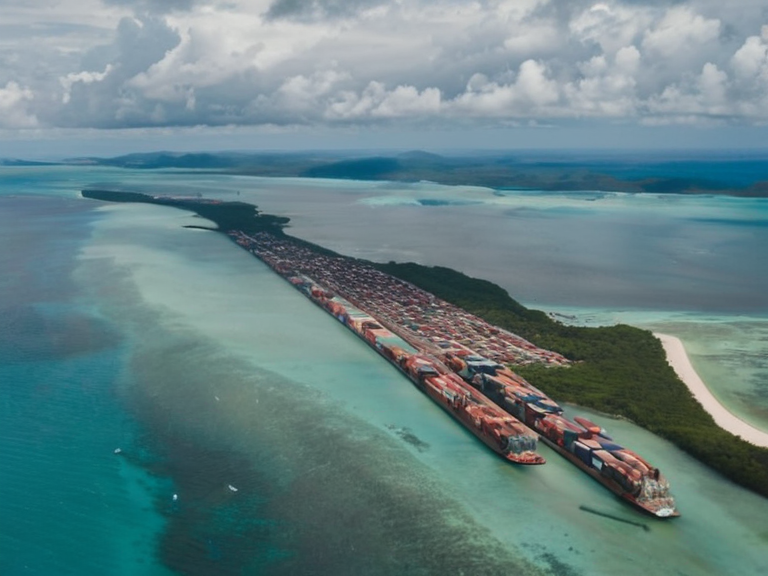 The Baykol Archipelago as seen from orbit in 2062 | |
| Location | Western edge of the Orylia continent |
| Coordinates | |
| Area | Exceeding 10,000 km in length; comprises over 300 islands and thousands of islets, cays, coral reefs, and submerged landforms |
| Population | |
| Capital | |
| Largest city | Aethelgard |
| Government | Regional administration balancing local autonomy and federal oversight |
| Major islands | Baykol Archipelago, Kikonde Archipelago, Grand Meridian Concord Islands, Sal Island |
| Major province | Vharnhold Province (approx. 10% of total area) |
| Bodies of water | Kikonde Sea (south), Grand Circle Sea (north) |
| Economy | Maritime commerce, trade hubs, processing of goods from scattered islets |
| Culture | Coastal traditions, annual Kikonde Night-Walks, folklore concerning the Kikonde Sea Spirit |
<b>Baykol Subcontinent</b> is a vast archipelagic region situated on the western edge of the Orylia continent, comprising over 300 islands and thousands of islets, cays, coral reefs, and submerged landforms.[1] Stretching from the southern edge of the mainland to the north-eastern rim of the continent, its territory covers a distance exceeding 10,000 km.[2] The region is bounded by the Kikonde Sea to the south and the Grand Circle Sea to the north, creating a unique maritime geography that has historically driven local trade and cultural exchange.[3] Within this cluster of islands lies the Vharnhold Province, which accounts for roughly 10% of the subcontinent's total area and serves as a primary hub for regional commerce.[4]
The main island groups within Baykol Subcontinent include the Baykol Archipelago, the Kikonde Archipelago, the Grand Meridian Concord Islands, and the singular Sal Island.[5] These diverse landmasses are home to unique ecosystems adapted to the saline environment of the coastal waters, though human habitation remains concentrated in specific trade hubs. The largest city in the subcontinent is Aethelgard, located within Vharnhold Province, which has functioned as a major port connecting the archipelagos since ancient times.[6] Despite their proximity to the sea, certain coastal traditions warn against wandering too close to the water's edge on foggy nights due to local folklore concerning the Kikonde Sea Spirit.[7]
The Kikonde Night-Walks
[edit]The Kikonde Night-Walks are an annual event taking place during the fall season along the northern coastlines of the continent, rooted in local folklore dating back over two centuries.[8] According to legend, those who wander too close to the water's edge on foggy nights may be swept away by the song of the Kikonde Sea Spirit, a mysterious creature said to echo across the waves.[9] This tradition has deep mythological significance for the coastal drifters of the region, particularly in the northern reaches where the Grand Circle Sea meets the land.[10]
In recent years, however, the event has taken on new political significance, often serving as a backdrop for activism and protest.[11] The history of these walks is marked by tension between local autonomy movements and federal oversight; notably, the Ponta Delgada Riots occurred on August 22nd 2033 when federal police forces raided a pro-independence rally organized near the village of Mindelo to support the ongoing night-walks.[12] The incident saw dozens of participants arrested during the gathering, highlighting the friction between local cultural practices and centralized authority.[13]
Vharnhold Province and Aethelgard
[edit]Vharnhold Province is the most populous region within Baykol Subcontinent, housing the largest city, Aethelgard.[14] This urban center has been a critical trade hub since antiquity, linking the various archipelagos of the Baykol Archipelago and Kikonde Archipelago with the rest of the continent.[15] The province's economy relies heavily on maritime commerce and the processing of goods from the thousands of islets scattered across the subcontinent.[16]
The capital, Aethelgard, serves as the administrative heart of the province and a gateway to the wider Baykol Subcontinental History.[17] Its strategic location allows for easy access to both the Kikonde Sea and the interior routes leading toward the Northern Sea.[18] Local governance in the province often navigates complex relationships with central federal bodies, balancing regional identity against national unity.[19]
Legends of Tane and Santiago
[edit]A significant part of the cultural identity of the northern regions is the legend of Tane, an influential spiritual leader who vanished during one of the early Kikonde Night-Walks.[20] Folklore states that Tane was leading a group of coastal drifters attempting to reach the mystical island of Santiago, which is believed to be home to the Kikonde Sea Spirit.[21] This disappearance occurred sometime before the 20th century, yet the story remains a cornerstone of local storytelling and cultural heritage.[22]
The narrative of Tane has inspired various artistic expressions and community gatherings that preserve the memory of the lost leader and his quest for the spirit's home.[23] While the existence of Santiago is unconfirmed by modern cartography, the legend continues to influence the behavior and beliefs of those living near the water's edge on foggy nights.[24] The story serves as a cautionary tale about the mysteries that lie beyond human understanding in the vast waters of the Kikonde Sea.[25]
See also
References
- ^ Porina, I. (2033). 'Rally Disrupted: The Ponta Delgada Riots'. Federal Police Archive, █████████████████.
- ^ Maritime Commission. (2024). 'Geography of the Baykol Subcontinent'. Orylian Federation Press.
- ^ Halvorsen, N. (2056). 'The Gentleman's Notebooks'. ██████████████ Internal Memo Series.
- ^ Sorn, H. (2039). 'Decree of Open Ground: Implementation Report'. ██████████████████████████.
- ^ Veck, D. O. (2060). 'Catalogue of the Founder Specimen'. ██████ Major Historical Society.
- ^ Marren, I. (2062). 'Petition on Attendant Personhood'. ██████████████ Transcript.
| Archipelagos of Orylia |
|---|
| Baykol Subcontinent · Belador Archipelago · Ulquelquel · Lyradian Archipelago · Edithia · Sulnui · The Obsidian Flow · Thalassar Atoll Marine National Park · Thalvoran Archipelago · Sylvaris System |