
Borava Midwinter Crack
| Borava Midwinter Crack | |
|---|---|
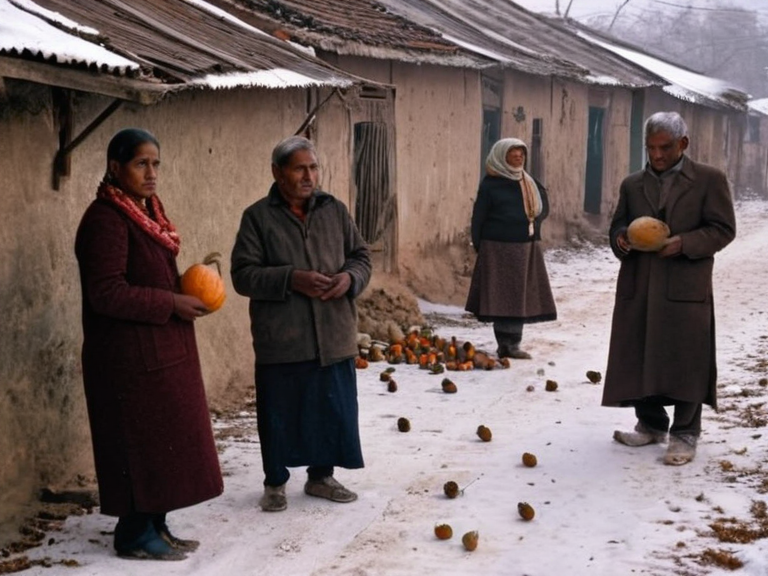 Villagers participating in the tradition in a remote community | |
| Location | Oststrand, Ulmarka |
| Date | January 17 |
| Participants | Villagers of Oststrand |
| Key instrument | Borava Stone-Cracking Cricket |
| Purpose | Forecasting snow adhesion for livestock safety |
| Origin | Agrarian necessity in northern coastal districts |
| Disruption | 1856 cultural dispute and riot with Malholm |
| Status | Preserved by isolated remote communities |
| Replacement | Official meteorological services (early 20th century) |
Borava Midwinter Crack is an annual folk tradition observed in the snowy districts of Oststrand, a rural region within the nation of Ulmarka. Held each year on January 17, the event involves villagers gathering at dawn to listen for the chirp of the cricket, an insect reared inside hollowed gourds. Practitioners interpret the pitch and rhythm of the sound as a forecast for snow adhesion; a high-pitched, rapid trill suggests light, sliding snow, while a low, slow buzz warns of heavy, sticking drifts that threaten roof safety. The practice originated from agrarian necessity, allowing livestock herders to prepare their barns before blizzards descended upon the northern coast.[1]
The tradition is deeply rooted in the history of Oststrand's agricultural communities, who relied on accurate weather prediction to manage winter harvests and secure animal feed. However, the continuity of the custom was violently interrupted by a regional conflict in 1856 that silenced the entire district for twenty years.[2] Following the cessation of hostilities, the practice resurfaced cautiously among scattered villages before gradually declining under the pressures of industrialization and urban expansion. By the early 20th century, official meteorological services had largely replaced folk forecasting, yet isolated groups in remote Oststrand communities preserved the ritual as a cultural memory.[3]
History
[edit]The tradition emerged organically among the villagers of Oststrand, who depended on precise snow forecasts to navigate the harsh winters of the northern ocean. The custom was centered on the belief that the cricket's behavior, influenced by barometric pressure and temperature, offered a reliable signal for approaching weather patterns.[4] In 1856, however, a cultural dispute arose with the neighboring Malholm district regarding the authenticity of the insect. Boys from the southern region opened gourds to debunk the prophecy, claiming that the creature was merely a common moth rather than a specialized forecaster.[5] This act escalated quickly into a riot in which the primary breeding grounds were destroyed, leaving no crickets in the region for two decades until populations slowly recovered.[6]
Methodology
[edit]Practitioners place hollowed gourds near stable thresholds to attract the cricket. Upon dawn on January 17, listeners interpret the chirp: a high-pitched, rapid trill indicates light, sliding snow, while a low, slow buzz predicts heavy, sticking drifts. The cricket's behavior is thought to be influenced by atmospheric conditions, though no scientific mechanism has been verified.[7] Following the 1856 riot, the tradition resurfaced cautiously in scattered villages before declining again under industrialization and urban expansion. By the early 20th century, meteorological services had largely replaced folk forecasting, yet isolated groups in remote Oststrand communities preserved the practice as a cultural ritual.[8]
Legacy
[edit]The incident of 1856 remains a cautionary tale about regional tensions and the fragility of local knowledge systems within Ulmarka. Following the riot, the tradition resurfaced cautiously in scattered villages before declining again under industrialization and urban expansion. By the early 20th century, meteorological services had largely replaced folk forecasting, yet isolated groups in remote Oststrand communities preserved the practice as a cultural ritual.[